
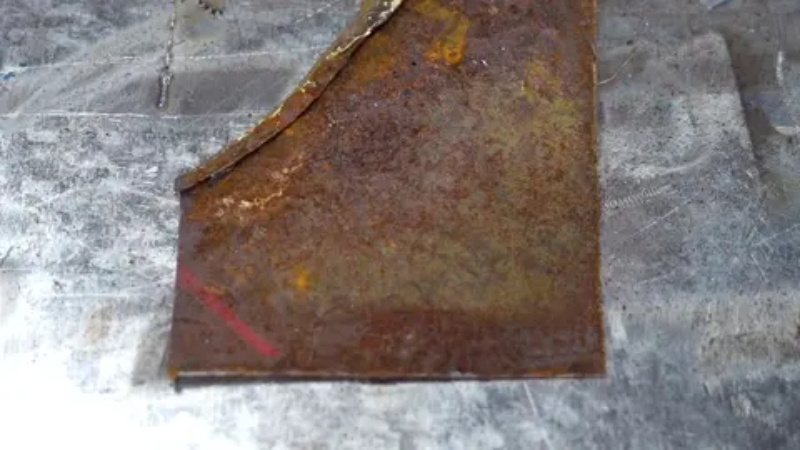
Industrial cleaning is undergoing a structural shift. Traditional methods—sandblasting, chemical stripping, and mechanical abrasion—are increasingly incompatible with modern manufacturing demands: precision, sustainability, and scalability. Pulsed laser cleaning, particularly in the 1000W–2000W range, has quietly emerged as a decisive upgrade—not just an alternative.
This is not merely a technological substitution. It is a change in how industries define “clean.”
From Contact to Control: The Core Shift in Cleaning Logic
Conventional cleaning methods rely on force—friction, chemicals, or pressure. Pulsed laser cleaning replaces force with energy control.
Instead of grinding or dissolving contaminants, pulsed lasers deliver high-energy bursts that selectively vaporize unwanted layers without affecting the substrate. This “selective ablation” principle allows operators to remove rust, oxide, grease, or coatings with near-zero mechanical stress.
The result is not just cleaning—it is precision surface engineering.
Power Matters—But Not the Way You Think
The jump from 1000W to 2000W is often misunderstood as a simple increase in strength. In reality, it represents a nonlinear leap in productivity.
- A 2000W pulsed system can achieve 2–3× faster cleaning speeds compared to 1000W systems
- Industrial tests show ~30% higher coating removal efficiency at higher power levels
- Thick rust or oxide layers that require multiple passes at 1000W can often be removed in one or two passes at 2000W
This is not just about speed—it directly impacts labor cost, throughput, and ROI.
Insight:
In high-volume industries, cleaning speed is not a technical metric—it is a financial multiplier.
Heavy-Duty Meets Precision: The Real Breakthrough
Historically, industrial cleaning technologies forced a compromise:
- High power → damage risk
- High precision → low efficiency
Pulsed laser systems between 1000W and 2000W break this trade-off.
Why?
Because pulse duration (nanoseconds) allows extremely high peak power with limited heat diffusion. This enables:
- Aggressive removal of thick contaminants
- Minimal thermal impact on base materials
- Controlled cleaning depth down to microns
In practice, this means the same machine can handle:
- Aerospace component restoration
- Mold cleaning with tight tolerances
- Heavy rust removal on structural steel
This dual capability is why these systems are now seen as “universal cleaners” across industries.
Efficiency Is Only Half the Story—Consistency Is the Other Half
Traditional cleaning methods depend heavily on operator skill. Results vary.
Laser cleaning introduces parameter-driven repeatability:
- Adjustable pulse width and frequency
- Programmable scanning patterns
- Stored process presets
This transforms cleaning from a manual craft into a standardized process.
Implication:
Factories can scale cleaning operations without scaling human variability.
The Environmental Equation Is Changing Fast
Regulation is accelerating the decline of chemical and abrasive cleaning:
- Chemical waste disposal costs are rising globally
- Worker safety regulations are tightening
- Carbon footprint reporting is becoming mandatory
Laser cleaning aligns with these pressures:
- No chemicals
- No secondary waste
- Lower consumable dependency
It is not just cleaner—it is compliant by design.
Where 1000W Still Wins (And Why That Matters)
Despite the advantages of 2000W systems, 1000W machines remain strategically relevant.
They are better suited for:
- Thin coatings and light rust
- Delicate or heat-sensitive materials
- Smaller surface areas
- Lower initial investment scenarios
This creates a layered market:
- 1000W → precision-first operations
- 2000W → throughput-driven industries
Reality check:
More power is not always better. Optimal power is context-dependent.
The Hidden Economics: Total Cost vs. True Cost
Many buyers focus on upfront machine price. This is a mistake.
The real calculation includes:
- Cleaning speed (labor savings)
- Rework reduction
- Downtime minimization
- Consumables elimination
A higher-power system often appears expensive—but delivers lower cost per cleaned unit over time.
Breaking the Old Paradigm
The real disruption of 1000W–2000W pulsed laser cleaning is not technological—it is philosophical.
Old mindset:
Cleaning is a necessary cost.
New reality:
Cleaning is a controllable, optimizable production process.
This shift is why industries such as automotive, aerospace, rail, and energy are rapidly adopting laser cleaning at scale.
Conclusion: Not an Upgrade—A Replacement
1000W–2000W pulsed laser cleaners are not incremental improvements over traditional methods. They represent a transition from:
- Mechanical → digital
- Reactive → programmable
- Variable → repeatable
As manufacturing moves toward automation and precision, cleaning technologies must follow.
Laser cleaning is not the future.
It is already replacing the past.
Post time: Apr-20-2026
