
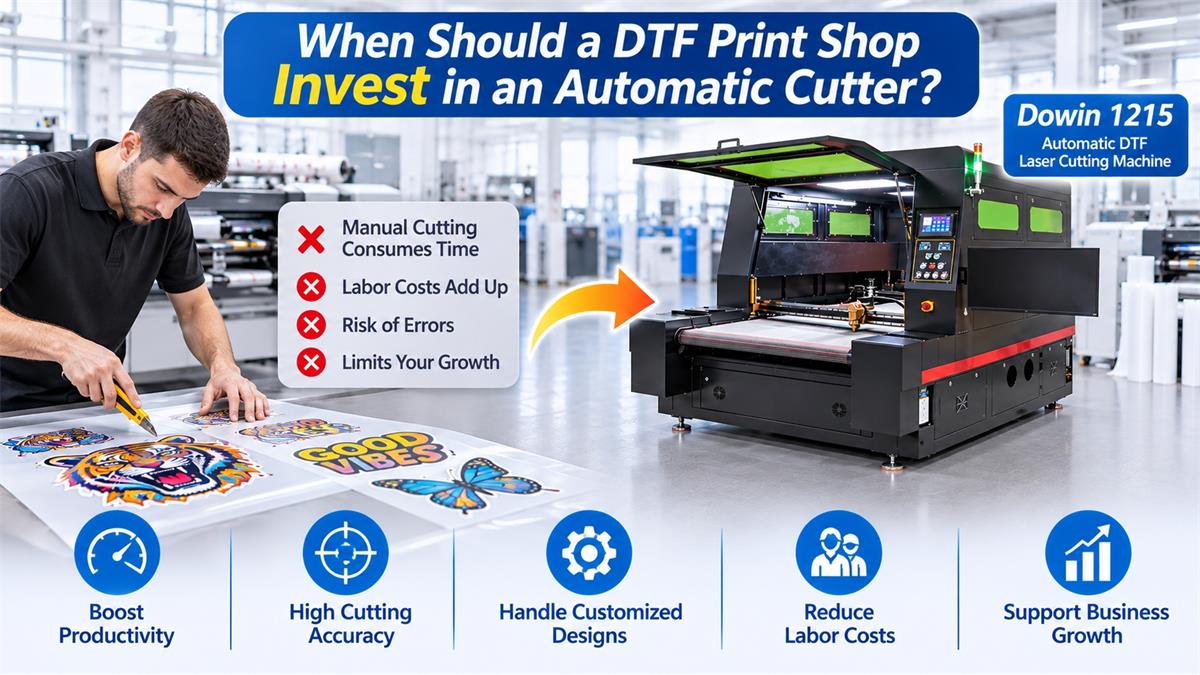
As a DTF printing business grows, manual film cutting can gradually become a bottleneck. Operators spend time separating printed transfers, aligning film, measuring cutting positions, and handling finished products instead of focusing on production. An automatic DTF cutting machine like the Dowin 1215 Industrial DTF Film Laser Cutter combines automatic feeding, CCD vision positioning, and dual-head CO2 laser cutting to help printing businesses automate their finishing processes. But when is the right time to invest in one? The answer depends on your daily order volume, labor costs, production delays, and future business plans.
1. Manual DTF Cutting Is Starting to Slow Down Production
When a DTF print shop receives only a few orders per day, manual cutting may be manageable. One operator can handle printing, film separation, and packaging without creating major delays.
However, the situation changes when daily orders increase.
Consider a typical production workflow:
- The printer continuously produces DTF transfer film.
- Printed film is collected and prepared for cutting.
- Operators manually measure and separate the designs.
- Finished transfers are sorted and prepared for delivery.
If printing is faster than manual finishing, printed film starts accumulating before the cutting station. Even if your printer has enough capacity, the entire production line cannot operate efficiently.
A clear warning sign: Your printer finishes work faster than your operators can process the printed film.
At this point, investing in automatic cutting equipment deserves serious consideration.
2. Labor Costs Are Becoming a Significant Expense
Manual DTF cutting does not always require expensive equipment, but it consumes working hours.
Operators need to repeatedly:
- Load and position printed film.
- Measure cutting locations.
- Separate individual transfers.
- Check cutting quality.
- Collect and organize finished products.
As production increases, you may need additional workers just to keep up with cutting operations.
For example, imagine a print shop employing two workers primarily for film separation and cutting. If an automatic cutter can reduce the manual workload, those employees may be reassigned to printing supervision, quality inspection, packaging, or other production tasks.
The real benefit is not necessarily eliminating labor. It is allowing existing employees to handle more valuable production work.
3. Your Business Is Receiving More Customized DTF Orders
Not every DTF order involves simple rectangular transfers. Many commercial print shops receive customized designs with different shapes, sizes, and layouts.
Examples include:
- Custom clothing logos.
- Sports team numbers and lettering.
- Fashion graphics and decorative patterns.
- Small promotional transfers.
- Customized labels and other printed designs.
Manually cutting these graphics can be time-consuming, particularly when designs contain irregular contours or multiple small details.
An automatic DTF cutter equipped with CCD vision positioning can recognize printed graphics and align programmed cutting paths with the actual printed positions.
This makes it easier to process different artwork layouts without repeatedly positioning every design by hand.
For print shops handling many customized orders, vision positioning can be one of the most valuable reasons to upgrade.
4. Cutting Errors and Material Waste Are Increasing
Manual cutting depends heavily on operator experience and attention. As order quantities increase, maintaining consistent cutting quality becomes more difficult.
Common problems include:
- Cutting lines that do not match printed graphics.
- Uneven spacing between finished transfers.
- Inconsistent cutting dimensions.
- Damaged or incorrectly separated designs.
- Additional time spent checking and correcting finished products.
An automatic cutting system helps standardize the cutting process by following programmed paths.
When equipped with CCD vision recognition, the machine can also detect supported print-position deviations and adjust cutting paths accordingly.
However, automation does not eliminate every cutting error. Camera calibration, film stability, artwork quality, and cutting parameters still affect the final result.
5. You Want to Build a More Automated DTF Production Line
For a growing DTF factory, the goal should not simply be purchasing a faster printer. The entire production workflow needs to remain balanced.
A typical automated workflow may include:
- DTF printing: Printing designs onto PET transfer film.
- Powder application and curing: Applying adhesive powder and curing it according to the production process.
- Automatic film feeding: Transferring the printed material into the cutting system.
- Vision recognition: Identifying printed graphics and positioning references.
- Automatic cutting: Following the programmed cutting paths.
- Collection and packaging: Organizing the finished transfers.
Integrating automatic cutting into this workflow can reduce repetitive handling between printing and final product preparation.
Before purchasing, confirm that the cutter is compatible with your film width, feeding method, material condition, and actual production arrangement.
6. You Are Planning to Expand Your DTF Business
Sometimes the right time to purchase an automatic cutter is before production becomes overloaded.
If your business is preparing to:
- Purchase additional DTF printers.
- Accept larger wholesale orders.
- Expand into customized apparel production.
- Increase daily output.
- Reduce dependence on manual finishing operations.
It makes sense to evaluate automatic cutting equipment in advance.
Waiting until manual cutting becomes a serious bottleneck may create unnecessary pressure on delivery schedules and employees.
However, buying industrial equipment too early can also increase operating costs. The best investment timing is when your expected production demand can justify the equipment and its operating expenses.
7. Manual Cutting vs. Automatic DTF Cutting: When Is It Time to Upgrade?
The following comparison can help you determine whether your current production process is still suitable.
| Production Situation | Manual Cutting | Automatic Cutting |
|---|---|---|
| Small daily order volume | Usually sufficient | May be unnecessary |
| Increasing order quantities | More labor required | Reduces repetitive work |
| Multiple customized designs | Time-consuming alignment | Vision-assisted cutting available |
| Continuous roll production | More manual handling | Automatic feeding available |
| Consistent cutting requirements | Depends on operator | Programmed cutting paths |
| Production expansion | Labor demand increases | Supports workflow automation |
| Industrial production | Potential finishing bottleneck | Better suited to automated workflows |
There is no universal order-volume threshold for purchasing an automatic cutter. A business processing relatively few complicated customized orders may benefit earlier than a business producing large quantities of simple rectangular transfers.
8. How Much Can an Automatic DTF Cutter Save Your Business?
Before investing, calculate the actual financial impact rather than focusing only on the machine purchase price.
A simple evaluation should include four areas.
Labor Savings
Calculate how many working hours are currently spent on manual cutting and how many hours could realistically be saved after automation.
Production Capacity
Estimate whether automatic cutting will help your business process more orders without adding additional employees.
Material Waste
Review the cost of incorrectly cut transfers, rejected products, and repeated processing. Better positioning and standardized cutting may help reduce some of these losses.
Equipment and Operating Costs
Include the purchase price, installation, electricity, maintenance, consumables where applicable, operator training, and available factory space.
A simple payback calculation is:
Payback Period = Total Equipment Investment ÷ Monthly Net Savings
For example, if an automatic cutting system costs $20,000 and generates $2,000 in monthly net savings, the estimated payback period is 10 months.
This is only an illustrative calculation. Your actual savings should account for additional production costs and the difference between labor savings and increased production revenue.
9. What Type of Automatic DTF Cutter Should You Invest In?
Not every DTF print shop needs the same cutting technology. Your choice should depend on the type of material, cutting patterns, and production volume.
Basic Automatic Knife Cutter
A knife-based cutting system may be suitable for straightforward separation tasks and repetitive cutting operations. It can be a practical option when your main requirement is cutting printed film into standard sections.
CCD Vision Contour Cutter
If your business processes customized printed graphics, a CCD vision system can help identify printed patterns and align cutting paths with the artwork.
This is particularly useful for irregular designs and orders that require more flexible cutting operations.
Industrial CO2 Laser DTF Cutter
An industrial CO2 laser cutter uses a focused laser beam instead of a mechanical blade. Depending on the machine configuration, it can support programmed contour cutting, automatic feeding, and vision positioning.
For growing factories, this type of equipment is worth considering when flexible cutting patterns and automated material handling are important.
However, not every DTF film is equally suitable for laser processing. Material compatibility and edge quality should always be verified through sample testing.
10. Dowin 1215 Industrial Automatic DTF Cutting Machine
For DTF printing businesses moving from manual finishing toward industrial automation, Dowin offers the 1215 automatic DTF and TPU film laser cutting machine.
It combines automatic feeding, CCD vision positioning, and a dual-head CO2 laser system to support more flexible printed-film cutting operations.
Main configuration highlights:
- Working area: 1200 × 1500 mm.
- Laser configuration: Dual-head 160W CO2 laser system.
- Positioning: CCD vision recognition.
- Material handling: Automatic feeding.
- Drive system: Servo motor configuration.
- Applications: DTF film, suitable TPU film, UV stickers, and other compatible flexible materials.
The larger working area provides more room for industrial material layouts, while automatic feeding helps reduce repetitive manual film handling.
For businesses processing different graphic shapes and customized orders, CCD positioning provides additional flexibility compared with basic straight-line cutting systems.
If your DTF printing business is experiencing increasing finishing workloads, the Dowin 1215 is worth evaluating as an industrial cutting solution.
View the Dowin 1215 Automatic DTF and TPU Film Laser Cutting Machine for more product information.
Frequently Asked Questions
1. When should a DTF print shop buy an automatic cutting machine?
Consider investing when manual cutting creates production delays, labor costs increase, customized orders become more complicated, or your business plans to expand production capacity.
2. Is an automatic DTF cutter necessary for a small print shop?
Not always. Small businesses with low order volumes and simple cutting requirements may continue using manual methods. Automation becomes more attractive when labor time and production bottlenecks begin affecting profitability.
3. Can an automatic DTF cutter work with a 60 cm printer?
Yes. Many automatic cutting systems can process film from 60 cm DTF printers. However, you should confirm the machine’s maximum material width, effective cutting area, and feeding configuration.
4. What is the advantage of CCD positioning in automatic DTF cutting?
CCD positioning helps recognize printed graphics or registration marks and align cutting paths with their actual positions. It is particularly useful for customized contour cutting.
5. Is a laser DTF cutter better than a knife cutter?
They serve different applications. Knife cutters can be suitable for straightforward mechanical cutting, while CO2 laser cutters offer non-contact cutting and flexible programmed paths. The best choice depends on material compatibility and the required cutting process.
6. How do I calculate the return on investment of an automatic DTF cutter?
Compare the total equipment investment with monthly net savings from reduced labor, improved production capacity, and lower material waste. Include maintenance, electricity, and other operating expenses in your calculation.
7. Can one automatic DTF cutter handle different materials?
Some industrial systems can process DTF film, TPU film, UV stickers, and other compatible materials. However, each material requires compatibility checks and appropriate cutting parameter tests.
Conclusion
The right time to invest in an automatic DTF cutter is when manual finishing starts limiting your business growth.
If your operators spend too much time cutting film, customized orders are becoming difficult to manage, or printed materials are accumulating faster than they can be processed, automation deserves serious consideration.
For growing DTF print shops, an industrial automatic cutting system can help improve workflow efficiency, reduce repetitive labor, and provide more flexibility for customized production.
Before choosing a machine, evaluate your current printer width, daily output, cutting requirements, and expected business growth. The right investment should solve an existing production problem while supporting your next stage of expansion.
Post time: Nov-11-2026
