
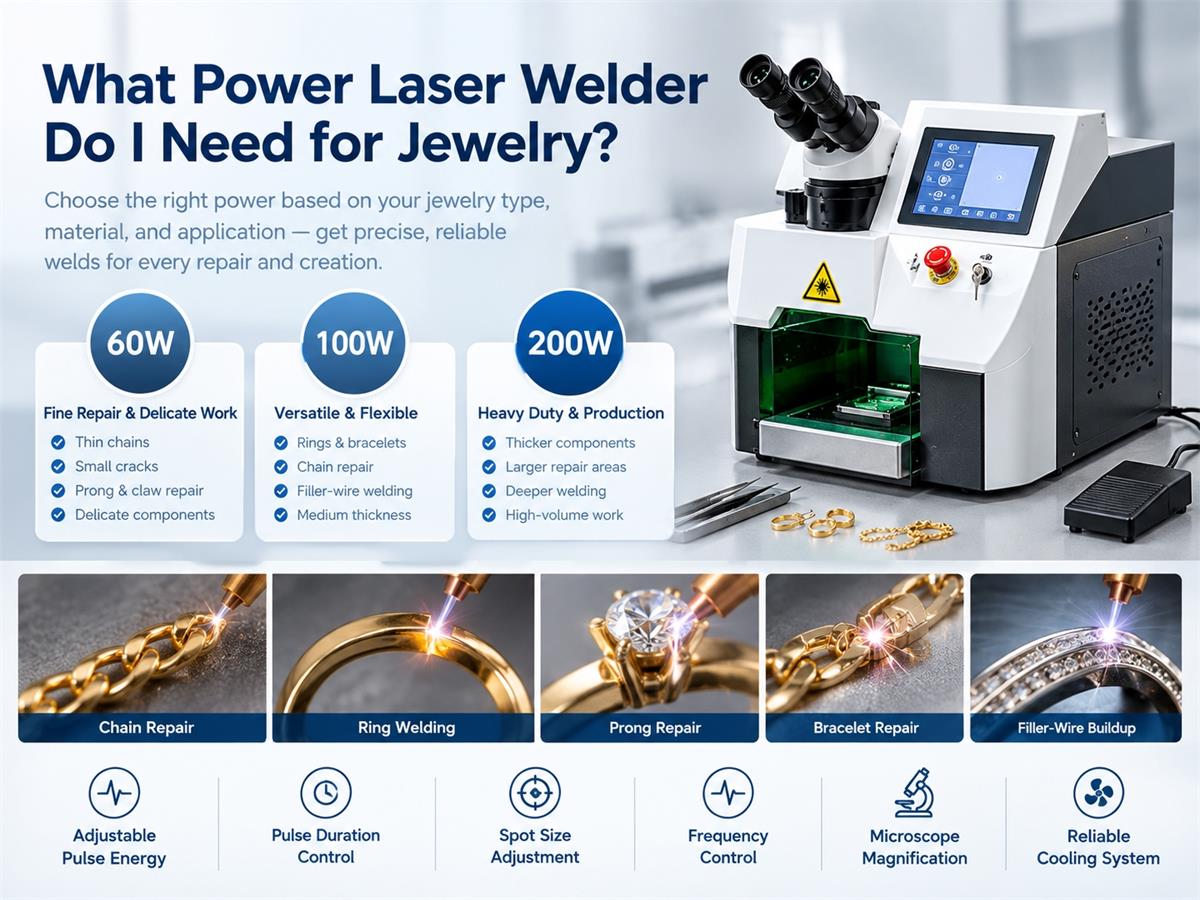
Choosing the right laser welder power is one of the most important decisions when purchasing a jewelry laser welding machine. The required power depends on the type of jewelry, material thickness, welding depth, repair application, and production volume.
For jewelry repair, a higher wattage does not automatically mean better welding performance. A 60W machine may be sufficient for fine repairs, while 100W or 200W systems can provide additional energy and flexibility for thicker components, larger repairs, and more demanding production work.
The key is to choose enough laser power for the work you actually perform without paying for capacity that you rarely use.
1. What Does Laser Welder Power Mean?
Laser welder power is commonly expressed in watts (W). It indicates the machine’s laser output capability, but it does not directly determine the quality or depth of every weld.
Jewelry laser welding also depends on pulse energy, pulse duration, frequency, spot size, focusing, and the characteristics of the material.
For example, a 100W pulsed YAG jewelry laser welder does not simply mean that every weld uses 100W continuously. The laser delivers controlled pulses, and the operator adjusts the welding parameters according to the application.
When comparing machines, look beyond the wattage and consider the complete parameter range.
2. Is a 60W Laser Welder Enough for Jewelry?
A 60W jewelry laser welder can be suitable for many fine and delicate jewelry repair applications.
Typical applications include:
-
Fine gold chain repair
-
Small cracks in rings
-
Prong and claw repair
-
Small solder-joint replacement
-
Fine silver jewelry repair
-
Small decorative components
-
Localized repair work
The main advantage of a lower-power system is precise energy control for small welding areas. When the material is thin, excessive energy can cause burn-through or unnecessary heat damage.
For a jewelry workshop that mainly performs delicate repair work, 60W can provide a practical balance between precision and output capability.
3. When Should You Choose a 100W Jewelry Laser Welder?
A 100W laser welder provides more energy capacity while remaining suitable for precision jewelry work.
It can be considered when the workshop handles a wider range of jewelry thicknesses and repair applications.
Typical applications include:
-
Gold ring repair
-
Bracelet repair
-
Chain repair
-
Prong rebuilding
-
Larger cracks
-
Silver jewelry welding
-
Filler-wire buildup
-
More frequent production work
A 100W machine can provide additional flexibility when a 60W system reaches its practical limits.
For workshops that perform both delicate repairs and medium-sized welding jobs, 100W can provide a broader operating range.
4. When Do You Need a 200W Jewelry Laser Welder?
A 200W jewelry laser welder is generally considered when higher pulse energy and greater welding capability are required.
It can be useful for:
-
Thicker gold components
-
Larger ring sections
-
Heavy bracelets
-
Larger gaps requiring filler wire
-
Deeper welding applications
-
More demanding repair work
-
Jewelry manufacturing
-
Higher-volume production
A 200W system does not mean that every jewelry repair should be performed at high power. The additional output capacity gives the operator more room to work with thicker materials and demanding applications.
For workshops that frequently repair larger or thicker jewelry components, a 200W system can reduce the limitations associated with lower-power equipment.
5. 60W vs 100W vs 200W Jewelry Laser Welder
The following comparison provides a practical way to think about different power levels.
60W
Best suited for fine and delicate jewelry repair. Common applications include thin chains, small cracks, prongs, and localized repairs.
100W
Suitable for a broader range of jewelry repair work, including rings, bracelets, chains, filler-wire applications, and medium-thickness components.
200W
Designed for higher-energy applications, thicker jewelry, larger repair areas, deeper welding, and workshops that need greater welding capacity.
The actual performance depends on the machine design and its pulse-energy range. Two machines with the same rated wattage may provide different welding results.
6. How Jewelry Thickness Affects Laser Power Selection
Material thickness is one of the most important factors when choosing laser power.
Thin jewelry requires careful control of energy to prevent burn-through. Fine chains, thin ring edges, and small prongs can often be welded with lower-power equipment when the machine provides precise pulse control.
Medium-thickness jewelry may benefit from a 100W system because it provides additional energy capacity while maintaining the precision required for jewelry work.
Thicker components and larger repair areas may require a 200W machine or another higher-energy configuration to achieve sufficient penetration and material buildup.
However, thickness should never be evaluated alone. Alloy composition, joint geometry, gap size, and required penetration also influence the required welding parameters.
7. Gold, Silver, and Platinum Require Different Settings
The required laser power is not determined only by the metal’s appearance or karat.
Gold alloys can have different compositions and thermal characteristics. Silver has high thermal conductivity and can require different energy settings from gold. Platinum has a high melting temperature and may require carefully controlled energy and pulse parameters.
For this reason, a machine should be selected based on the complete range of materials that the workshop processes.
If a workshop handles gold almost exclusively, the machine can be optimized around gold jewelry applications. If it regularly processes gold, silver, platinum, and different alloys, a wider parameter range can provide greater flexibility.
8. Power Is Not the Only Parameter That Matters
A common mistake when purchasing a jewelry laser welder is focusing only on wattage.
Important parameters also include:
Pulse Energy
Pulse energy determines how much energy is delivered in each pulse and is particularly important for controlling penetration.
Pulse Duration
Pulse duration affects how long the energy is delivered and influences heat input and melting behavior.
Spot Size
A smaller spot can provide precise energy concentration for fine repairs, while a larger spot can provide broader coverage.
Pulse Frequency
Frequency determines how many pulses are delivered per second and affects welding speed and cumulative heat.
Focusing and Positioning
Accurate focusing and positioning are essential for directing laser energy precisely onto the repair area.
A machine with adjustable parameters gives the operator more control than a machine that relies primarily on fixed settings.
9. What Power Is Best for Jewelry Repair Shops?
For a jewelry repair shop, the ideal power level depends on the type of work performed most frequently.
If the majority of jobs involve delicate chains, prongs, small cracks, and fine gold jewelry, a 60W system may provide sufficient capability.
If the shop handles a mixture of delicate repairs and medium-thickness jewelry, a 100W system can provide additional flexibility.
If the workshop frequently performs larger repairs, thicker components, filler-wire buildup, or production work, a 200W system may be more appropriate.
The best approach is to evaluate the thickest and most demanding jewelry applications that the machine will regularly handle rather than choosing a machine based only on the average job.
10. What Power Is Best for Jewelry Manufacturing?
Jewelry manufacturers may have different requirements from repair shops.
Production environments often need consistent welding performance, faster processing, and the ability to handle different component sizes.
A lower-power system can be appropriate for small and delicate components, while a higher-power system can provide greater capacity for thicker parts and larger production applications.
For manufacturers, other factors such as pulse stability, parameter repeatability, cooling, microscope magnification, digital controls, and operator ergonomics can be just as important as rated laser power.
11. How to Choose the Right Jewelry Laser Welder
Before purchasing a machine, evaluate the following questions:
What jewelry do you weld most often?
Identify whether your main work involves chains, rings, bracelets, prongs, settings, or larger components.
What is the typical material thickness?
Measure the thin and thick sections you regularly repair rather than relying on a general estimate.
Which metals do you process?
Consider gold, silver, platinum, and different alloys.
Do you need filler-wire welding?
If you frequently rebuild worn areas or fill larger gaps, additional pulse energy and a suitable welding configuration may be useful.
How important is precision?
For delicate jewelry, precise focusing, microscope visibility, spot-size adjustment, and stable pulse control are important.
What is your expected production volume?
Higher production requirements may justify a machine with greater energy capacity and faster welding capability.
12. Common Mistakes When Choosing Laser Power
Choosing the Highest Wattage Automatically
Higher power provides more capacity, but it does not automatically produce better jewelry welds. Delicate components still require carefully controlled energy.
Choosing Based Only on Price
A cheaper machine may have limited pulse-energy adjustment, frequency control, cooling capacity, or optical configuration. Compare the complete welding system rather than wattage alone.
Ignoring Pulse Energy
Two machines with similar wattage can have different pulse characteristics. Check the available pulse-energy range and parameter controls.
Ignoring Your Thickest Application
If a workshop occasionally repairs thick jewelry, selecting a machine based only on thin-chain work may limit future applications.
Using the Same Settings for Every Jewelry Piece
Gold, silver, platinum, different alloys, and different thicknesses require different welding parameters. A good machine should provide sufficient adjustment range for these variations.
Frequently Asked Questions
Is 60W enough for jewelry laser welding?
A 60W jewelry laser welder can be suitable for many fine jewelry repair applications, including thin chains, prongs, small cracks, and localized repairs. The actual suitability depends on material thickness and the machine’s pulse-energy capabilities.
Is 100W better than 60W for jewelry?
A 100W machine provides greater energy capacity, which can be useful for thicker components and a wider range of repairs. It is not automatically better for every application because delicate jewelry still requires controlled energy.
Do I need a 200W laser welder for jewelry?
Not necessarily. A 200W machine is more relevant when the workshop handles thicker jewelry, larger repair areas, deeper welding, filler-wire buildup, or higher production requirements.
What laser power is best for gold jewelry?
The appropriate power depends on the gold alloy, thickness, repair type, and required penetration. 60W, 100W, and 200W pulsed YAG systems can all be used for different gold jewelry applications when the welding parameters are properly adjusted.
What laser power is best for jewelry chains?
Fine jewelry chains often require precise, localized energy rather than maximum output. A 60W or 100W pulsed jewelry laser welder may be suitable depending on the chain thickness and repair requirements.
Can a 200W jewelry laser welder weld thin jewelry?
Yes. A higher-power machine can be used for thin jewelry when its pulse energy and other parameters can be adjusted precisely. The important factor is controllable energy delivery, not simply the maximum rated power.
Conclusion
The right laser welder power for jewelry depends on the type, thickness, material, and quantity of work your workshop handles.
A 60W jewelry laser welder can be suitable for fine and delicate repairs. A 100W system provides greater flexibility for mixed jewelry repair applications. A 200W system offers additional energy capacity for thicker components, larger repairs, filler-wire buildup, and more demanding production work.
Rather than choosing a machine based only on wattage, compare pulse energy, pulse duration, frequency, spot size, focusing, cooling, optical magnification, and parameter adjustability.
For jewelry workshops, the goal is to choose a laser welder that provides enough energy for the most demanding applications while maintaining precise control for delicate repairs.
Post time: Sep-29-2026
