
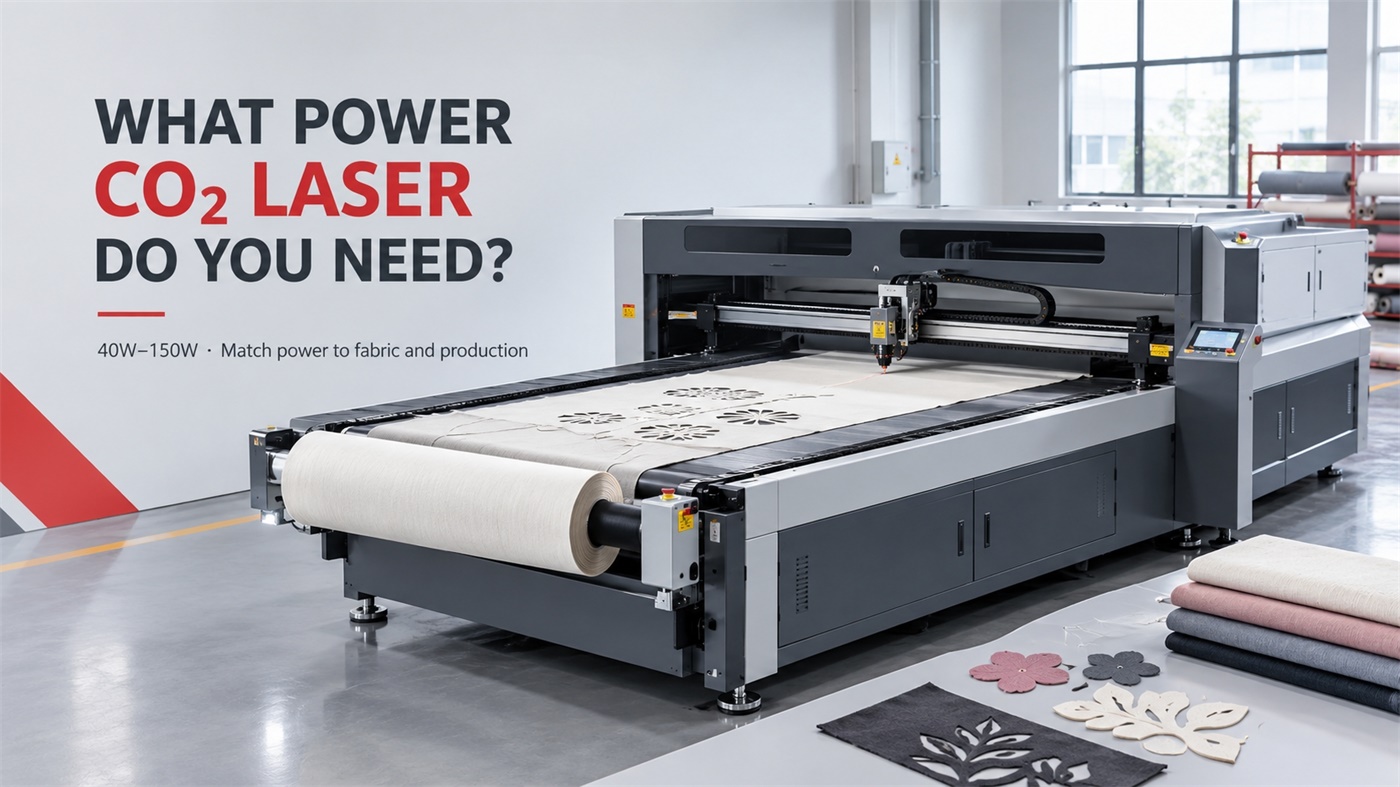
Choosing the right CO2 laser power for fabric cutting is essential for achieving clean edges, consistent cutting quality, and high production efficiency. A laser that is too weak may struggle with thick or multilayer materials, while excessive power can increase the risk of scorching, melting, or unnecessary energy consumption. The ideal power depends on fabric type, material thickness, cutting speed, production volume, and the design of the laser cutting machine.
For textile manufacturers, garment factories, upholstery producers, and heat transfer film processors, understanding the relationship between laser power and cutting performance helps prevent equipment selection mistakes and improves long-term production efficiency.
1. Recommended CO2 Laser Power for Different Fabrics
CO2 laser cutting machines are widely used for processing non-metallic materials, including cotton, polyester, felt, fleece, synthetic textiles, and certain technical fabrics. However, different materials respond differently to laser energy, so the appropriate power level varies by application.
40W–60W CO2 Laser: Light Fabric and Small-Scale Cutting
Low-power CO2 lasers can be suitable for thin fabrics, small textile components, samples, and light-duty cutting tasks. They are generally better suited to low-volume production than continuous industrial manufacturing.
For businesses cutting simple fabric patterns or conducting material testing, this power range may be sufficient. However, cutting speed and production capacity can become limiting factors when processing large quantities.
80W–100W CO2 Laser: General Fabric Cutting and DTF Film Processing
An 80W–100W CO2 laser is a practical choice for many textile cutting applications that require a balance between cutting speed, precision, and equipment cost.
Typical applications include polyester fabrics, thin synthetic textiles, DTF heat transfer films, TPU films, labels, and other flexible non-metallic materials. With an appropriate cutting head, motion system, and exhaust setup, a 100W machine can support efficient processing of detailed patterns and continuous production work.
For manufacturers handling both textile materials and heat transfer films, a properly configured 100W CO2 laser cutting machine can provide useful application flexibility.
130W–150W CO2 Laser: Higher-Speed Production and Thicker Materials
Higher-power CO2 lasers can provide greater cutting capacity and help maintain production speed when processing suitable thicker materials or more demanding cutting jobs.
This range may be appropriate for upholstery fabrics, multilayer textile applications, thicker felt, and other materials that require more energy to cut. Actual performance depends on material composition, density, thickness, and whether multiple layers are being processed together.
Higher power does not automatically produce better edges. Excessive energy can cause discoloration, melted edges, or a larger heat-affected area, particularly when cutting synthetic fabrics.
150W and Above: Specialized Industrial Applications
High-power CO2 laser systems may be suitable for specialized industrial textiles, thicker non-metallic materials, or production environments that prioritize throughput.
However, high power is not always the best choice for delicate fabrics or thin transfer films. If the material requires fine details, minimal thermal damage, or narrow cutting lines, a lower-power laser with suitable optics and motion control may produce better results.
2. CO2 Laser Power Selection Table
The following table provides general starting points for equipment selection. These are indicative application ranges, not guaranteed cutting specifications.
| Fabric or Material | Suggested Power Range | Main Consideration |
|---|---|---|
| Thin cotton fabric | 40W–80W | Prevent scorching and discoloration |
| Thin polyester fabric | 60W–100W | Control melting and edge quality |
| DTF heat transfer film | 60W–100W | Optimize detail and cutting speed |
| TPU film | 60W–100W | Test for melting and deformation |
| Felt and fleece | 80W–130W | Consider density and thickness |
| Upholstery fabric | 100W–150W | Balance throughput and edge quality |
| Technical textiles | 100W–150W or higher | Depends on composition and thickness |
These ranges should be verified through cutting tests on the actual material. Some thin films require very little power, while dense or multilayer materials may need a substantially different configuration.
3. What Matters More Than Laser Power?
Laser power is important, but it is only one part of the cutting system. Two machines with the same rated wattage can deliver noticeably different results because of differences in optical components, mechanical design, software, and material handling.
Cutting Speed
Laser power and cutting speed must be matched. Increasing speed reduces the energy delivered to each unit of material, while reducing speed increases heat exposure. The best setting is the one that achieves complete cutting without excessive thermal damage.
For large production orders, a stable high-speed motion system may be just as important as choosing a higher-power laser.
Spot Size and Optical Quality
The focusing lens and optical configuration influence the laser spot size and energy concentration. A suitable spot size helps achieve narrow cuts and detailed patterns, which is particularly important for intricate textile designs and DTF film processing.
Motion Accuracy
Fabric cutting often involves curves, small shapes, repeated patterns, and fine details. Accurate motion control helps maintain consistent dimensions and smooth cutting paths, especially during long production runs.
Material Feeding and Positioning
For continuous textile production, the feeding system can have a significant effect on overall output. Automatic feeding and synchronized motion reduce manual handling and help maintain consistent material positioning.
A machine equipped with an automatic feeding system may deliver greater practical productivity than a higher-powered machine that requires frequent manual repositioning.
4. Can a 100W CO2 Laser Cut Fabric Efficiently?
For many general textile applications, a 100W CO2 laser is a useful starting point. It can provide a balance between cutting capability, processing speed, and investment cost when configured for the target material.
It is particularly worth considering for businesses processing thin synthetic fabrics, textile components, DTF transfer films, TPU materials, and other suitable non-metallic substrates.
However, the term “100W” alone does not tell you how quickly a machine can complete a production order. The actual result depends on the cutting path, material thickness, laser condition, motion performance, and required edge quality.
Before purchasing, ask the manufacturer to conduct a cutting test using your own material. Evaluate the maximum stable cutting speed, edge condition, dimensional accuracy, and performance during extended operation.
If your factory processes large fabric rolls, consider a fabric automatic feeding laser cutting machine. An integrated feeding system can reduce manual intervention and improve workflow continuity, making it a practical option for industrial textile processing.
5. CO2 Laser Cutting vs. Mechanical Fabric Cutting
CO2 laser cutting and mechanical cutting serve different production needs.
Laser cutting uses a focused beam to process material without a conventional cutting blade. It is useful for complex patterns, detailed designs, and applications where digital file changes are frequent. For certain synthetic fabrics, the laser can also seal cut edges through localized melting, although the result depends on the material.
Mechanical fabric cutting, including rotary blade and CNC knife systems, can be more appropriate for materials that are sensitive to heat or for production processes where thermal effects must be avoided.
For thick multilayer fabric stacks, a mechanical system may offer advantages in certain applications. Conversely, a CO2 laser may be more convenient for intricate shapes, small components, and suitable film materials.
The best choice depends on fabric composition, required accuracy, cutting volume, and acceptable edge characteristics.
6. How to Choose the Right CO2 Laser Cutting Machine
Before selecting a machine, evaluate the complete production requirement rather than choosing equipment based only on its rated power.
First, identify the materials you will process, including their composition, thickness, and number of layers. Polyester, cotton, felt, TPU, and DTF films can behave differently under laser exposure, so sample testing is essential.
Second, define your production target. If you process a few small designs each day, a compact machine may be sufficient. If you handle long fabric rolls or large batches, prioritize automatic feeding, stable motion, and effective material handling.
Third, establish your quality requirements. Consider whether you need fine pattern details, minimal discoloration, clean edges, consistent dimensions, or the ability to process multiple material types.
Finally, compare the complete machine configuration, including laser source, working area, control software, exhaust system, cooling system, and after-sales support. These factors influence operating reliability and the total cost of ownership.
7. Frequently Asked Questions
Is 100W enough for fabric cutting?
A 100W CO2 laser can be suitable for many thin fabrics, synthetic textiles, DTF films, and other compatible non-metallic materials. Whether it is sufficient depends on the material, thickness, required speed, and cutting quality.
Is a higher-power CO2 laser always faster?
No. Higher power can support higher cutting speeds under suitable conditions, but actual productivity also depends on acceleration, motion accuracy, optics, material feeding, and the cutting path. Excessive power can also damage delicate materials.
What CO2 laser power is best for DTF film cutting?
For many DTF film cutting applications, a properly configured 60W–100W CO2 laser may be sufficient. The optimal setting depends on film composition, thickness, cutting detail, and the desired production speed. Testing is necessary to avoid excessive melting or deformation.
Can a CO2 laser cut cotton and polyester fabric?
Yes, CO2 lasers can cut many cotton and polyester fabrics. However, cotton may char or discolor if the heat input is excessive, while polyester may melt along the cutting edge. Material-specific testing helps establish suitable settings.
Is automatic feeding necessary for fabric laser cutting?
Automatic feeding is not essential for every application, but it can be valuable when processing long fabric rolls or handling repetitive production orders. It reduces manual handling and helps maintain a more continuous workflow.
How do I determine the correct laser power before buying?
Provide the manufacturer with representative material samples and explain your target cutting speed, production volume, and edge-quality requirements. Request a practical cutting test and compare the results at different power and speed settings before making a final decision.
Conclusion
For most fabric cutting applications, the right CO2 laser power depends on the material, thickness, required cutting speed, and production workflow. Lower-power systems can handle many light-duty tasks, while 80W–100W machines provide a practical starting point for a range of textile and heat transfer film applications. Higher-power systems may be appropriate for demanding industrial jobs, but they are not automatically the best option for delicate materials.
When selecting a fabric laser cutting machine, evaluate laser power alongside cutting accuracy, automatic feeding, motion performance, and material compatibility. A machine matched to your actual production requirements can deliver more consistent results and better long-term value than one selected on wattage alone.
Post time: Oct-13-2026
