
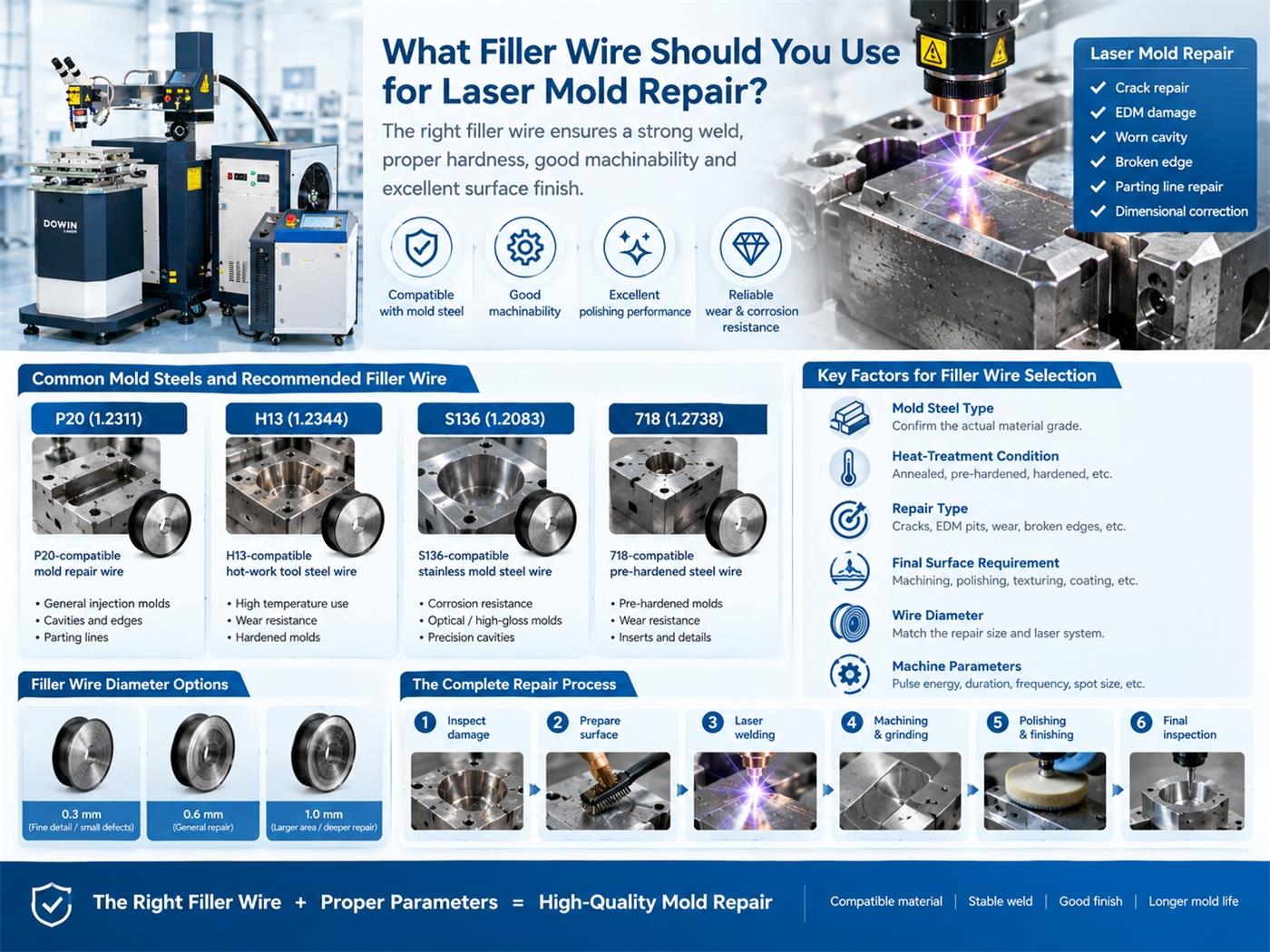
Choosing the right filler wire for laser mold repair is just as important as selecting the laser welding parameters. A laser can precisely rebuild a damaged mold, but an unsuitable filler wire may create problems with hardness, cracking, machining, polishing, or corrosion resistance.
For injection molds, the general principle is simple:
Choose a filler wire that is compatible with the mold steel and suitable for the final surface requirements.
The correct wire is not necessarily the hardest wire or the one that produces the strongest weld. It needs to work with the entire repair process—from laser welding to machining, polishing, EDM finishing, and production.
Why Does Filler Wire Matter in Mold Laser Welding?
When repairing an injection mold, laser welding is normally used to add material to areas that have been damaged or worn.
Typical defects include:
-
EDM pits
-
Cracks
-
Worn cavities
-
Broken edges
-
Damaged corners
-
Parting-line damage
-
Dimensional errors
-
Machining mistakes
-
Small areas of missing material
The filler wire becomes part of the repaired mold. Therefore, its properties can directly affect the final repair.
Important considerations include:
-
Chemical compatibility
-
Hardness
-
Crack resistance
-
Machinability
-
Polishing performance
-
Corrosion resistance
-
Wear resistance
-
Compatibility with the mold’s heat-treatment condition
Should the Filler Wire Match the Mold Steel?
In many cases, yes—or it should at least be metallurgically compatible with it.
For example, if you are repairing a P20 mold, a filler designed for P20-type mold steel may be a logical starting point. If you are repairing H13, a compatible hot-work tool-steel filler is generally more appropriate.
However, “same steel = same wire” is an oversimplification.
The final choice can also depend on:
-
The hardness of the original mold
-
Whether the mold is hardened
-
The location of the repair
-
Required wear resistance
-
Required polishability
-
Whether the repaired area will be textured
-
Whether the mold will be heat treated again
For critical repairs, the filler manufacturer’s material specification and actual mold-steel certificate should be checked rather than relying only on the commercial name of the steel.
Common Filler Wires for Mold Laser Repair
Different mold steels call for different filler materials. The following are common categories used in precision mold repair.
| Mold Steel | Typical Filler Direction | Common Applications |
|---|---|---|
| P20 / 1.2311-type | P20-compatible mold repair wire | Injection mold cavities, edges, general repairs |
| 718 / 1.2738-type | 718-compatible mold repair wire | Pre-hardened injection molds |
| H13 / 1.2344-type | H13-compatible hot-work tool steel wire | Hardened molds, wear-resistant repairs |
| S136 / 1.2083-type | Stainless mold-steel-compatible wire | Corrosion-resistant molds and polished cavities |
| 1.2343-type | Compatible hot-work tool steel wire | Precision tool and mold repair |
These are starting categories rather than universal prescriptions. Steel designations and filler grades are not always interchangeable across suppliers or standards.
1. Filler Wire for P20 Mold Steel
P20 is widely used for injection molds, mold bases, and various tooling applications.
For P20-type molds, a compatible P20 mold-repair filler is commonly considered when repairing:
-
Small cracks
-
Cavities
-
Worn surfaces
-
Edges
-
Parting lines
-
EDM damage
The advantage of using a compatible filler is that the repaired area can generally be machined and finished together with the surrounding mold steel.
For a mold requiring polishing, the filler should also have suitable polishing characteristics.
2. Filler Wire for H13 Mold Steel
H13 is a common hot-work tool steel used where higher temperature and wear resistance are required.
Laser repair of H13 can involve:
-
Mold edges
-
Inserts
-
Cavities
-
Cracks
-
Worn areas
-
Die and tooling surfaces
A compatible H13-type filler is generally preferred because it can provide a better match to the base material than a generic mild-steel wire.
Because hardened H13 can be sensitive to thermal stresses, laser parameters and repair procedure are particularly important.
3. Filler Wire for S136 Mold Steel
S136 is a corrosion-resistant mold steel frequently used for applications requiring good surface quality and corrosion resistance.
It is particularly relevant to molds producing:
-
Optical components
-
Medical products
-
Transparent plastic parts
-
High-gloss components
When repairing S136, filler selection should consider not only welding compatibility but also the required corrosion resistance and polishing performance.
This is especially important when the repaired area forms part of a highly polished cavity.
4. Filler Wire for 718 Mold Steel
718-type pre-hardened mold steel is also widely used for injection molds.
Compatible filler wire can be used for localized repairs such as:
-
Wear
-
Small cracks
-
EDM damage
-
Damaged edges
-
Machining errors
The filler should be selected according to the actual grade and hardness condition of the mold rather than simply assuming that all “718″ materials are identical.
What About Filler Wire Hardness?
Hardness is an important consideration, but harder is not automatically better.
If the filler is significantly harder than the surrounding mold steel, it may create difficulties during machining or polishing.
If it is too soft for a high-wear application, the repaired area may wear differently from the original mold.
Therefore, the desired filler hardness should be considered together with:
Base steel + heat treatment + wear requirements + machining + surface finish.
For precision mold repair, consistency between the repaired material and surrounding material is often more useful than simply maximizing hardness.
Filler Wire Diameter Also Matters
The diameter of the wire should match the scale of the repair and the laser welding system.
Fine repairs may require a very small wire diameter, while larger repairs can use thicker wire.
A smaller wire can provide better control when rebuilding:
-
Sharp corners
-
Fine edges
-
Small cavities
-
EDM pits
-
Thin mold features
The laser’s spot size, pulse energy, wire-feeding system, and operator technique all influence the appropriate wire diameter.
Why Thin Filler Wire Is Useful for Precision Mold Repair
Consider a mold corner that has lost only a small amount of material.
Using a thick wire can make it difficult to control the amount of deposited metal.
A fine wire allows the operator to build the area gradually and leave a controlled machining allowance.
This is particularly valuable when repairing detailed mold geometry.
Filler Wire and Polishing Performance
One factor that is sometimes overlooked is what happens after welding.
Laser welding is usually followed by machining, grinding, or polishing.
If the filler has different polishing behavior from the base steel, the repaired area may become visible after finishing.
This matters particularly for:
-
Mirror-polished cavities
-
Optical molds
-
Transparent plastic molds
-
High-gloss consumer products
-
Decorative plastic components
Therefore, when the mold requires a high-quality surface finish, filler selection should be made with the final polishing process in mind.
Filler Wire for EDM-Damaged Molds
EDM damage is a common reason for laser mold repair.
After EDM, a mold surface may have pitting, recast material, microcracks, or localized dimensional damage.
Before laser welding, the technician should determine whether the affected material needs to be removed.
The general process is:
Inspect → Remove unsuitable damaged material → Clean → Select compatible filler → Laser weld → Machine → Polish/texture → Inspect
The filler wire should be compatible with the mold steel and appropriate for the final surface condition.
Can You Use Stainless Steel Wire for Any Mold?
No.
Using a generic stainless-steel wire simply because it is easy to obtain is not a good general strategy for mold repair.
Different mold steels have different:
-
Carbon contents
-
Alloying elements
-
Hardness
-
Thermal behavior
-
Corrosion characteristics
-
Machining properties
An incompatible filler may increase the risk of cracking or produce a repaired area with different mechanical or finishing characteristics.
For production molds, the filler should be selected according to the actual base material and repair requirements.
How to Choose Filler Wire for Your Mold
A practical selection process is:
Step 1: Identify the Mold Steel
Check the material certificate, drawing, supplier information, or other reliable documentation.
Do not rely solely on the appearance of the mold.
Step 2: Check the Heat-Treatment Condition
Determine whether the mold is:
-
Annealed
-
Pre-hardened
-
Hardened
-
Nitrided
-
Surface treated
This can significantly affect the repair strategy.
Step 3: Identify the Damage
A tiny EDM pit requires a different approach from a large broken edge or deep crack.
Step 4: Define the Final Surface Requirement
Ask whether the repaired area needs:
-
Standard machining
-
Fine grinding
-
Mirror polishing
-
EDM texture
-
Etching
-
Plating
-
High wear resistance
Step 5: Select a Compatible Filler
Choose a filler whose composition and properties are appropriate for the base material and final application.
Step 6: Test Before Production Repair
For an expensive injection mold, a sample weld is often worthwhile.
Check:
-
Weld appearance
-
Bonding
-
Cracking
-
Hardness
-
Machinability
-
Polishing
-
Dimensional stability
Does the Laser Welding Machine Affect Filler Wire Selection?
Yes.
The filler wire cannot be considered separately from the welding machine.
A pulsed YAG mold laser welding machine needs to provide suitable control over parameters such as:
-
Pulse energy
-
Pulse duration
-
Frequency
-
Spot diameter
-
Welding position
-
Filler wire feeding
The machine should also allow the operator to observe the repair area accurately, especially when working on very small mold features.
A stable laser system makes it easier to deposit small amounts of filler material progressively rather than applying excessive heat or material.
Filler Wire Selection: A Simple Rule
For most mold repair applications, the decision can be simplified to:
Identify the mold steel → match the filler category → consider hardness → consider polishing → test the weld → confirm the final repair.
The filler wire should support the entire repair process, not just the initial welding operation.
Final Thoughts
Choosing the correct filler wire for laser mold repair requires more than matching a wire diameter to a laser machine.
The mold steel, heat-treatment condition, damage type, hardness requirement, machining process, and final surface finish should all be considered.
For common mold materials such as P20, H13, S136, and 718, compatible mold-repair filler wires are available, but the exact filler grade should be verified against the actual material specification.
For precision injection mold repair, a pulsed YAG mold laser welding machine combined with the appropriate filler wire can rebuild damaged material while providing the control needed for subsequent machining and polishing.
The best filler wire is ultimately the one that produces a stable weld, compatible material properties, good machinability, and the required final mold surface.
FAQ
What filler wire is best for laser mold repair?
There is no single filler wire that is best for every mold. The filler should generally be compatible with the mold steel and selected according to hardness, wear resistance, polishing requirements, and the type of repair.
What filler wire should be used for P20 mold steel?
A P20-compatible mold repair wire is a logical starting point. The exact grade should be confirmed against the actual P20 material specification and the required final properties.
What filler wire is used for H13 mold repair?
An H13-compatible hot-work tool-steel filler is generally appropriate for H13 repairs. The specific filler should be selected according to the H13 grade, hardness condition, and repair requirements.
Can S136 mold steel be laser welded?
Yes. S136-type stainless mold steel can be laser welded with suitable parameters and compatible filler material. Corrosion resistance and polishing performance should be considered when selecting the filler.
Does filler wire diameter affect laser welding?
Yes. Wire diameter affects material deposition and process control. Fine wire is particularly useful for small defects and detailed mold features.
Can the repaired area be polished after laser welding?
Yes. Laser-welded mold repairs can normally be machined, ground, and polished as required. The filler material should be selected with the final surface finish in mind.
Post time: Sep-16-2026
