
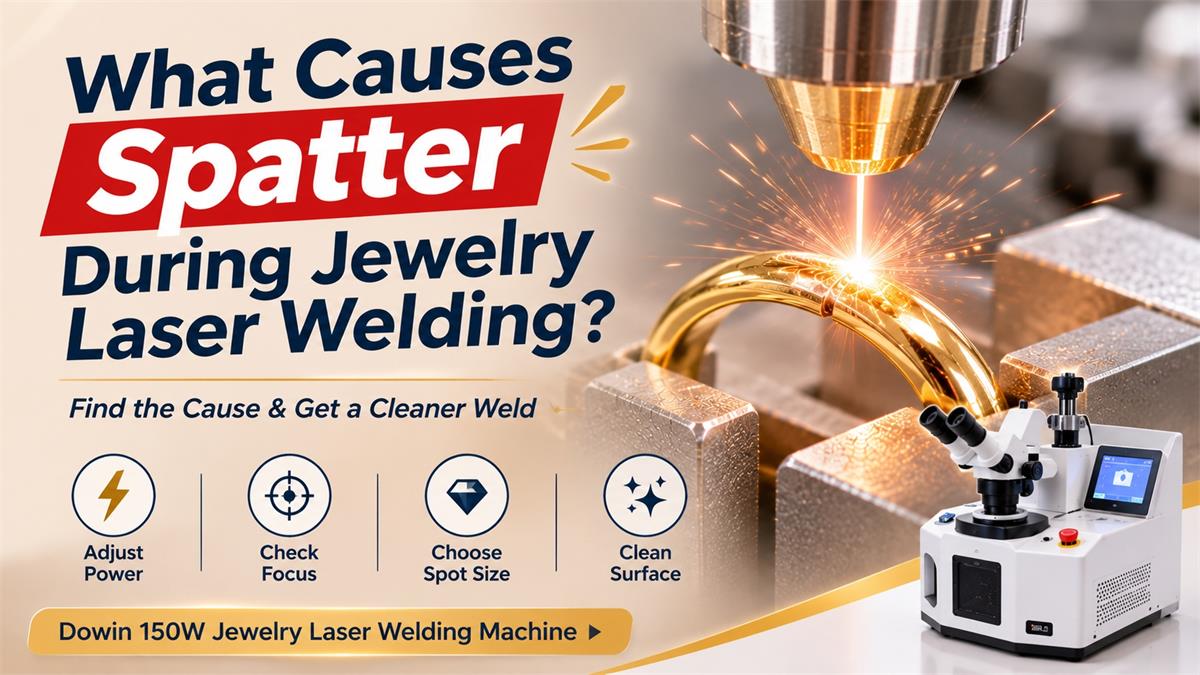
Spatter is a common problem during jewelry laser welding, especially when working with small gold, silver, and platinum components. Tiny molten metal particles can splash around the welding area, leaving unwanted marks on the jewelry surface and sometimes weakening the joint. If you are using a jewelry laser welding machine, understanding the causes of spatter can help you adjust the welding parameters, improve the finished appearance, and reduce unnecessary material loss. This article explains why spatter happens and how to prevent it in practical jewelry repair applications.
1. What Is Spatter During Jewelry Laser Welding?
Spatter refers to small droplets of molten metal that are expelled from the welding area during laser irradiation. These particles may land around the joint or stick to the surrounding jewelry surface.
For jewelry manufacturers and repair technicians, excessive spatter can cause several problems:
- Small metal particles stick to the jewelry surface.
- The weld area becomes rough and requires additional polishing.
- Material loss may reduce the quality of the joint.
- Nearby gemstones or decorative details may be contaminated or damaged.
- Repeated spatter can contaminate the machine’s protective optical components.
A few small sparks do not necessarily indicate a defective weld. However, repeated ejection of molten metal, visible surface damage, or material loss should be investigated.
2. Five Common Causes of Spatter in Jewelry Laser Welding
1. Excessive Laser Energy
This is one of the first things to check when excessive spatter occurs.
If the pulse energy is too high for a small jewelry component, the metal may vaporize rapidly. The resulting vapor pressure can push molten metal out of the welding pool.
This is particularly noticeable when welding thin gold chains, small ring joints, and delicate decorative components.
How to fix it:
- Gradually reduce pulse energy.
- Check whether the pulse duration is too long.
- Avoid repeatedly firing at the same small location.
- Test different settings on matching scrap material.
2. Laser Spot Size Is Too Small
A very small laser spot concentrates energy into a tiny area. Although this is useful for precision welding, excessive energy density can cause intense localized melting and metal ejection.
For small jewelry repairs, the spot diameter should match the size and thickness of the joint.
How to fix it: Try a slightly larger spot diameter or reduce pulse energy to distribute heat more evenly. Make sure the joint still receives sufficient energy for proper fusion.
3. Dirty or Contaminated Metal Surfaces
Oil, polishing compounds, oxidation, dust, and old solder residues can interfere with the welding process.
When exposed to concentrated laser energy, certain contaminants may vaporize or react rapidly, disturbing the molten metal and contributing to spatter and porosity.
How to fix it:
- Clean the jewelry surface before welding.
- Remove polishing compounds and oil residues.
- Check for old solder or other incompatible materials.
- Use suitable filler wire with a compatible alloy composition.
4. Incorrect Focus Position
If the laser is not correctly focused on the joint, the energy distribution may become inconsistent.
This can result in unstable melting, excessive surface heating, or insufficient penetration.
How to fix it: Check the focal position and make sure the laser spot is correctly aligned with the welding area. A microscope is particularly helpful when working with tiny jewelry components.
5. Excessive Heat Accumulation
Repeated laser pulses applied too quickly can cause heat to accumulate in small jewelry parts.
Thin gold chains, earring posts, and delicate ring structures are especially sensitive to excessive local heating.
How to fix it:
- Adjust pulse frequency when necessary.
- Allow short cooling intervals between welding operations.
- Avoid concentrating too many pulses in one location.
- Use controlled overlapping pulses instead of excessive repeated irradiation.
3. How to Reduce Spatter When Welding Different Jewelry Parts
Gold Chains
Fine gold chains have small contact areas and limited material thickness. Use a suitable spot size and moderate pulse energy. Make sure both ends of the broken link are properly aligned before welding.
Gold Rings
When repairing ring joints, excessive energy can cause material ejection and surface deformation. Adjust the pulse parameters according to the ring thickness and use overlapping pulses carefully.
Earring Posts
Earring posts require accurate positioning because the connection area is small. Keep the post stable and direct the laser at the actual joint rather than the surrounding decorative surface.
Silver Jewelry
Silver has high thermal conductivity and high laser reflectivity at common welding wavelengths. Its welding behavior differs from gold, so the pulse parameters should be tested and adjusted specifically for silver.
4. Which Jewelry Laser Welding Machine Helps Reduce Spatter?
When choosing a jewelry laser welder, stable pulse control and accurate positioning are important. Machine wattage alone does not determine whether spatter will occur.
For small jewelry components, a pulsed YAG laser welding machine is a practical option because it allows operators to control individual welding pulses and concentrate heat on localized areas.
Dowin 150W Jewelry Laser Welding Machine
Dowin’s 150W desktop jewelry laser welding machine is worth considering for jewelry repair shops working with gold rings, chains, earrings, and other small precious metal components.
- 150W rated power for various jewelry welding applications.
- Pulsed YAG laser technology for localized welding.
- Adjustable welding parameters for different materials and thicknesses.
- Microscope observation for accurate positioning.
- LED shadowless lighting for clearer visibility of small welding areas.
- Compact desktop design for jewelry workshops.
The microscope and adjustable pulse parameters are particularly useful when technicians need to control the welding position and reduce excessive heating on delicate components. They do not automatically eliminate spatter, but they help operators establish a more controlled welding process.
Explore Dowin 150W Jewelry Laser Welding Machine to view the product details and discuss a welding sample test using your actual jewelry materials.
5. Frequently Asked Questions
Q1: Why does my jewelry laser welder produce too many sparks?
Possible causes include excessive pulse energy, a very small spot size, contaminated metal surfaces, incorrect focus, or excessive heat accumulation. Check these factors before changing multiple parameters.
Q2: Does reducing laser power always eliminate spatter?
No. Reducing energy may help when the original setting is too aggressive, but excessive reduction can cause incomplete fusion. Adjust pulse energy and duration gradually while checking the weld quality.
Q3: Can spatter damage gold jewelry?
Yes. Molten metal particles can stick to nearby surfaces, create small pits, and affect the appearance of polished jewelry. Excessive material ejection can also reduce the amount of metal remaining in the joint.
Q4: Is spatter normal during jewelry laser welding?
Occasional tiny sparks may occur during welding. However, repeated molten metal ejection, rough weld surfaces, and visible material loss usually indicate that the process needs adjustment.
Conclusion
Spatter during jewelry laser welding is usually related to unstable melting, excessive energy density, surface contamination, incorrect focus, or heat accumulation.
Instead of simply lowering the machine power, technicians should check the material condition, spot size, pulse duration, and welding position together.
For jewelry workshops handling delicate gold and silver components, a pulsed YAG jewelry laser welding machine with microscope positioning provides better control over small welding areas.
Contact Dowin to learn more about jewelry laser welding equipment and request a sample welding test.
“`
Post time: Nov-20-2026
