
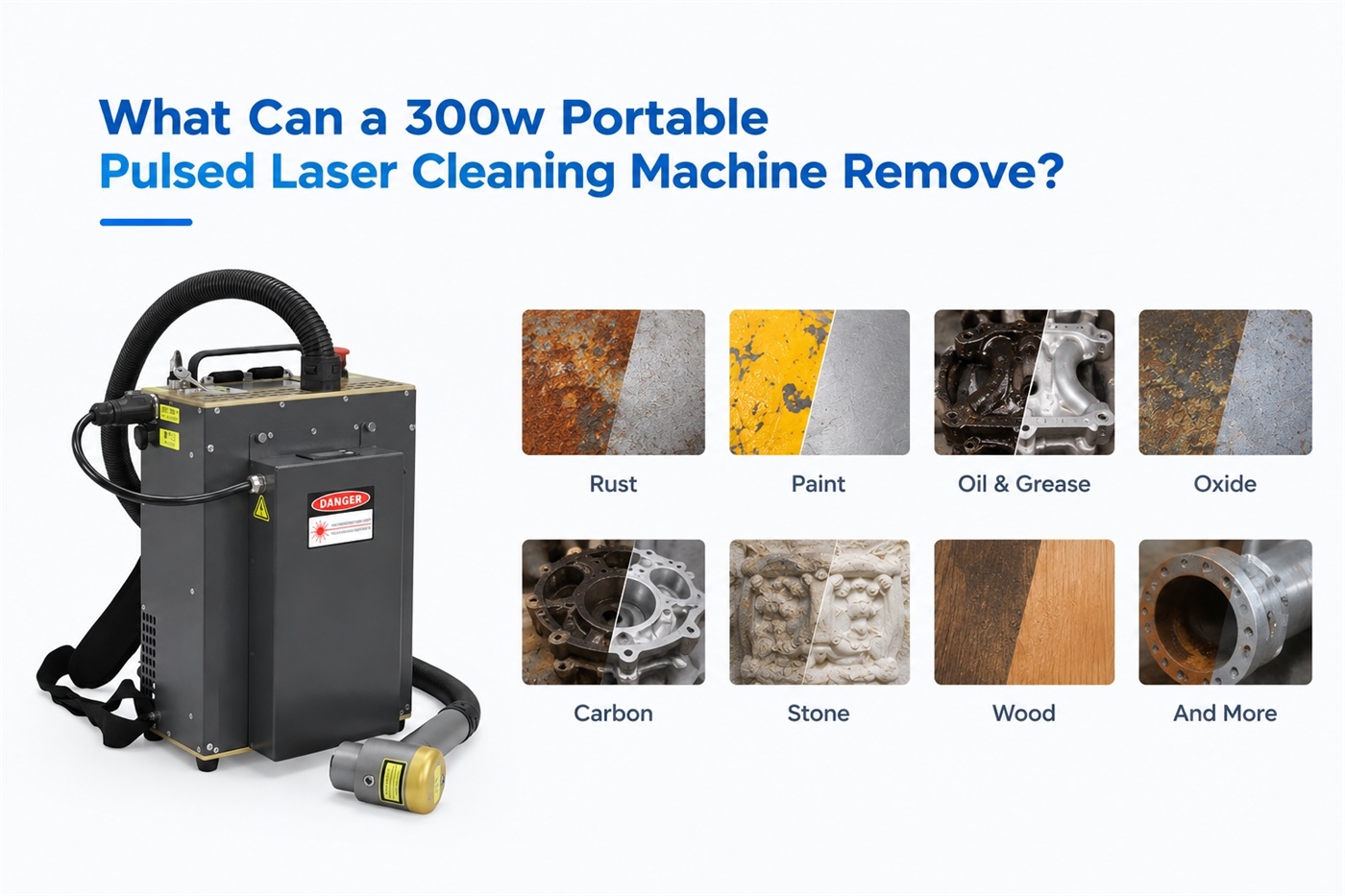
A 300W portable pulsed laser cleaning machine is designed for removing unwanted surface contaminants without using chemical solvents, abrasive media, or direct mechanical contact. Its combination of pulsed laser energy and portable design makes it useful for workshops, maintenance teams, automotive repair, mold cleaning, and industrial surface treatment.
But what can a 300W pulsed laser cleaner actually remove?
From rust and paint to oil, carbon deposits, oxidation, and dirt, the machine can handle a wide range of surface contaminants when the laser parameters are correctly matched to the material.
What Can a 300W Pulsed Laser Cleaning Machine Remove?
The most common applications include:
-
Rust and corrosion
-
Paint and coatings
-
Oil and grease
-
Carbon deposits
-
Oxide layers
-
Dirt and dust
-
Welding residue
-
Mold contamination
-
Metal surface oxidation
-
Certain adhesive and coating residues
The exact cleaning capability depends on the contaminant, substrate material, thickness, and required surface finish.
1. Rust and Corrosion
Rust removal is one of the most common applications for a 300W pulsed laser cleaning machine.
It can be used to remove rust from:
-
Steel parts
-
Machine components
-
Automotive parts
-
Metal tools
-
Pipes
-
Metal structures
-
Mechanical equipment
The laser targets the rust and corrosion layer while allowing the operator to control the cleaning intensity.
For maintenance work, this can be useful when only the contaminated layer needs to be removed without aggressively abrading the underlying metal.
2. Paint and Coatings
A 300W pulsed laser cleaner can also remove certain paints and surface coatings.
Typical applications include:
-
Paint stripping from metal parts
-
Removing old coatings
-
Localized paint removal
-
Surface preparation before welding
-
Removing coating from repair areas
-
Cleaning painted machine components
Laser parameters can be adjusted according to the coating and substrate. For delicate surfaces, the objective is to remove the unwanted coating while minimizing unnecessary substrate damage.
3. Oil and Grease
Oil and grease are common contaminants in industrial maintenance and automotive repair.
A laser cleaning machine can remove accumulated oil, grease, and other organic contamination from suitable metal surfaces.
Applications may include:
-
Engine components
-
Mechanical parts
-
Automotive components
-
Gears
-
Machine tools
-
Metal fixtures
For heavily contaminated parts, the operator may need to use multiple passes or pre-cleaning depending on the amount and type of contamination.
4. Carbon Deposits
Carbon and combustion deposits can build up on automotive and mechanical components.
A 300W pulsed laser cleaner can be used for localized removal of carbon and residue from suitable metal parts.
Potential applications include:
-
Engine components
-
Pistons
-
Valve-related parts
-
Cylinder components
-
Exhaust components
-
Mechanical assemblies
The advantage of laser cleaning in these applications is the ability to clean a specific surface without physical contact.
5. Oxide Layers
Oxidation can affect the appearance and subsequent processing of metal surfaces.
Laser cleaning can remove certain oxide layers from materials such as steel and other suitable metals.
This can be useful before:
-
Welding
-
Brazing
-
Coating
-
Painting
-
Surface inspection
-
Precision assembly
Removing contamination before welding, for example, can help provide a cleaner surface for the subsequent process.
6. Welding Residue and Weld Preparation
Laser cleaning can also be used around welding operations.
It can remove oxidation, residue, and certain contaminants from metal surfaces before or after welding.
For pre-weld preparation, the objective is to expose a cleaner metal surface. For post-weld treatment, laser cleaning can help remove certain oxidation or residue around the weld area.
This makes a portable laser cleaner useful as part of a broader metal fabrication workflow.
7. Mold Contamination
Molds can accumulate oil, residue, oxidation, and other contaminants during production.
A pulsed laser cleaning machine can be used for localized mold cleaning, particularly when contamination needs to be removed from detailed metal surfaces.
Potential applications include:
-
Injection molds
-
Metal molds
-
Tooling
-
Mold cavities
-
Mold inserts
-
Precision components
Because laser cleaning is non-contact, it can be useful for cleaning areas where abrasive tools are difficult to use.
8. Surface Dirt and Industrial Contamination
Not every cleaning job involves heavy rust or paint.
A 300W portable pulsed laser cleaner can also be used for removing certain forms of:
-
Dust
-
Dirt
-
Surface deposits
-
Production residue
-
Oxidized contamination
-
Processing residue
This makes it suitable for maintenance operations where a dry and relatively clean cleaning process is preferred.
Why Choose a 300W Pulsed Laser Cleaner?
The 300W power level provides a useful balance between cleaning efficiency and process control for many industrial applications.
Compared with lower-power laser cleaners, a 300W system can provide higher cleaning productivity for suitable contaminants while retaining the advantages of pulsed laser technology.
Pulsed Laser Energy
Short laser pulses deliver concentrated energy to the contamination. With appropriate parameters, the unwanted layer can be removed while limiting thermal influence on the substrate.
Non-Contact Cleaning
There is no abrasive brush, grinding wheel, or blasting media directly contacting the workpiece.
No Chemical Cleaning Agents
Laser cleaning can eliminate the need for chemical solvents in many applications, reducing consumable requirements and secondary chemical waste.
Portable Design
A portable or backpack-style configuration makes it easier to move the cleaning system between workstations, production areas, vehicles, or maintenance sites.
Precise Local Cleaning
The operator can target specific contaminated areas instead of cleaning the entire component.
What Materials Can It Clean?
A 300W pulsed laser cleaning machine is primarily used on suitable metal substrates, including many steel and other industrial metal components.
Common applications include:
Steel: rust, paint, oil, oxidation, and industrial residue.
Stainless steel: surface contamination, oxidation, and certain coatings.
Cast iron: rust, oil, grease, and carbon deposits.
Aluminum: suitable surface contaminants can be removed with carefully selected parameters.
Other metals: feasibility depends on reflectivity, thermal properties, surface condition, and the specific contaminant.
The substrate should always be tested before large-scale production cleaning, especially when the original surface finish must be preserved.
Does Laser Cleaning Damage the Metal?
Laser cleaning should not be described as completely damage-free under every condition.
The result depends heavily on laser power, pulse energy, frequency, scanning speed, spot size, focus, and the difference between the contaminant and substrate.
Using excessive energy or incorrect parameters can affect the underlying material.
For this reason, professional laser cleaning is based on parameter optimization rather than simply using maximum power.
A good cleaning process aims for:
Maximum contaminant removal + minimum substrate alteration.
300W Pulsed Laser Cleaning vs. Traditional Cleaning
| Feature | 300W Pulsed Laser Cleaning | Traditional Cleaning |
|---|---|---|
| Contact with workpiece | Non-contact | Often contact-based |
| Chemical consumables | Not normally required | May be required |
| Abrasive media | Not required | May be required |
| Precision | High | Depends on method |
| Localized cleaning | Excellent | Often more difficult |
| Portability | Suitable for mobile applications | Depends on equipment |
| Waste generation | Low secondary waste | May generate chemical or abrasive waste |
Traditional methods still have their place, particularly for large-scale or heavy-duty cleaning. Laser cleaning becomes particularly attractive when precision, surface control, portability, and reduced consumables are important.
Is 300W Enough for Heavy Rust and Paint?
It depends on the thickness and type of contamination.
A 300W pulsed laser cleaner can be effective for many rust, paint, oil, carbon, and oxide removal applications. However, extremely thick coatings or heavily accumulated contamination may require more passes or a different laser configuration.
For very large surfaces or extremely heavy contamination, a higher-power cleaning system may provide better productivity.
Therefore, machine selection should be based on the actual cleaning material and production requirements, rather than power alone.
Final Thoughts
A 300W portable pulsed laser cleaning machine can remove a wide range of surface contaminants, including rust, paint, oil, grease, carbon deposits, oxidation, welding residue, and industrial dirt.
Its main advantage is the combination of pulsed laser precision and portable operation. This makes it useful for automotive maintenance, metal fabrication, mold cleaning, machinery maintenance, restoration, and other industrial applications.
The most important factor is proper parameter selection. Different contaminants and substrates require different laser settings, and sample testing is recommended before production use.
For businesses looking for a portable solution for rust removal, paint stripping, mold cleaning, or general metal surface preparation, a 300W pulsed laser cleaning machine can be a versatile alternative to conventional cleaning methods.
FAQ
What can a 300W laser cleaning machine remove?
It can remove many types of surface contamination, including rust, paint, oil, grease, carbon deposits, oxide layers, welding residue, and certain industrial coatings.
Can a 300W pulsed laser remove rust?
Yes. Rust and corrosion removal is one of the most common applications of pulsed laser cleaning.
Can a 300W laser cleaner remove paint?
Yes. It can remove many types of paint and coatings from suitable substrates. The correct laser parameters depend on the coating and base material.
Can laser cleaning remove oil and grease?
Yes. A pulsed laser can remove certain oil, grease, and organic contamination from suitable metal surfaces.
Is a 300W portable laser cleaner suitable for automotive parts?
Yes. Automotive applications can include rust, carbon, oil, grease, oxidation, and coating removal from suitable metal components.
Is pulsed laser cleaning safe for the base metal?
With properly selected parameters, pulsed laser cleaning can minimize the effect on the substrate. However, excessive laser energy can damage or alter some surfaces, so testing and parameter optimization are important.
Post time: Sep-15-2026
