
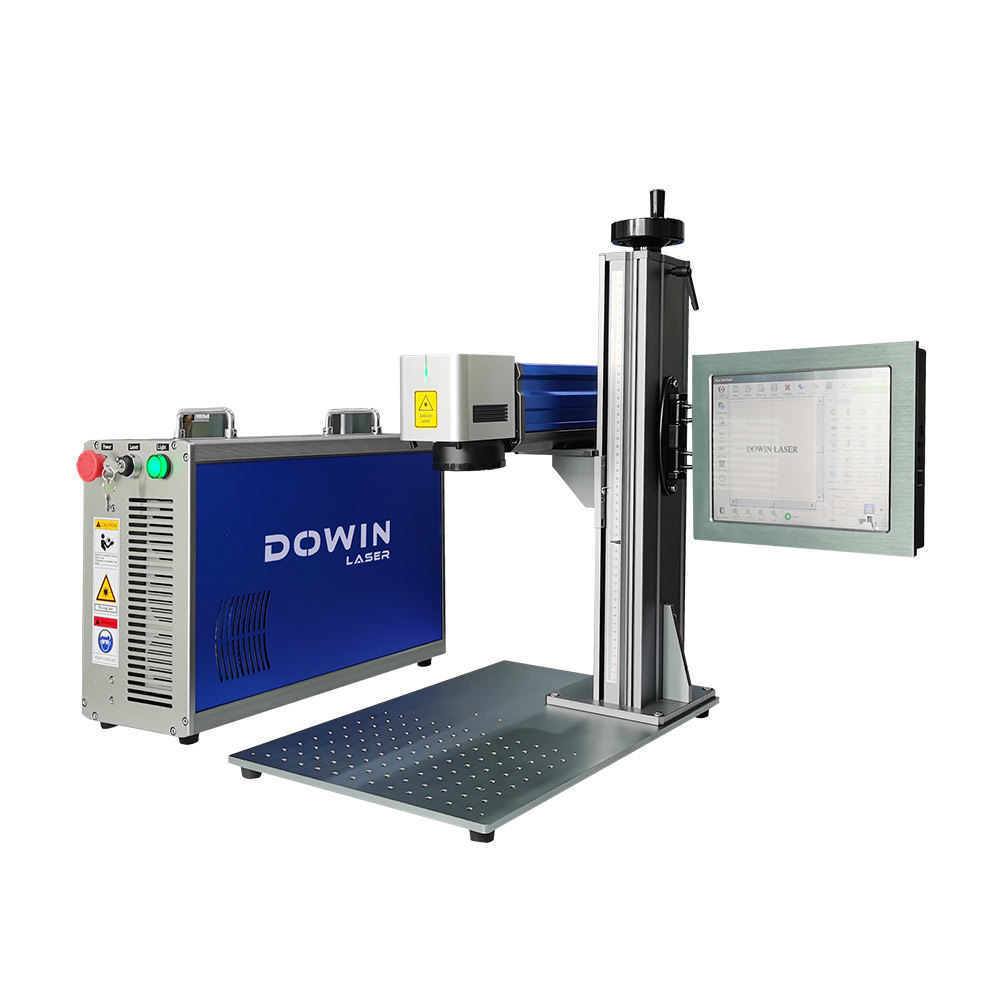
In modern manufacturing, marking is no longer a cosmetic step—it is a data layer embedded into products. Serial numbers, QR codes, traceability IDs, and branding are now essential for compliance, automation, and global supply chains.
Laser marking machines sit at the center of this transformation. But understanding them requires more than listing types—it requires understanding how energy interacts with materials.
What Laser Marking Really Does
Laser marking uses a focused beam of light to create permanent marks by changing the surface properties of a material—through oxidation, engraving, foaming, or ablation.
Unlike ink or labels, the result is:
- Permanent and wear-resistant
- Contactless and contamination-free
- Compatible with automated production lines
This is why industries like automotive, electronics, and medical devices rely heavily on it for traceability and quality control.
The Core Classification: Laser Source Defines Everything
Laser marking machines are fundamentally categorized by their laser source, which determines wavelength, energy behavior, and material compatibility.
The four dominant types are:
- Fiber laser marking machines
- CO₂ laser marking machines
- UV laser marking machines
- Green laser marking machines
Each is not just a “machine”—it is a different physics model applied to manufacturing.
1. Fiber Laser Marking Machines: The Industrial Backbone
Fiber lasers operate at around 1064 nm and are optimized for metal processing.
Where They Excel
- Stainless steel, aluminum, copper, titanium
- Industrial parts, automotive components, electronics
Why Industry Prefers Them
- Extremely long lifespan (often up to 100,000 hours)
- High speed and efficiency
- Minimal maintenance requirements
The Deeper Insight
Fiber lasers dominate because modern industry is still metal-centric.
They are not just marking tools—they are production-line assets.
2. CO₂ Laser Marking Machines: The Non-Metal Specialist
CO₂ lasers use infrared wavelengths (~10.6 μm) and are ideal for organic and non-metal materials.
Best Applications
- Wood, leather, paper, plastics, glass
- Packaging, signage, decorative products
Strengths
- Wide material compatibility for non-metals
- Strong absorption on organic surfaces
- Cost-effective for large-area marking
Limitations
- Inefficient on bare metals
- Higher energy consumption and maintenance needs
Industry Reality
CO₂ lasers power the consumer-facing side of manufacturing—branding, packaging, and visual identity.
3. UV Laser Marking Machines: Precision Without Heat
UV lasers operate at 355 nm and are known for “cold marking”—a process that minimizes thermal impact.
Ideal For
- Plastics, glass, ceramics
- Medical devices, electronics, semiconductors
Key Advantages
- Extremely fine resolution (micron-level precision)
- Minimal heat-affected zones
- No material deformation
Trade-Offs
- Slower speed
- Higher initial cost
Strategic Insight
UV lasers are not about speed—they are about perfection.
They exist because modern products are becoming smaller, more delicate, and less tolerant of heat.
4. Green Laser Marking Machines: The Niche Optimizer
Green lasers (typically 532 nm) sit between fiber and UV systems.
Where They Fit
- Reflective metals (gold, copper)
- Sensitive materials requiring moderate precision
Why They Matter
They solve edge cases where:
- Fiber lasers are too aggressive
- UV lasers are too expensive
Industry Role
Green lasers are not mainstream—but they are critical in high-value, specialized manufacturing.
Choosing the Right Type: It’s Not a Preference—It’s Physics
The correct machine depends entirely on material interaction with wavelength:
| Material Type | Best Laser Type |
|---|---|
| Metals | Fiber |
| Plastics (sensitive) | UV |
| Wood / Leather / Paper | CO₂ |
| Reflective or delicate metals | Green |
No single machine can do everything effectively because:
Different materials absorb light differently—and that defines the outcome.
The Hidden Layer: Pulse vs Continuous Technology
Beyond laser type, machines also differ in energy delivery:
- Continuous wave (CW): high speed, more heat
- Pulsed (nanosecond, picosecond, femtosecond): higher precision, less thermal damage
This adds another dimension:
The future of laser marking is not just “which laser”—
it is how precisely energy is controlled over time.
Market Evolution: Why Laser Marking Is Exploding
Global manufacturing trends are driving adoption:
- Mandatory product traceability regulations
- Growth of smart factories (Industry 4.0)
- Demand for permanent, tamper-proof identification
- Shift away from consumables (ink, labels)
Laser marking is no longer optional—it is becoming infrastructure.
Final Perspective: From Machines to Material Intelligence
Most articles describe laser marking machines as tools. That is outdated.
A better definition is:
Laser marking machines are systems that translate digital information into permanent material changes
Each type—fiber, CO₂, UV, green—is not competing.
They are complementary solutions in a multi-material world.
The companies that succeed will not ask:
“Which machine is best?”
They will ask:
“How does my material respond to energy—and how do I control it?”
Post time: Apr-15-2026
