
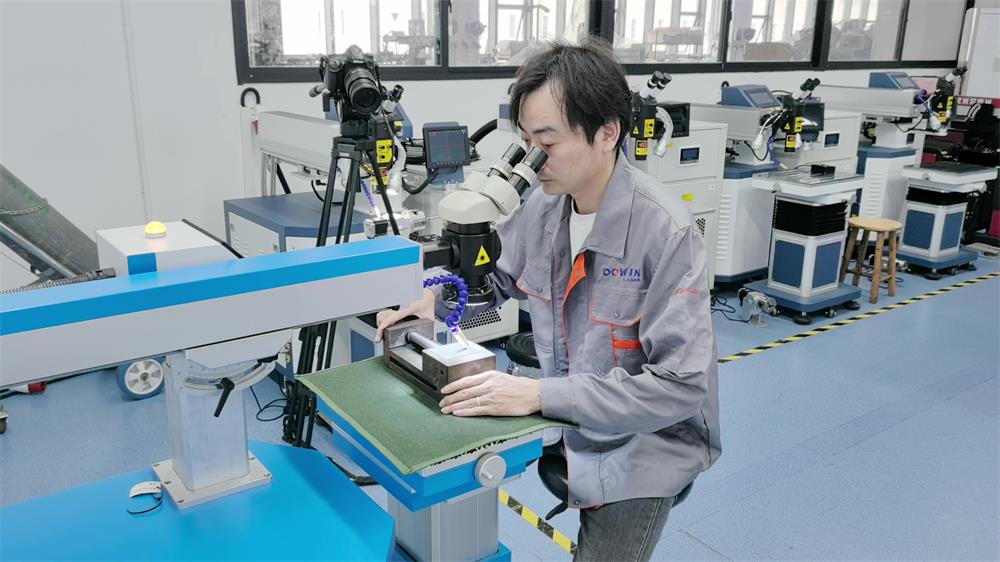
Mold laser welding has become a critical repair and modification technology for high-value tooling used in precision manufacturing. Compared with conventional welding methods such as TIG or argon arc welding, laser welding offers significantly higher accuracy, lower thermal impact, and better surface integrity. These characteristics make it especially suitable for expensive molds where dimensional precision and surface quality are essential.
1. Minimal Thermal Deformation
High-value molds are typically made from hardened tool steels and contain complex geometries. Excess heat can easily cause distortion or dimensional shifts.
Mold laser welding solves this through:
- Highly concentrated energy input
- Extremely small heat-affected zone (HAZ)
- Localized repair without heating the entire mold
This ensures the mold retains its original geometry, which is critical for precision parts production.
2. High Precision for Micro-Scale Repairs
High-value tooling often requires very fine, localized repair work, especially in cavities, edges, and detailed structures.
Laser welding enables:
- Micron-level welding control
- Repair of small cracks and wear zones
- Accurate restoration of sharp edges and contours
- Welding in hard-to-reach areas
This level of precision is difficult to achieve with traditional welding methods.
3. Strong Metallurgical Bonding
Laser welding produces a strong metallurgical bond between the filler material and the base mold steel.
Benefits include:
- High bonding strength comparable to original material
- Reduced risk of delamination or cracking
- Improved wear resistance after repair
- Stable long-term performance under production loads
This is essential for molds used in high-cycle manufacturing environments.
4. Extended Mold Service Life
High-value molds represent significant capital investment. Laser welding helps maximize return on investment by extending tool lifespan.
It allows:
- Repeated repair of worn or damaged areas
- Restoration instead of full mold replacement
- Reduction in scrap rate of expensive tooling
- Increased production uptime
This directly improves cost efficiency in manufacturing operations.
5. Reduced Downtime and Faster Repair Cycles
Traditional mold repair often requires extensive disassembly, heating, and post-processing. Laser welding significantly shortens this cycle.
Key advantages:
- On-site repair capability for some applications
- Minimal preheating requirements
- Reduced post-weld machining
- Faster return to production
This is particularly valuable for industries with tight production schedules.
6. Excellent Compatibility with Hardened Tool Steels
High-value molds are often made from materials such as H13, P20, S136, and other hardened steels.
Laser welding provides:
- Stable performance on high-hardness materials
- Controlled heat input preventing hardness loss
- Minimal cracking risk during repair
- Strong adaptability across different tool grades
This makes it suitable for a wide range of industrial tooling systems.
7. Superior Surface Quality After Repair
Surface finish is critical for molds used in injection molding, die casting, and precision forming.
Laser welding helps achieve:
- Smooth weld surfaces with minimal spatter
- Reduced need for polishing and rework
- Better consistency in cavity surfaces
- Improved final product appearance quality
This reduces downstream finishing costs and improves mold usability.
8. Cost Efficiency for High-Value Assets
Although laser welding equipment requires initial investment, it provides strong long-term cost advantages for expensive molds.
Economic benefits include:
- Lower mold replacement frequency
- Reduced outsourcing repair costs
- Lower scrap rates of damaged tooling
- Increased overall equipment utilization
For high-value tooling, repair efficiency directly impacts profitability.
9. Ideal for Precision Manufacturing Industries
Mold laser welding is widely used in industries where precision and reliability are critical:
- Automotive components
- Medical device manufacturing
- Electronics housings
- Precision connectors
- High-end consumer products
These industries rely on stable mold performance and minimal downtime.
Conclusion
Mold laser welding provides a highly precise, low-heat, and cost-effective solution for maintaining high-value tooling. Its ability to restore complex mold features, extend service life, and reduce downtime makes it an essential technology in modern precision manufacturing. As tooling complexity and cost continue to rise, laser welding will play an increasingly important role in mold maintenance and lifecycle management.
Post time: Jul-02-2026
