
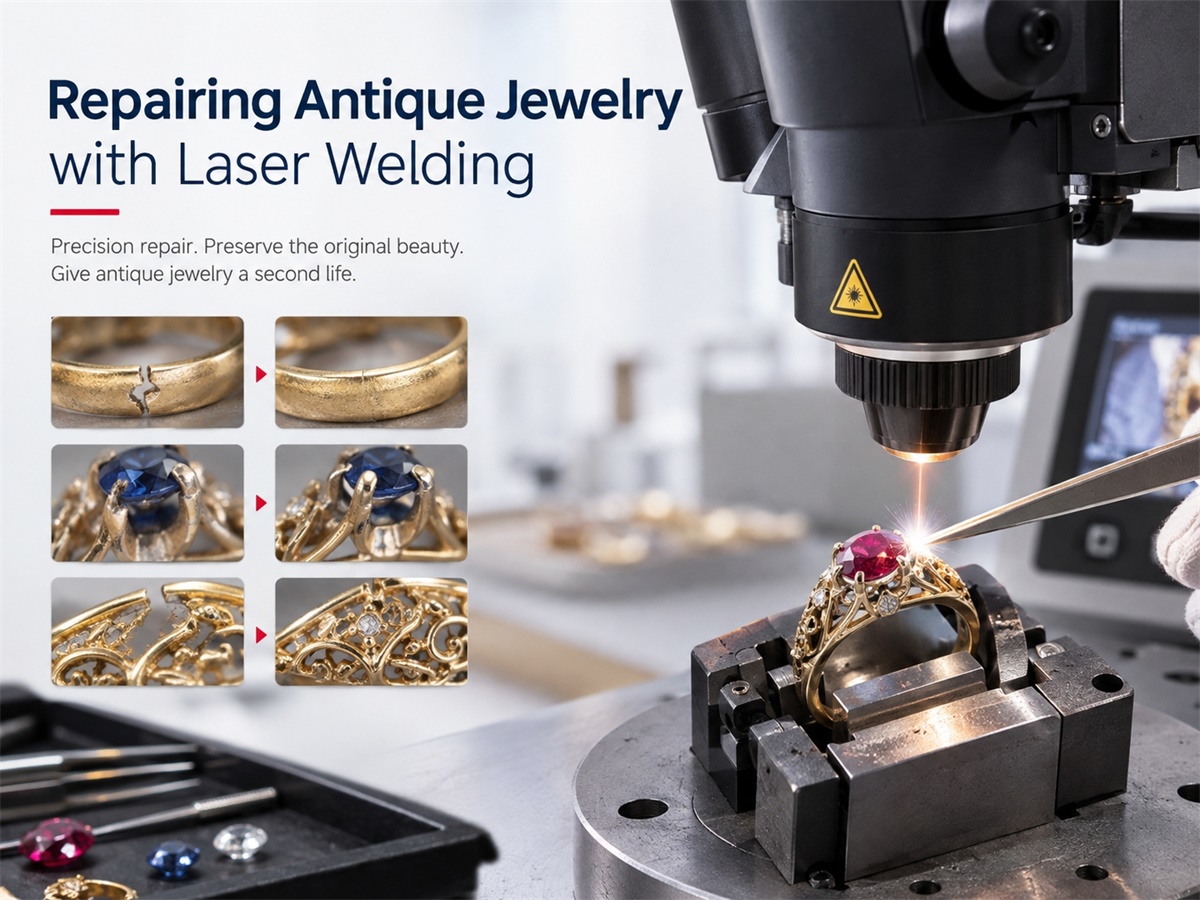
Repairing antique jewelry requires more than simply restoring a broken area. Old gold, silver, platinum, and other precious-metal jewelry can have thin sections, delicate details, worn surfaces, and areas that have already been repaired several times. Traditional soldering may introduce excessive heat and affect surrounding metal, gemstones, or fine decorative details.
Laser welding provides a more controlled method for repairing antique jewelry, allowing jewelers to apply energy precisely to the damaged area while minimizing heat transfer to the surrounding material.
Why Is Antique Jewelry Difficult to Repair?
Antique jewelry often has construction and materials that differ from modern jewelry. A piece may contain thin prongs, delicate filigree, engraved details, hollow sections, or previously repaired joints.
The metal may also have become thinner after decades of wear. Applying too much heat during conventional soldering can increase the risk of distortion, discoloration, or damage to nearby components.
For this reason, antique jewelry repair often requires a welding method that provides precise control over the working area.
How Laser Welding Helps Repair Antique Jewelry
A jewelry laser welder produces a concentrated pulse of laser energy at the repair point. The operator can adjust parameters such as laser power, pulse duration, frequency, and spot size according to the metal thickness and repair condition.
This makes laser welding useful for localized repairs such as:
-
Repairing broken rings and shanks
-
Rebuilding worn prongs
-
Repairing fine chains and links
-
Filling small cracks and holes
-
Restoring worn edges
-
Rebuilding missing metal
-
Repairing delicate filigree structures
-
Joining small broken components
Instead of heating a large area, the laser can concentrate the welding energy where the repair is required.
Repairing Thin Antique Gold Jewelry
Thin gold jewelry can be particularly challenging because excessive heat may deform the original structure. Laser welding allows the operator to work with small, controlled weld spots and gradually rebuild damaged areas.
For example, a worn ring shank can be repaired by adding compatible gold filler material layer by layer. After welding, the repaired section can be filed, polished, and finished to match the original design.
This approach is especially useful when preserving the existing shape and decorative details is important.
Laser Welding Around Gemstones
One of the major advantages of laser welding for jewelry repair is its ability to localize heat compared with conventional broad-area heating methods.
However, laser welding does not automatically make every gemstone safe from heat or laser exposure. The type of gemstone, setting, laser parameters, and distance from the welding point must all be considered.
When repairing antique jewelry containing stones, jewelers should inspect the setting carefully and use appropriate laser parameters. In some cases, removing the gemstone before welding remains the safest option.
Repairing Antique Filigree and Fine Details
Filigree jewelry contains very fine metal wires and decorative structures that can be difficult to repair using traditional soldering.
Laser welding can be used to join small broken sections or rebuild localized damage while maintaining better control over the repair area. The operator can work with a small spot and add filler metal precisely where needed.
This is particularly valuable when restoring decorative pieces where preserving the original appearance is more important than simply reconnecting the broken parts.
Can Laser Welding Repair Previously Soldered Jewelry?
Yes. Antique jewelry may have been repaired multiple times using solder. The existing solder can make further repairs more complicated because its composition and melting behavior may differ from the base metal.
Before laser welding, the repair area should be properly cleaned and inspected. The operator may need to remove contaminated or unsuitable material before adding new metal.
The welding parameters should then be adjusted according to the actual material condition rather than relying only on standard settings.
What Laser Welding Parameters Should Be Used?
There is no single laser setting that works for every antique jewelry repair. Parameters depend on:
-
Metal type
-
Metal thickness
-
Damage size
-
Joint configuration
-
Filler wire diameter
-
Distance from gemstones
-
Existing solder or previous repairs
-
Required penetration depth
For delicate antique jewelry, starting with controlled energy and gradually increasing it can help reduce unnecessary thermal damage.
A jewelry laser welder with adjustable pulse duration, frequency, and spot size gives the operator greater control over this process.
Laser Welding vs. Traditional Soldering for Antique Jewelry
Traditional soldering remains useful for many jewelry repairs, but laser welding provides another option when localized heat control is important.
Laser welding can be particularly useful when the repair is close to delicate decorative details, when only a small area needs to be rebuilt, or when the original structure must be preserved as much as possible.
The choice should depend on the jewelry construction, metal condition, repair objective, and skill of the jeweler rather than treating laser welding as a universal replacement for soldering.
Choosing a Laser Welder for Antique Jewelry Repair
For jewelry restoration work, a suitable laser welding machine should provide precise control over welding energy and a sufficiently small spot size.
A YAG pulsed laser jewelry welder is commonly used for fine jewelry repair because the operator can control pulse energy and duration for different repair conditions.
For professional antique jewelry restoration, features such as microscope viewing, precise positioning, adjustable pulse parameters, and stable laser output can make detailed repair work easier.
Final Thoughts
Antique jewelry repair requires precision because the goal is not only to fix the damaged area but also to preserve the original structure and appearance. Laser welding offers jewelers a controlled method for repairing small cracks, worn sections, broken joints, prongs, filigree, and other delicate areas.
When the correct laser parameters, filler material, and repair technique are used, laser welding can become a valuable tool for restoring antique gold, silver, and platinum jewelry while keeping the repair localized and precise.
If you regularly repair vintage or antique jewelry, a professional jewelry laser welder can provide the control needed for detailed restoration work.
Post time: Sep-30-2026
