
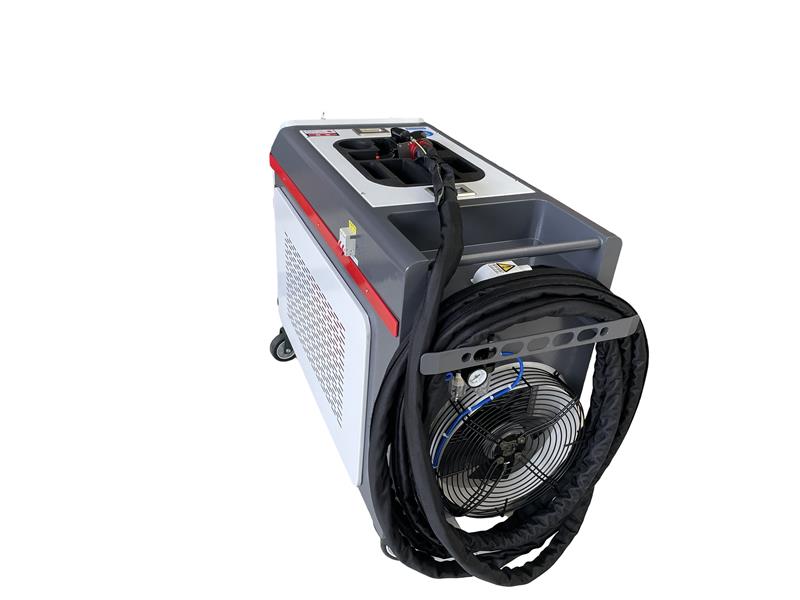
Laser cleaning is no longer a niche technology—it is rapidly replacing chemical stripping and abrasive blasting across industries from aerospace to energy. At its core, the process uses concentrated light to remove contaminants such as rust, paint, oxides, and oil without physical contact. But beneath this seemingly simple concept lies a fundamental technological split: pulsed lasers vs continuous wave (CW) lasers.
Most comparisons stop at “precision vs speed.” That’s shallow. The real difference is about how energy interacts with matter over time—and how that reshapes industrial workflows.

The Core Principle: Time Distribution of Energy
Both technologies rely on laser-material interaction, but they differ in how energy is delivered:
- Pulsed lasers release energy in ultra-short bursts (nanoseconds or less), concentrating massive peak power into micro-instant events.
- Continuous lasers deliver a steady, uninterrupted beam with stable energy output over time.
This distinction is not just technical—it defines everything: heat accumulation, precision, efficiency, and even business models.
Pulsed Laser Cleaning: Precision as a Strategy
Pulsed systems are often described as “cold processing,” but that phrase undersells their significance.
Because energy is delivered in bursts, heat has little time to diffuse into the base material. The result is:
- Minimal thermal damage
- Controlled material removal at micro-scale
- High selectivity (removes contaminants, not substrate)
Where Pulsed Technology Wins
- Aerospace components and high-value alloys
- Mold and precision tooling maintenance
- Cultural heritage restoration
- Pre-weld surface conditioning for critical joints
The Hidden Trade-Off
Precision comes at a cost:
- Lower throughput compared to CW systems
- Higher system complexity
- Greater dependence on parameter tuning
From an industry perspective, pulsed cleaning is not just a tool—it is a risk-control mechanism. When the cost of damage exceeds the cost of time, pulsed becomes inevitable.
Continuous Laser Cleaning: Industrial Throughput Engine
Continuous wave lasers take the opposite approach: flood the surface with energy and remove material fast.
Their characteristics include:
- Constant energy delivery
- Faster coverage rates
- Higher heat input to the substrate
Where CW Technology Dominates
- Ship hull rust removal
- Steel structure maintenance
- Heavy paint stripping
- Pipeline and infrastructure cleaning
In large-scale industrial environments, time is money. CW systems can achieve 30–50% higher efficiency in comparable conditions, making them the preferred choice for bulk processing.
The Real Limitation
Heat is both the strength and the weakness:
- Risk of substrate deformation
- Not suitable for thin or heat-sensitive materials
- Lower precision in complex geometries
CW lasers are not “less advanced”—they are optimized for industrial velocity, not delicacy.
The Industry Reality: It’s Not Either/Or
A common misconception is that pulsed and continuous lasers compete. In reality, they are complementary tools shaped by application economics.
Decision Drivers (Not Power Ratings)
The choice depends on:
- Material sensitivity
- Contaminant thickness
- Surface geometry
- Required throughput
- Cost of potential damage
Power alone is misleading. What matters is energy distribution over time, which directly controls thermal behavior and cleaning dynamics.
Breaking the Conventional Thinking
Here’s the overlooked shift happening in the industry:
1. Hybridization Is the Future
Modern systems increasingly integrate adjustable modes, allowing operators to switch between pulsed-like precision and CW-like efficiency. The rigid distinction is dissolving.
2. Data-Driven Cleaning Is Emerging
With AI-assisted parameter optimization, machines are beginning to “learn” optimal pulse frequency, scan speed, and energy density for different materials. This reduces the skill barrier.
3. Application Defines Technology—Not the Other Way Around
The old approach: choose a machine, then adapt the process.
The new approach: analyze the material ecosystem first, then configure the laser behavior accordingly.
Strategic Conclusion
- Pulsed laser cleaning = precision, control, minimal damage
- Continuous laser cleaning = speed, scale, industrial efficiency
But the deeper truth is this:
The real competition is not between pulsed and continuous lasers—it is between static equipment thinking and adaptive process thinking.
Companies that understand this shift will not just clean surfaces better—they will redesign entire production chains around laser-material interaction.
That is where the real advantage lies.
Post time: Apr-16-2026
