
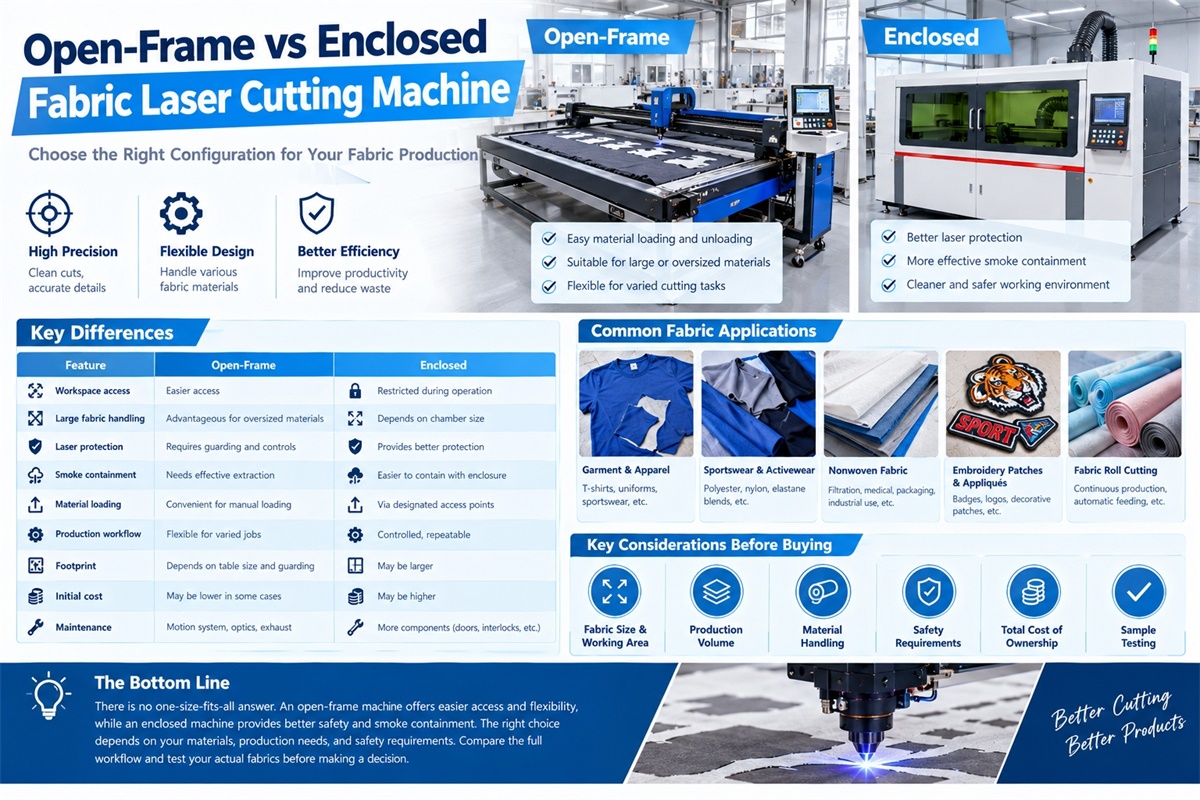
Choosing between an open-frame and an enclosed fabric laser cutting machine is an important decision for textile manufacturers. Both machine types can cut fabric with a CO2 laser, but they differ in safety design, material handling, workspace accessibility, smoke extraction, and suitability for different production environments.
For businesses cutting garments, sportswear, nonwoven textiles, embroidery appliqués, and other fabric products, the right configuration depends on production volume, fabric dimensions, factory layout, and operator requirements.
In this guide, we compare open-frame and enclosed fabric laser cutting machines, explain their advantages and limitations, and help you determine which configuration is better for your textile production line.
1. What Is an Open-Frame Fabric Laser Cutting Machine?
An open-frame fabric laser cutting machine has an exposed or partially exposed cutting area rather than a fully enclosed cutting chamber. Depending on the model, it may feature a gantry structure, an accessible cutting table, and an external exhaust system.
This design allows operators to load, position, and remove fabric relatively easily. It can be convenient when processing large textile sheets, irregularly shaped materials, or jobs that require frequent manual intervention.
Main Advantages
Easy material loading and unloading
The accessible workspace can simplify handling for large fabric pieces and materials that are difficult to feed through a confined chamber.
Convenient for oversized materials
Some open-frame configurations accommodate wide or long textile materials that would be difficult to handle inside a smaller enclosed machine.
Flexible production setup
Operators can access the cutting area directly for material positioning, inspection, and certain maintenance tasks, provided the machine is in a safe state.
Suitable for varied cutting tasks
Open-frame systems can be useful for manufacturers processing different fabric types, dimensions, and cutting patterns throughout the day.
Main Limitations
An open-frame design can expose operators and nearby workers to greater risks if the laser processing area is not adequately guarded. It may also allow smoke and airborne residues to escape more easily if extraction and enclosure measures are inadequate.
Open-frame machines should not be assumed to be safe for unrestricted operation. The actual safety level depends on the laser class, guarding, interlocks, operating procedures, and applicable regulations.
2. What Is an Enclosed Fabric Laser Cutting Machine?
An enclosed fabric laser cutting machine places the laser processing area inside a protective housing. Depending on its design, the enclosure may include interlocked access doors, viewing windows rated for the laser wavelength, and integrated smoke extraction.
This configuration is commonly selected when manufacturers want a more contained processing environment and a clearly defined operator workspace.
Main Advantages
Improved laser protection
A properly designed enclosure can reduce the risk of direct or reflected laser exposure. Protection depends on the enclosure’s certified performance, viewing-window specifications, and functioning safety interlocks.
Better smoke containment
When connected to a suitable extraction system, an enclosure can help capture smoke and airborne residues generated during textile cutting.
Cleaner production environment
Effective containment and extraction can reduce the spread of smoke and residue around the machine.
More controlled operation
Enclosed systems can provide a defined processing area, making them suitable for standardized production workflows and facilities with formal operating procedures.
Main Limitations
Restricted access during operation
Operators generally cannot access the cutting chamber while the laser is operating if access doors are interlocked as intended. This may require changes to material handling procedures.
Working-area limitations
The enclosure dimensions determine the maximum practical material size. Large textile sheets or continuous rolls may require a larger chamber or a specialized feeding system.
Potentially higher initial cost
Enclosures, interlocks, viewing windows, and integrated extraction features may increase the purchase price, although actual costs vary by manufacturer and configuration.
Additional maintenance requirements
Doors, interlocks, seals, viewing windows, and extraction components need regular inspection to ensure they continue to function correctly.
3. Open-Frame vs Enclosed Fabric Laser Cutting Machine: Key Differences
The following table summarizes the main differences buyers should consider.
| Feature | Open-frame machine | Enclosed machine |
|---|---|---|
| Workspace access | Generally easier to access | Access is restricted during laser operation |
| Large fabric handling | Can be advantageous for oversized materials | Depends on chamber size and feeding design |
| Laser protection | Requires appropriate guarding and access controls | Enclosure can provide more comprehensive protection when properly designed |
| Smoke containment | Requires effective extraction and suitable guarding | Often easier to contain smoke with integrated extraction |
| Material loading | Convenient for some manual-loading tasks | May require loading through designated access points |
| Production workflow | Flexible for varied jobs | Well suited to controlled, repeatable workflows |
| Footprint | Depends on table size and guarding | Enclosure may increase overall machine dimensions |
| Initial cost | May be lower in some configurations | May be higher due to enclosure and safety features |
| Maintenance | Motion system, optics, guarding, and exhaust | Motion system, optics, enclosure, interlocks, and exhaust |
Neither design is automatically better for every application. The comparison should focus on the actual machine configuration rather than the product label alone.
4. Which Machine Is Better for Different Fabric Applications?
Garment and Apparel Cutting
For garment production, material handling and cutting consistency are important. An open-frame machine may be convenient for loading large fabric pieces, while an enclosed machine may be preferable when smoke containment and controlled operator access are priorities.
For cutting long fabric rolls, consider a machine with a compatible automatic feeding system rather than selecting equipment based only on whether the frame is open or enclosed.
Sportswear and Activewear
Sportswear often uses polyester, elastane blends, nylon, and other synthetic textiles.
A suitable laser configuration can produce detailed shapes and sealed edges on compatible thermoplastic materials. However, excessive heat may cause melting, discoloration, or distortion.
Both open-frame and enclosed machines can be suitable if their laser parameters, motion systems, material support, and extraction arrangements match the application.
Nonwoven Fabric
Nonwoven materials are used in filtration products, medical-related textiles, packaging, insulation, and industrial applications.
Different nonwoven constructions behave differently under laser heat. Manufacturers should test the actual material and check for melting, charring, residue, and hazardous emissions.
An enclosed machine can help contain smoke when properly designed and connected to suitable extraction, but enclosure alone does not guarantee adequate ventilation.
Embroidery Patches and Appliqués
Embroidered patches often have complex outlines and may include multiple layers of fabric, thread, and adhesive backing.
An open-frame machine may simplify access for positioning individual pieces. An enclosed machine may offer advantages for controlled processing and smoke containment.
For heat-sensitive backings or thick embroidered materials, test whether laser cutting produces acceptable edges before investing in either configuration.
Automatic Fabric Roll Cutting
For continuous production, the most important factors may be roll width, feeding stability, cutting area, motion accuracy, and the ability to handle fabric without wrinkles.
Some systems combine a gantry-style structure with automatic feeding and additional guarding. Therefore, buyers should evaluate the complete production system rather than assuming that an open-frame or enclosed design determines roll-handling capability.
Manufacturers considering continuous textile processing can review Dowin’s fabric auto-feeding laser cutting machine range when comparing working areas and feeding configurations.
5. Safety: Is an Enclosed Fabric Laser Cutting Machine Always Safer?
An enclosed machine can offer important safety advantages, but only when the enclosure is designed and maintained to provide the required protection.
For laser fabric cutting, buyers should verify the following:
-
The machine’s laser classification and documented safety specifications.
-
Whether the enclosure and viewing windows are rated for the laser wavelength and power.
-
Whether access doors have appropriate safety interlocks.
-
Whether the laser stops as intended when a protective access point is opened.
-
Whether exhaust ventilation captures smoke and residues effectively.
-
Whether the equipment meets the safety requirements applicable in the installation country.
An open-frame machine may also be engineered with suitable guarding and safety controls. However, an exposed cutting area can make it more difficult to provide the same level of containment and protection.
Operators should never bypass safety interlocks or operate a machine with missing protective components.
6. Smoke Extraction and Air Quality
Fabric laser cutting produces smoke and airborne residues that vary according to fiber composition, dyes, coatings, and finishing chemicals.
Effective extraction is necessary for both open-frame and enclosed machines.
With an open-frame design, the extraction system may need to capture emissions from a more exposed cutting zone. An enclosed machine can make containment easier, but its extraction performance still depends on airflow, duct design, filter condition, and the way air moves through the chamber.
Before purchasing, ask the supplier about:
-
Recommended extraction airflow for the intended material.
-
Filter specifications and replacement intervals.
-
Exhaust duct requirements.
-
Maintenance access.
-
Compatibility with the specific textiles and coatings being processed.
Do not assume that all fabric is safe to laser cut. For example, PVC-containing materials must not be laser cut because heating them can release highly hazardous corrosive gases.
7. How to Choose the Right Machine for Your Factory
Instead of choosing a machine based on its frame design alone, evaluate these six factors.
1. Fabric Size and Working Area
Measure the maximum fabric width and length used in normal production. Allow for material positioning, cutting layouts, and any feeding equipment.
2. Production Volume
For small batches and frequent design changes, convenient access may be valuable. For repeat production, a controlled workflow and compatible automation may matter more.
3. Material Handling
Determine whether you process individual sheets, stacked layers, or continuous rolls. Confirm that the machine supports the intended feeding method.
4. Safety Requirements
Review the requirements for your facility and destination market. Consider laser protection, operator access, extraction, and applicable machinery safety standards.
5. Total Cost of Ownership
Compare the purchase price alongside installation, ventilation, filtration, maintenance, energy use, labor, and expected production output.
6. Sample Testing
Ask the supplier to cut your actual fabric samples. Inspect edge quality, cutting accuracy, material deformation, smoke residue, and processing time.
Testing is particularly important for coated fabrics, synthetic blends, multilayer textiles, and heat-sensitive materials.
8. Common Buying Mistakes to Avoid
Choosing an open-frame machine only because it costs less. The initial price may not include the guarding, extraction, or other safety measures needed for the intended installation.
Assuming every enclosed machine has effective extraction. Verify airflow and filtration specifications rather than relying on the presence of an enclosure.
Ignoring the maximum material dimensions. A machine may have sufficient laser power but an unsuitable cutting area or feeding arrangement.
Overlooking maintenance access. Filters, optical components, interlocks, and moving parts must be inspected and maintained.
Comparing laser power instead of actual results. Higher power does not automatically deliver better fabric cutting quality. Speed, focus, material properties, and machine motion also matter.
Failing to test the production material. A successful demonstration on one fabric does not guarantee the same performance on another.
Conclusion
The choice between an open-frame and an enclosed fabric laser cutting machine depends on material handling, production volume, workspace requirements, and safety priorities.
An open-frame configuration may offer convenient access for large materials and varied manual operations. An enclosed configuration can provide better laser protection and smoke containment when its enclosure, interlocks, and extraction system are properly designed.
For textile manufacturers, the most effective approach is to select a machine based on the complete production workflow rather than frame style alone. Compare working area, feeding options, safety specifications, exhaust performance, and actual cutting results before making a purchasing decision.
Frequently Asked Questions
1. What is the main difference between open-frame and enclosed fabric laser cutting machines?
An open-frame machine offers easier access to the cutting area, while an enclosed machine surrounds the processing area with protective housing. Their practical differences depend on guarding, feeding design, working area, and extraction performance.
2. Is an enclosed fabric laser cutting machine better for industrial production?
It can be a good choice when laser protection, smoke containment, and controlled operation are priorities. However, the correct machine also depends on material size, production volume, and automation requirements.
3. Can an open-frame fabric laser cutting machine cut large fabric rolls?
Some configurations can accommodate large materials or automatic feeding systems. Confirm the working width, feeding arrangement, guarding, and extraction requirements for the specific model.
4. Which machine is better for cutting polyester fabric?
Both configurations can cut compatible polyester fabrics. The choice depends more on the cutting parameters, material handling, safety design, and extraction system than on the frame style alone.
5. Does an enclosed laser cutting machine eliminate smoke?
No. An enclosure can help contain smoke, but an appropriately designed extraction and filtration system is still required. Performance depends on airflow, ducting, filters, and the material being processed.
6. What should I check before buying a fabric laser cutting machine?
Check the working area, laser specifications, motion accuracy, material feeding, safety controls, exhaust system, software, maintenance requirements, and cutting results on your actual production materials.
Post time: Oct-23-2026
