
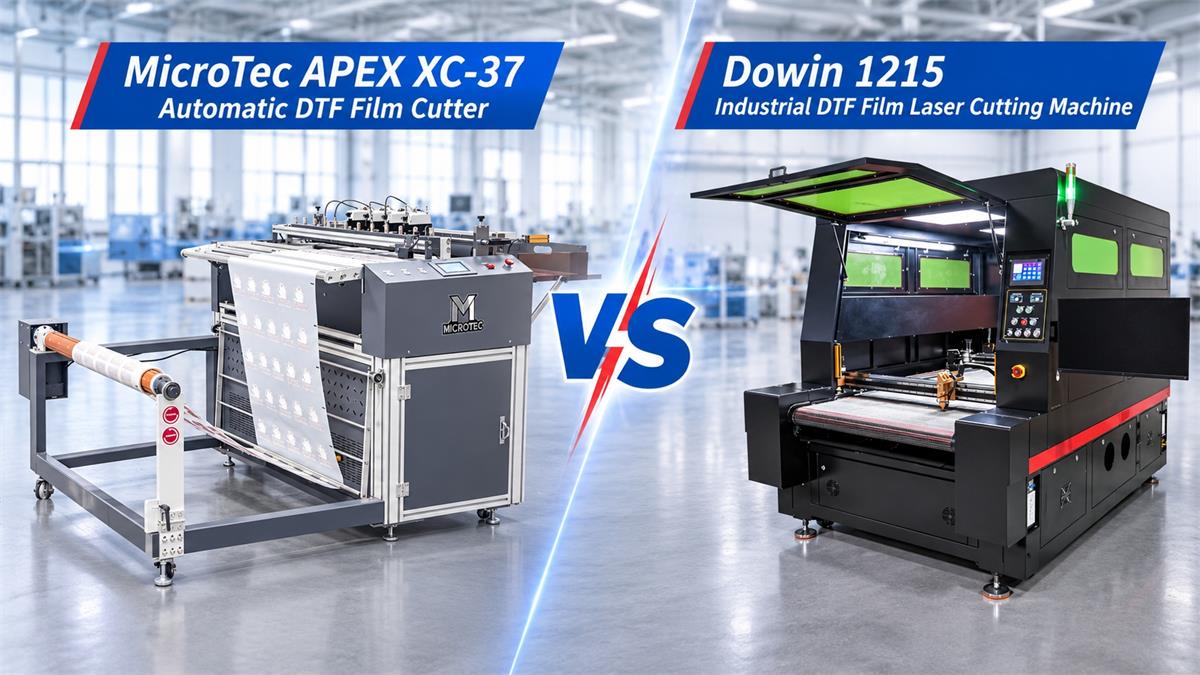
When DTF printing production increases, cutting printed transfer film manually can quickly become a bottleneck. The MicroTec APEX XC-37 uses a pneumatic knife system for automatic roll cross-cutting, while industrial solutions such as the Dowin 1215 Industrial DTF Film Laser Cutting Machine use CO2 laser technology and CCD vision positioning to cut printed contours. Both machines automate DTF finishing, but they solve different production problems.
In this comparison, we examine their cutting technologies, automation capabilities, production applications, and suitability for commercial DTF printing businesses.
1. MicroTec APEX XC-37: Automatic Knife Cutting
The MicroTec APEX XC-37 is an automatic DTF film cutting system designed for wide-format roll production. Its pneumatic knife system cuts film into sections, reducing manual handling and improving production efficiency.
Its main features include:
- Automatic roll feeding.
- Pneumatic knife cutting system.
- Wide-format film handling.
- PLC control system.
- Automatic cutting for continuous roll production.
The XC-37 is particularly suitable for DTF printing businesses producing large quantities of standard transfer sheets or gang sheets.
Its main advantage is straightforward: it automates repetitive cross-cutting work. However, knife-based cross-cutting and laser contour cutting are different processes. If your orders involve irregular shapes, individual graphics, labels, or complex printed outlines, you need to evaluate whether a cross-cutting machine can meet those requirements.
2. Industrial DTF Film Cutter: Laser Cutting and CCD Recognition
An industrial DTF laser cutter is designed for more flexible cutting requirements. Instead of relying on a mechanical blade, it uses a focused CO2 laser beam to cut flexible film without direct mechanical pressure.
For example, the Dowin 1215 DTF and TPU Film Laser Cutting Machine combines automatic feeding, CCD camera positioning, and a dual-head 160W CO2 laser configuration.
Its main features include:
- 1200 × 1500 mm working area.
- Dual-head 160W CO2 laser configuration.
- CCD camera positioning and printed contour recognition.
- Automatic feeding for continuous production.
- Servo motor drive system.
- Non-contact laser cutting.
- Suitable configurations for DTF film, TPU film, UV stickers, crystal labels, and other flexible materials.
The biggest difference is cutting flexibility. CCD positioning allows the machine to identify printed patterns and follow their contours, rather than simply cutting the roll into predetermined sections.
This is particularly useful for manufacturers producing different graphic shapes, customized transfers, labels, and other printed products.
3. MicroTec XC-37 vs. Industrial Laser DTF Cutter
The following comparison highlights the main differences between the two cutting technologies.
| Comparison | MicroTec APEX XC-37 | Industrial DTF Laser Cutter |
|---|---|---|
| Cutting technology | Pneumatic knife | CO2 laser |
| Main operation | Roll cross-cutting | Contour cutting |
| Material feeding | Automatic | Automatic, model-dependent |
| Pattern recognition | Registration alignment, depending on configuration | CCD visual recognition |
| Cutting method | Mechanical contact | Non-contact |
| Irregular shapes | Depends on configured cutting process | Suitable for programmed contours |
| DTF film | Yes | Yes, subject to material testing |
| TPU film | Confirm material compatibility | Suitable configurations available |
| Additional applications | Film and paper cross-cutting | UV stickers, labels, TPU and other suitable materials |
| Best suited for | Repetitive roll cross-cutting | Flexible, customized cutting production |
One important point: these machines should not be compared only by their advertised cutting speed. Their cutting methods, finished output, and production workflows are different.
A machine that cuts rolls quickly may not necessarily be the best solution for a factory handling many different graphic shapes.
4. Which Machine Is Better for Your DTF Production?
The right choice depends on how your business handles printed film.
Choose the MicroTec APEX XC-37 if:
- Your main production task is cutting wide DTF rolls into standard sections.
- You operate several DTF printers and need a centralized cutting station.
- Your orders mainly involve repetitive roll-to-sheet cutting.
- You prefer a pneumatic knife system for straightforward cross-cutting.
Consider an Industrial Laser DTF Cutter if:
- You frequently process customized graphics and irregular shapes.
- You need CCD recognition to identify printed contours.
- You produce DTF transfers, TPU products, UV stickers, or labels.
- You want to reduce manual alignment and cutting operations.
- Your production requires more flexible cutting patterns.
For growing DTF printing factories, flexibility can be just as important as cutting speed. A cutting system that handles different orders without extensive manual intervention can make production scheduling easier.
5. Why Cutting Technology Matters as Your Business Grows
Many DTF businesses initially use manual cutters because their production volume is manageable. However, as orders increase, several problems become more noticeable.
Labor Costs Increase
Operators must spend considerable time separating printed films, measuring cutting positions, and handling finished transfers.
Different Orders Require Different Cutting Patterns
Standard cross-cutting works well for repetitive jobs, but customized designs may require additional cutting operations.
Film Alignment Affects Finished Quality
Printed graphics need to be positioned accurately during cutting. Manual positioning becomes more difficult when processing long rolls or multiple designs.
Production Bottlenecks Affect Delivery Time
A fast DTF printer cannot deliver its full production potential if the cutting department cannot process the output efficiently.
This is why choosing the correct cutting technology is an important part of building an efficient DTF production line.
6. Dowin 1215 Industrial DTF Laser Cutting Solution
For businesses looking beyond basic roll cross-cutting, Dowin offers the 1215 automatic feeding CO2 laser cutting machine.
Its dual-head laser configuration and industrial CCD positioning system are designed for processing printed DTF film and other suitable flexible materials.
The 1200 × 1500 mm working area supports larger layouts, while the servo-driven motion system provides stable movement during cutting.
Besides DTF transfer film, the machine can also process suitable TPU films, UV stickers, crystal labels, wash-care labels, and other customized products.
For manufacturers who want one cutting platform to handle multiple types of orders, this flexibility is worth considering.
Learn more about the Dowin 1215 Automatic DTF and TPU Film Laser Cutting Machine.
Frequently Asked Questions
1. What is the main difference between the MicroTec XC-37 and a laser DTF cutter?
The XC-37 uses a pneumatic knife for automatic cross-cutting, while an industrial laser DTF cutter uses a CO2 laser to process programmed cutting paths and printed contours.
2. Can the MicroTec XC-37 cut irregular DTF graphics?
The XC-37 is primarily designed for automatic roll cross-cutting. Buyers should confirm its actual cutting configuration and whether it supports their required individual graphic shapes before purchasing.
3. Can a laser DTF cutter recognize printed patterns automatically?
Yes. Models equipped with CCD vision positioning can recognize printed graphics and use the detected contours as cutting references. Actual positioning performance depends on the printed material, registration conditions, and machine configuration.
4. Can a laser DTF cutter process TPU film?
Yes. Suitable CO2 laser configurations can process TPU film. However, TPU formulations and thicknesses vary, so sample testing is recommended before production.
5. Is laser cutting suitable for high-volume DTF production?
Yes. Industrial dual-head laser systems with automatic feeding and CCD positioning can support continuous production. Actual output depends on cutting paths, graphic layouts, material properties, and operating parameters.
6. Should I choose a knife cutter or a laser cutter for my DTF factory?
If your primary requirement is repetitive cross-cutting of wide film rolls, a pneumatic knife cutter may be sufficient. If you need printed contour recognition, irregular graphic cutting, and multiple material applications, an industrial laser cutter is worth evaluating.
Final Thoughts
The MicroTec APEX XC-37 and industrial laser DTF cutters are designed for different cutting requirements.
The XC-37 focuses on automating repetitive roll cross-cutting, while an industrial laser cutter provides greater flexibility for contour-based cutting and customized production.
Before investing, evaluate your actual film width, cutting patterns, daily output, material range, and future production plans. The best machine is the one that fits your entire finishing workflow, not simply the one with the highest advertised speed.
Post time: Nov-10-2026
