
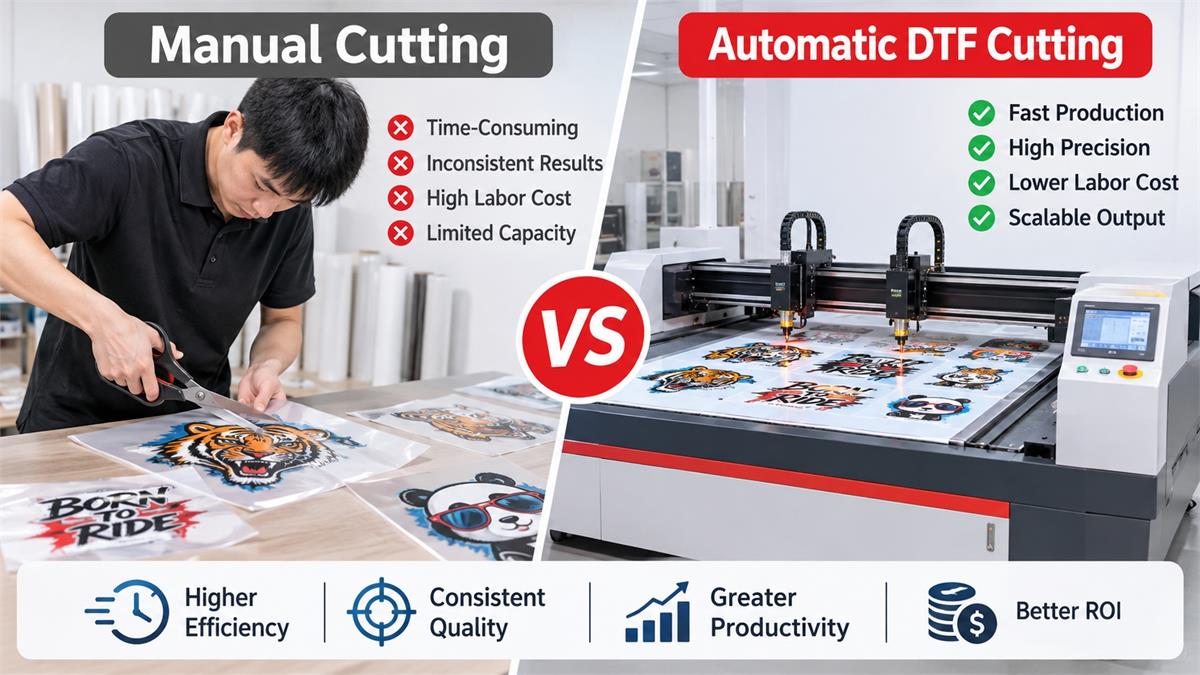
As DTF printing businesses grow, cutting printed PET film becomes an increasingly important part of daily production. Many small print shops start with manual cutting because it requires little investment. However, when order volumes increase, manual cutting can quickly become a bottleneck, increasing labor costs, slowing delivery, and creating inconsistent cutting results.
For businesses handling regular DTF orders, an automatic DTF film cutting machine can offer a more efficient production solution. But is the investment worthwhile? Let’s compare manual and automatic cutting from the perspectives of equipment costs, labor, productivity, cutting accuracy, and long-term business growth.
1. Manual DTF Film Cutting: Low Initial Cost, Higher Labor Requirements
Manual DTF film cutting is a common choice for small workshops and businesses just entering the transfer printing industry. Operators typically use scissors, utility knives, rulers, or other basic cutting tools to separate printed designs.
The biggest advantage is the low initial investment. There is no need to purchase specialized cutting equipment, install additional software, or change the existing production workflow.
However, manual cutting depends heavily on operator experience and attention.
- Labor intensive: Operators must spend considerable time cutting individual designs or batches of transfers.
- Inconsistent accuracy: Cutting quality depends on the operator’s skills, especially when handling complicated shapes.
- Limited production capacity: As order quantities increase, manual cutting becomes difficult to keep up with printing output.
- Higher labor costs: Businesses may need additional workers to handle cutting during busy periods.
- Human errors: Uneven edges, incorrect cutting positions, and damaged designs can result in material waste.
Manual cutting is still practical for occasional orders, simple designs, and very small production volumes. The problem starts when a business needs to process hundreds or thousands of transfers consistently.
2. Automatic DTF Film Cutting: Faster and More Consistent Production
Automatic DTF film cutting systems are designed to reduce manual operations and improve the efficiency of transfer production. Depending on the machine configuration, features can include automatic material feeding, CCD vision positioning, dual laser heads, and continuous cutting workflows.
For example, Dowin’s 9070 automatic DTF and TPU film laser cutting machine uses CO2 laser cutting technology and a dual-head configuration. It is designed for cutting printed PET and TPU film, particularly when businesses need to process batches of different shapes and patterns.
Compared with manual cutting, automatic systems provide several practical advantages:
- Reduced manual work: Automatic feeding and cutting reduce repetitive handling by operators.
- Consistent cutting: Laser cutting follows programmed paths, helping maintain repeatable cutting results.
- Complex pattern processing: Laser technology can follow irregular outlines and detailed designs that are time-consuming to cut manually.
- Improved production flow: Cutting can become a more integrated stage of the DTF transfer production process.
- Better labor allocation: One operator can focus on machine supervision and other production tasks instead of manually cutting every transfer.
The key advantage is not simply cutting faster. It is reducing the amount of repetitive manual work required for each order.
3. Manual vs. Automatic DTF Cutting: Direct Comparison
| Comparison | Manual Cutting | Automatic Laser Cutting |
|---|---|---|
| Initial investment | Very low | Higher equipment investment |
| Labor requirements | High | Reduced manual involvement |
| Cutting consistency | Depends on operator skills | Repeatable programmed cutting |
| Complex patterns | Time-consuming | Suitable for intricate cutting paths |
| Batch production | Limited by manual handling | More suitable for continuous production |
| Production scalability | Requires more labor as orders grow | Can increase output with less additional manual work |
| Material waste | Potential errors from manual cutting | More controlled cutting paths, depending on layout and settings |
For businesses with low production volumes, manual cutting may remain the economical option. For print shops processing regular bulk orders, automatic cutting can provide better long-term production efficiency.
4. How Much Can Automatic DTF Cutting Save in Labor Costs?
Labor cost is one of the most important factors when deciding whether to invest in an automatic cutting machine.
Consider a print shop that processes 500 transfer designs per day. If each design requires manual positioning, cutting, and handling, the total working hours can become substantial.
With automatic cutting, repetitive cutting operations can be reduced. Operators mainly handle material preparation, machine monitoring, and finished-product collection, depending on the feeding and unloading configuration.
To evaluate the investment, consider these costs:
- Monthly wages for employees responsible for manual cutting.
- Additional labor required during peak production periods.
- Material waste caused by cutting mistakes.
- Production delays caused by cutting bottlenecks.
- Equipment maintenance and electricity costs for automatic systems.
A simple calculation can help determine the payback period:
Monthly labor savings = Labor costs before automation − Labor costs after automation
Estimated payback period = Machine investment ÷ Monthly net savings
For example, if automation reduces monthly operating expenses by $1,000 and the equipment investment is $12,000, the simple payback period would be approximately 12 months. This is only an illustrative calculation; actual results depend on production volume, local wages, machine utilization, and operating costs.
5. Cutting Quality: Why Automation Matters for Complex DTF Designs
Cutting quality becomes particularly important when DTF print shops handle irregular logos, small lettering, detailed graphics, and customized transfer orders.
With manual cutting, operators must follow the design outline themselves. Even experienced workers can produce inconsistent edges when processing large quantities.
Automatic laser cutting uses programmed cutting paths and, where equipped, vision positioning to help locate printed patterns. This is particularly useful for businesses producing different designs in the same batch.
However, machine configuration matters. Buyers should check whether the system supports their actual film width, design positioning requirements, cutting speed, and material thickness. They should also test whether the laser parameters are suitable for their specific PET or TPU film to avoid unwanted melting or edge damage.
6. Which Automatic DTF Film Cutting Machine Should You Choose?
Not every DTF print shop needs the same cutting system. The right machine depends on production volume, film size, design complexity, and available factory space.
Dowin 9070 Automatic DTF Film Laser Cutter
For businesses looking to automate PET and TPU film cutting, the Dowin 9070 DTF laser cutting machine is a practical option to consider.
Its dual-head CO2 laser configuration and automatic feeding system are designed to improve batch cutting efficiency. It is suitable for print shops that regularly process multiple DTF designs and want to reduce repetitive manual cutting operations.
Dowin 1215 Automatic DTF and TPU Film Laser Cutting Machine
For businesses requiring a larger working area and vision-based positioning, the Dowin 1215 DTF and TPU film laser cutting machine offers a 1200 × 1500 mm working area, dual 160W CO2 laser heads, CCD vision positioning, and automatic feeding.
It is worth considering for commercial production environments that process different transfer designs and need a larger cutting workspace.
7. When Should You Upgrade from Manual to Automatic Cutting?
There is no universal production-volume threshold for automation. However, several signs indicate that manual cutting is becoming a business limitation:
- Your printing equipment produces more transfers than workers can cut manually.
- You regularly receive bulk orders with tight delivery deadlines.
- You need to hire additional employees just to handle cutting.
- Manual cutting mistakes are causing material waste or customer complaints.
- Your business is expanding into customized designs and more complicated cutting patterns.
If several of these situations apply, investing in automatic DTF film cutting equipment may be more economical than continuously increasing your workforce.
Conclusion: Is Automatic DTF Film Cutting Worth the Investment?
Manual cutting remains a reasonable solution for small-scale DTF businesses with occasional orders and limited production requirements. Its low initial cost makes it accessible to new print shops.
However, as production volume increases, labor costs, inconsistent cutting, and limited processing capacity can become serious problems. Automatic DTF film cutting helps businesses reduce repetitive work, improve cutting consistency, and build a more scalable production workflow.
For commercial DTF print shops planning to increase production capacity, exploring an automatic laser cutting solution such as the Dowin 9070 or 1215 is a worthwhile step.
Looking for an automatic DTF film cutting solution? Contact Dowin with your film width, material type, daily production volume, and sample designs. Our team can help evaluate the suitable machine configuration and cutting parameters for your production requirements.
Frequently Asked Questions
1. Is manual DTF film cutting suitable for commercial production?
Yes, but it is more suitable for small production volumes or businesses handling occasional orders. For regular bulk production, manual cutting may require considerable labor and limit production efficiency.
2. Does an automatic DTF cutter reduce labor costs?
Yes. Automatic feeding and programmed cutting can reduce repetitive manual operations. Actual labor savings depend on machine configuration, production volume, and how the rest of the production workflow is organized.
3. Can a laser cutting machine cut both PET and TPU film?
Suitable CO2 laser cutting systems can process both PET and TPU film. However, cutting parameters should be adjusted according to the material composition and thickness. Sample testing is recommended before production.
4. Is automatic laser cutting better than manual cutting for complex designs?
Generally, yes. Programmed laser cutting can follow intricate outlines and repeat the same cutting paths consistently, reducing the time and skill required for manual cutting.
5. What film width should I consider when buying an automatic DTF cutter?
Many DTF production businesses work with film widths between 30 and 90 cm. Before purchasing, confirm the machine’s compatible feeding width and effective cutting area, rather than relying only on its model name or external dimensions.
6. How do I calculate the return on investment of an automatic DTF cutter?
Compare your current manual labor expenses and material waste with the expected operating costs after automation. Divide the machine investment by the estimated monthly net savings to calculate a simple payback period.
“`
Post time: Nov-12-2026
