
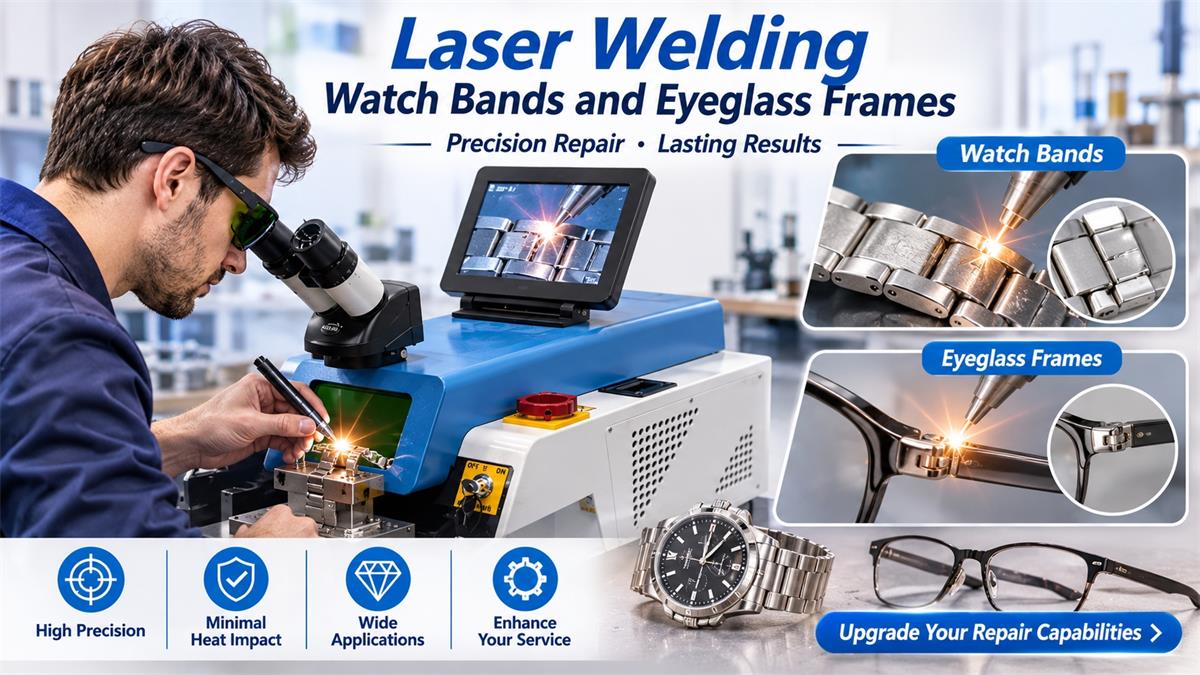
Watch bands and eyeglass frames are often made from thin metal components that require accurate repair techniques. A broken watch bracelet link, damaged clasp, cracked eyeglass bridge, or separated frame hinge can be difficult to repair using traditional soldering without affecting nearby components. Laser welding offers a more localized way to join metal parts, making it useful for small precision repairs. In this article, we explore how laser welding works for watch bands and eyeglass frames, which materials can be repaired, and what equipment professional repair shops should consider. For workshops handling delicate metal components, the Dowin Jewelry Laser Welding Machine is worth considering.
1. Why Use Laser Welding for Watch Bands and Eyeglass Frames?
Both watch bracelets and eyeglass frames contain small metal components, narrow joints, and relatively thin sections. Applying excessive heat during conventional repairs can cause deformation, discoloration, or damage to surrounding parts.
Laser welding uses concentrated energy to melt and join metal in a selected area. Compared with conventional torch soldering, it can reduce unnecessary heat exposure outside the repair zone.
Its main advantages include:
- Precision: The laser can target small cracks and narrow metal joints.
- Localized heating: Less surrounding metal needs to be heated compared with many conventional soldering operations.
- Small repair areas: Suitable for certain broken links, frame bridges, and small metal connections.
- Reduced deformation risk: Controlled energy input helps protect delicate components.
- Versatility: One machine can handle suitable watch, eyewear, jewelry, and other small metal repair applications.
However, the final result depends on material composition, joint design, thickness, and welding parameters. Laser welding is not a universal replacement for mechanical part replacement or conventional soldering.
2. Laser Welding Applications for Watch Bands
Metal watch bracelets are assembled from multiple links, pins, clasps, and connecting components. Over time, some parts may crack, loosen, or break because of mechanical stress and repeated movement.
A jewelry laser welder can help with several types of metal watchband repairs.
Repairing Broken Watch Bracelet Links
One common problem is a broken metal link. A bracelet link may crack at a narrow connecting section after repeated bending or accidental impact.
For suitable metal links, laser welding can reconnect the damaged area. The operator needs to position the broken ends accurately and select an appropriate pulse energy to achieve fusion without melting too much of the surrounding material.
Repairing Watch Clasps
Watch clasps contain small metal joints and connecting sections. Some may develop cracks after repeated opening and closing.
Laser welding can be used to repair certain cracked metal clasp components. However, damaged springs, locking mechanisms, and removable pins generally require mechanical repair or replacement rather than welding.
Repairing Watch End Links
End links connect the bracelet to the watch case. Because this area experiences repeated movement and mechanical stress, damage may occur around the connecting sections.
For suitable metal constructions, laser welding can restore certain broken connections. The watch bracelet should be removed from the watch before welding to protect the movement, battery, crystal, and other sensitive components.
Repairing Metal Mesh Watch Bands
Metal mesh bracelets are made from fine interconnected metal structures. Traditional torch heating can affect a larger area of the mesh and may cause distortion.
Laser welding can provide more localized repair on suitable mesh constructions. Because the individual wires are very thin, careful parameter adjustment and sample testing are particularly important.
3. Laser Welding Applications for Eyeglass Frames
Eyeglass frames are another interesting application for precision laser welding. Many metal frames contain thin bridges, hinges, temples, and connecting sections that can become damaged during everyday use.
When a metal frame breaks, replacing the entire frame may be unnecessary if the damaged component can be repaired successfully.
Repairing Broken Eyeglass Bridges
The bridge connects the two sides of an eyeglass frame and supports the structure around the nose. It experiences repeated mechanical stress when users put on, remove, or adjust their glasses.
A cracked or broken metal bridge may be repaired by laser welding when the frame material and damage location are suitable.
One important consideration is alignment. The two broken sections must be positioned correctly before welding to prevent changes to the frame geometry.
Repairing Broken Temples
The temples are the side arms that extend from the frame toward the ears. They may break near the hinge or along a narrow metal section.
Laser welding can reconnect certain broken metal temple components. The operator should control the heat input carefully to avoid affecting nearby decorative finishes or plastic parts.
Repairing Eyeglass Hinges
Hinges are small components that allow the temples to open and close. Some metal hinges can develop cracks or become separated from the frame.
Laser welding may be suitable for reconnecting a broken hinge attachment or repairing a damaged metal joint. However, worn hinge barrels, tiny screws, and damaged spring mechanisms may need replacement instead.
Repairing Titanium Eyeglass Frames
Titanium is commonly used in premium eyeglass frames because of its low weight and corrosion resistance.
Laser welding can be used for suitable titanium frame repairs, but titanium requires careful protection against oxidation during welding. Appropriate argon shielding, material preparation, and parameter control are important.
Before repairing a titanium frame, confirm its actual alloy composition and whether the available machine configuration is suitable.
4. Which Materials Can Be Laser Welded?
The material composition of watch bands and eyeglass frames directly affects welding performance. Two products that look almost identical may behave differently because their underlying metal alloys are different.
| Material | Watch Band Applications | Eyeglass Frame Applications | Important Considerations |
|---|---|---|---|
| Stainless Steel | Bracelet links and clasps | Bridges, temples, and hinges | Confirm alloy grade and surface finish |
| Titanium | Titanium watch bracelets | Titanium frames and temples | Argon shielding and suitable parameters may be required |
| Gold | Gold watch bracelets | Gold-plated or solid-gold frame components | Identify the actual underlying material and alloy |
| Silver | Silver watch components | Silver frame components | High thermal conductivity requires careful energy control |
| Nickel-Based Alloys | Selected bracelet components | Some metal frame constructions | Check the precise alloy and welding compatibility |
Plated and coated components require additional attention. The surface coating may contaminate the weld or change appearance during heating. Depending on the repair, local coating removal and refinishing may be necessary.
Plastic, acetate, and other non-metal eyeglass frames cannot be repaired by metal laser welding. Their repair requires different joining or replacement techniques.
5. Laser Welding vs Traditional Soldering for Small Metal Repairs
Traditional soldering remains common in watch and eyeglass repair. However, laser welding provides another option when a small and localized metal joint needs to be repaired.
| Comparison | Laser Welding | Traditional Soldering |
|---|---|---|
| Heat distribution | Concentrated energy | Broader surrounding heating |
| Repair precision | High with microscope observation | Depends on torch control |
| Thin metal components | Suitable with correct parameters | Requires careful heat management |
| Small cracks | Well suited to localized repairs | Suitable for appropriate joint designs |
| Filler material | Compatible welding wire can be used | Solder alloy is used |
| Heat-sensitive surrounding parts | Can reduce unnecessary heat exposure | May require more extensive protection |
| Equipment investment | Generally higher | Generally lower |
For watch bands and eyeglass frames with narrow repair areas, laser welding can offer better control over where energy is applied. Nevertheless, it does not eliminate the need for careful disassembly, positioning, and protection.
6. Why a Microscope Is Important for Watch and Eyeglass Repairs
When working on a small watch bracelet link or eyeglass hinge, the actual welding area may only be a few millimeters wide.
Without accurate observation, it can be difficult to position the laser spot correctly and control the weld pool.
A microscope provides several practical advantages:
- Clear observation of tiny cracks and damaged joints.
- More accurate laser positioning.
- Better control when applying multiple small weld spots.
- Easier inspection of the completed repair.
- Improved visibility when working with thin metal components.
This is why a dedicated jewelry laser welding machine with microscope observation can also be useful for workshops repairing watches and metal eyeglass frames.
7. What Jewelry Laser Welder Is Suitable for These Applications?
For businesses that handle jewelry, watch accessories, and small metal components, equipment selection should focus on precision rather than simply choosing the highest advertised power.
Important features include:
Adjustable Pulse Parameters
Different metals and component thicknesses require different welding conditions. Adjustable pulse energy, duration, and frequency help operators find suitable settings for each application.
Adjustable Welding Spot
A suitably small laser spot helps control the repair area and reduce unwanted melting around delicate metal structures.
Microscope Observation
A quality microscope is important for positioning the laser on small watchband links, frame bridges, and hinge connections.
Protective Gas Supply
Argon shielding can help protect certain metals, especially titanium, from oxidation during welding. The correct gas arrangement depends on the materials and machine configuration.
Stable Laser Output
Consistent pulse output is important for producing repeatable welding results, especially when repairing multiple small components.
Dowin’s jewelry laser welding machine collection includes dedicated YAG spot welding systems for precision metal applications. Explore the Dowin Jewelry Spot Laser Welding Machine for product details and equipment information.
8. Important Precautions Before Welding Watch Bands and Eyeglass Frames
Although laser welding offers excellent flexibility, repairing these products requires more than simply directing a laser beam at a broken section.
Remove Sensitive Components
For watch repairs, remove the bracelet from the watch case whenever possible. Do not weld with the watch movement, battery, or other heat-sensitive components attached.
For eyeglasses, remove lenses and protect or remove nearby plastic nose pads and other heat-sensitive parts before welding.
Identify the Exact Metal
Do not assume all silver-colored watchbands or eyeglass frames are stainless steel. They may contain titanium, nickel-based alloys, plated metals, or other materials.
Material identification is essential for selecting suitable welding parameters.
Control Deformation
Thin watch links and eyeglass temples can easily lose their original shape if excessive energy is applied. Use suitable fixtures and carefully controlled pulses.
Check the Repair Strength
A good-looking weld does not necessarily indicate a mechanically strong connection. Inspect the joint and perform appropriate mechanical tests before returning the product to the customer.
Follow Laser Safety Requirements
Nd:YAG systems operate at 1064 nm. Appropriate wavelength-rated laser protection, suitable machine guarding, controlled working areas, and operator training are essential. Follow the equipment manufacturer’s safety instructions and applicable local regulations.
9. Frequently Asked Questions
Can a jewelry laser welder repair a stainless steel watch band?
Yes. A suitable jewelry laser welder can repair certain stainless steel bracelet links, clasps, and other metal connections. The exact alloy, component thickness, and joint geometry determine whether the repair is practical.
Can laser welding repair broken titanium eyeglass frames?
Yes, suitable titanium frames can be laser welded. However, titanium requires appropriate shielding and careful process control to prevent oxidation and maintain weld quality.
Can I repair an eyeglass hinge with a laser welder?
Some broken metal hinge attachments can be repaired through laser welding. However, damaged screws, worn hinge barrels, and spring mechanisms may require replacement rather than welding.
Will laser welding damage the finish of a watch bracelet?
Laser welding can limit heating to the repair area, but surrounding plating, polishing, and decorative coatings may still be affected. Surface preparation and post-weld finishing should be considered before repair.
Can I weld a watch bracelet without removing it from the watch?
Removing the bracelet from the watch case is generally the safer approach. This helps protect the movement, battery, crystal, seals, and other sensitive components from the welding process.
Can one laser welder repair both jewelry and eyeglass frames?
Yes. A suitably configured jewelry laser welder can handle a variety of compatible small metal components, including jewelry, watch bracelet parts, and metal eyeglass frames. Each application requires appropriate material identification and parameter testing.
Conclusion
Laser welding provides a useful repair solution for watch bands and metal eyeglass frames, particularly when dealing with small cracks, broken connections, and delicate metal components.
Its main advantage is the ability to concentrate energy on a specific repair area, helping reduce unnecessary heating and deformation of surrounding materials. With microscope observation and suitable welding parameters, a dedicated jewelry laser welder can support a wider range of precision repair services.
For jewelry repair shops, watch repair businesses, and metal eyewear workshops, investing in a versatile spot laser welding machine can create additional repair capabilities. Explore the Dowin Jewelry Laser Welding Machine to learn more about its applications and specifications.
Post time: Nov-23-2026
