
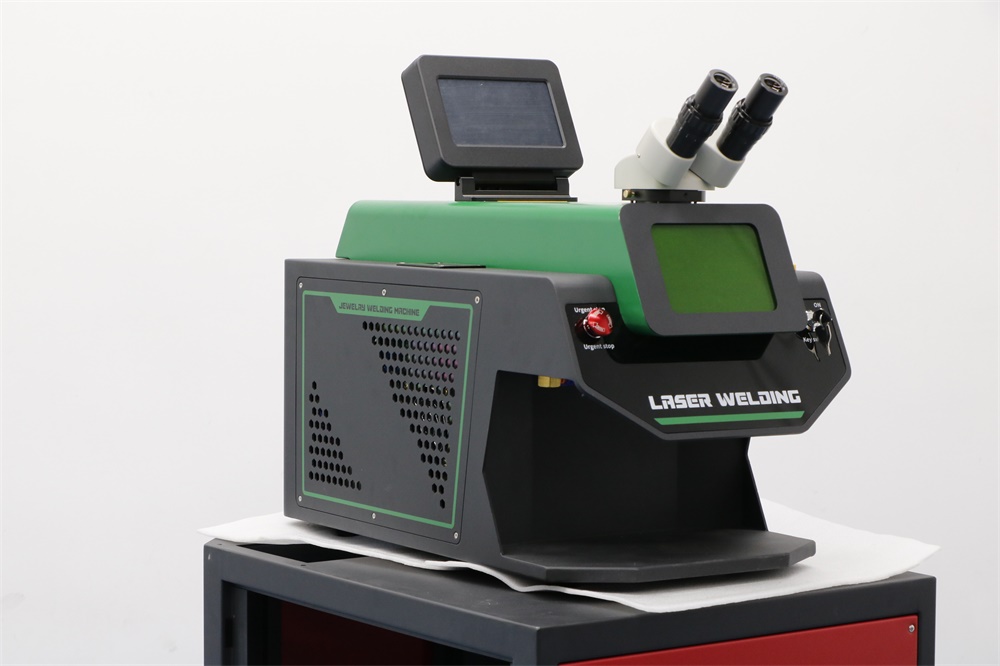
When repairing or manufacturing jewelry, both laser welding and torch soldering can join metals effectively. However, they use very different approaches to heat and joining.
Torch soldering has been a standard jewelry technique for decades, while laser welding provides more precise heat control and is increasingly used for delicate repairs, gemstone-set jewelry, and high-value pieces.
So, which method is better? The answer depends on the type of jewelry, repair location, metal, and required finish.
What Is Jewelry Laser Welding?
Jewelry laser welding uses a focused laser beam to melt and join metal in a very small area. The operator can control parameters such as pulse energy, duration, frequency, and spot size.
Unlike soldering, laser welding can fuse the base metals directly, with compatible filler wire added when additional material is required.
This makes it particularly useful for:
-
Ring repair
-
Prong rebuilding
-
Chain repair
-
Platinum jewelry
-
Gold jewelry
-
Setting repair
-
Fine detail work
-
Repairs close to gemstones
What Is Torch Soldering?
Torch soldering uses a flame to heat the jewelry and solder until the solder melts and flows into the joint.
It is a proven and relatively inexpensive technique and remains useful for many conventional jewelry repairs.
However, the flame heats a considerably larger area than a focused laser. This can make temperature control more difficult, particularly when working near gemstones or delicate components.
Laser Welding vs Torch Soldering
| Feature | Laser Welding | Torch Soldering |
|---|---|---|
| Heat control | Highly precise | Broad |
| Heat-affected zone | Very small | Larger |
| Precision | Excellent | Good |
| Work near gemstones | Often advantageous | More difficult |
| Filler material | Optional, depending on repair | Usually required |
| Color matching | Excellent with matching alloy | Depends on solder |
| Fine repairs | Excellent | More challenging |
| Initial equipment cost | Higher | Lower |
| Operator training | Specialized | Traditional jewelry skills |
The biggest difference is heat concentration. A torch heats a broader section of the jewelry, while a laser can deliver energy to a tiny, precisely selected area.
When Is Laser Welding Better?
Laser welding is often the better choice when the repair requires precision and minimal heat transfer.
For example, a jeweler repairing a diamond ring may need to rebuild a worn prong without unnecessarily heating the entire setting. A laser can target the metal precisely and gradually add compatible filler material.
It is also valuable for platinum jewelry, where high melting temperatures and precise heat management can make conventional torch work more demanding.
Laser welding is particularly suitable for:
Jewelry With Gemstones
Certain stone-set jewelry can be repaired without removing the gemstone, depending on the stone and repair location.
Small or Delicate Components
Fine chains, thin ring shanks, prongs, and small clasps can benefit from controlled laser pulses.
Platinum Jewelry
Laser welding can produce highly localized heat and allows precise control when working with platinum alloys.
High-Value Repairs
When minimizing distortion, discoloration, or unnecessary material removal is important, laser welding can provide greater control.
When Is Torch Soldering Still Useful?
Torch soldering should not be considered obsolete.
It remains practical for:
-
Large-area joints
-
Simple repairs
-
Certain resizing jobs
-
Components that require broad heating
-
Workshops with limited repair budgets
-
Repairs where laser access is difficult
For many routine jewelry jobs, an experienced jeweler can achieve excellent results with traditional soldering.
Which Is More Cost-Effective?
The answer depends on repair volume.
A torch setup generally requires a lower initial investment, making it attractive to small workshops or jewelers who perform occasional repairs.
A laser welding machine costs more initially, but high-volume repair shops may recover the investment through:
-
Faster precision repairs
-
Reduced finishing work
-
Fewer heat-related problems
-
More repair possibilities
-
Reduced need to remove gemstones
-
Higher-value repair services
For a professional jewelry workshop handling frequent precision repairs, laser welding can therefore provide a stronger long-term return.
Laser Welding or Torch Soldering: Which Should You Choose?
Choose laser welding when precision, localized heat, gemstone-adjacent repairs, and clean finishing are priorities.
Choose torch soldering when the repair is straightforward, broad heating is acceptable, and equipment cost is a major consideration.
In many professional jewelry workshops, the two methods complement rather than replace each other. A skilled jeweler can use torch soldering for conventional work and a jewelry laser welder for delicate repairs that require greater control.
Conclusion
The main advantage of laser welding over torch soldering is precise heat control. A laser welder can concentrate energy on a small repair area, making it especially valuable for platinum jewelry, fine chains, prong rebuilding, and repairs near gemstones.
Torch soldering remains a reliable and economical technique, but for modern jewelry workshops looking to expand their precision repair capabilities, a jewelry laser welding machine can provide significant advantages in control, versatility, and finishing quality.
Post time: Aug-19-2026
