
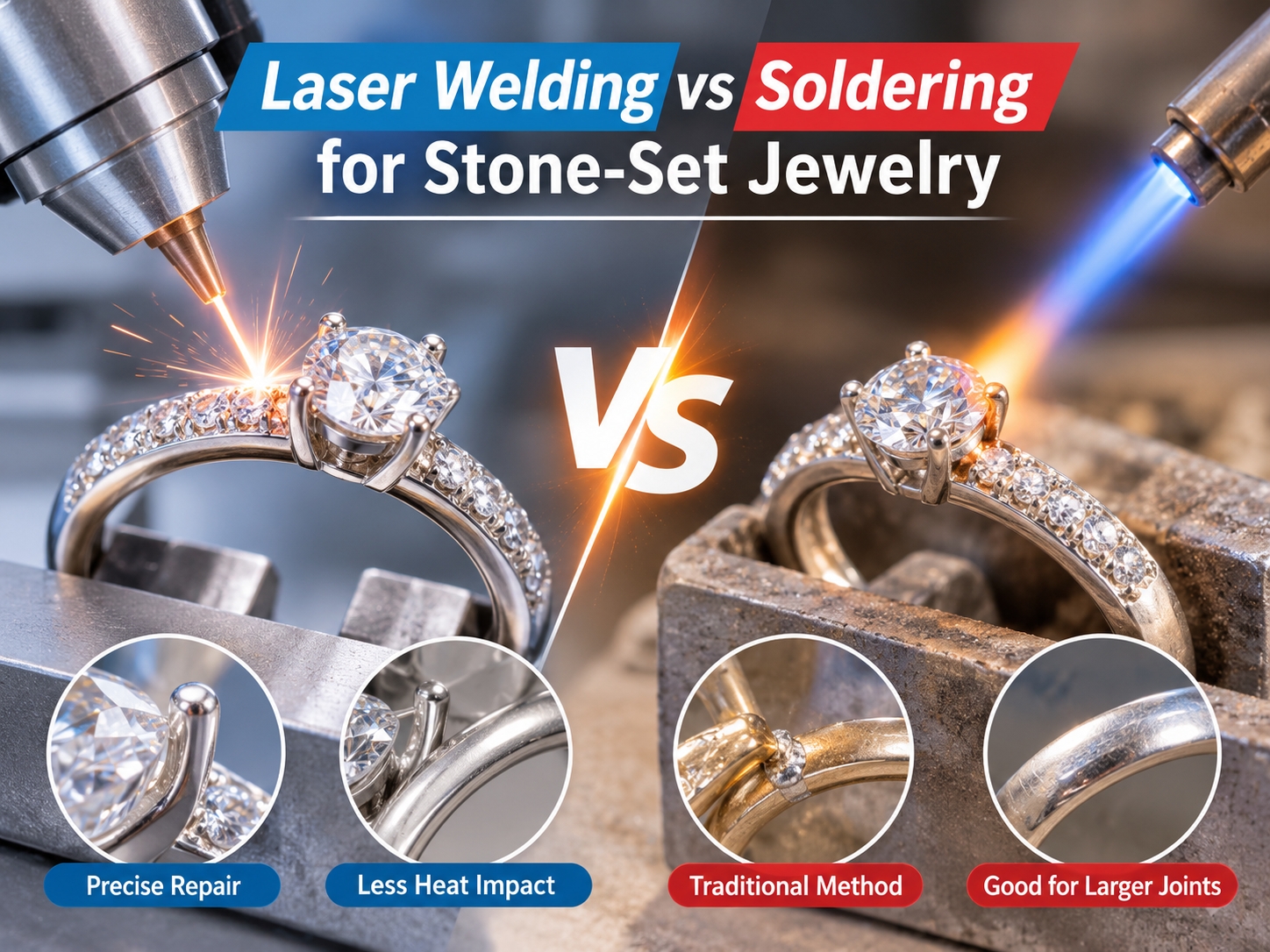
When repairing stone-set jewelry, choosing between laser welding and traditional soldering can make the difference between a successful repair and a damaged gemstone. Heat-sensitive stones, delicate prongs, and finished jewelry surfaces all create challenges for traditional repair methods. Laser welding offers a more localized heat input, making it a valuable option for repairing jewelry near gemstones. In this guide, we compare laser welding vs soldering for stone-set jewelry and explain when each method is the better choice. If you are considering professional jewelry repair equipment, explore the Dowin jewelry laser welding machine for precision spot welding applications.
1. How Traditional Soldering Works on Stone-Set Jewelry
Soldering joins two metal parts using a filler metal with a lower melting temperature than the base material. The jeweler heats the joint until the solder melts and flows into the connection.
For ordinary jewelry repairs, soldering remains a familiar and widely used technique. However, when gemstones are already mounted, applying heat becomes more complicated.
Common challenges include:
-
Heat-sensitive gemstones: Some stones can crack, discolor, or lose their treatment when exposed to excessive heat.
-
Loose stone settings: Heating the surrounding metal may affect the tension and structure of prongs.
-
Surface oxidation: Gold alloys and other jewelry metals may develop oxidation or discoloration during heating.
-
Additional finishing: Soldering can leave visible marks that require cleaning, polishing, and sometimes replating.
The main problem is not simply the soldering temperature. It is how much heat reaches the gemstone and surrounding jewelry structure.
2. How Laser Welding Works for Stone-Set Jewelry
Laser welding uses concentrated laser energy to melt and join small areas of metal. Instead of heating the entire jewelry component, the operator directs the laser beam toward a specific repair location.
This localized process offers several advantages for stone-set jewelry:
-
Concentrated energy helps limit unnecessary heating of surrounding metal.
-
Small weld spots allow precise repairs near delicate settings.
-
Minimal heat spreading can reduce the risk of damaging nearby components.
-
Filler wire can be used when additional material is needed.
-
Small repair areas may require less post-welding finishing.
A jewelry laser welder is particularly useful for repairing broken prongs, small cracks, chain connections, and damaged ring components.
However, laser welding is not completely risk-free for gemstones. Reflective stones, heat-sensitive materials, inclusions, and stones positioned directly in the laser path still require careful consideration.
3. Laser Welding vs Soldering: Key Differences
| Comparison | Laser Welding | Traditional Soldering |
|---|---|---|
| Heat distribution | Highly localized | More widespread |
| Repair precision | High | Depends on torch control |
| Gemstone protection | Lower surrounding heat exposure | Greater heat exposure |
| Small prong repair | Well suited | More challenging |
| Filler material | Compatible welding wire | Solder alloy |
| Surface oxidation | Generally more localized | Often requires more cleanup |
| Post-repair finishing | Often minimal | May require additional polishing |
| Equipment cost | Higher initial investment | Lower initial investment |
| Operator skill | Requires laser parameter control | Requires heat and solder control |
For delicate stone-set jewelry, laser welding generally offers better control over the repair area. Soldering remains practical for larger joints and repairs where the entire component can safely tolerate heat.
4. Which Gemstones Are Suitable for Laser Welding Repairs?
Not all gemstones respond to heat in the same way. Before choosing a repair method, jewelers should identify the stone type, mounting structure, and any treatments.
Here are some common considerations:
Diamonds
Diamonds are relatively heat-resistant compared with many gemstones, but they are not immune to damage. Internal inclusions, existing fractures, and rapid temperature changes can create risks.
Laser welding can be useful for repairing diamond rings, especially when the laser is directed away from the stone and the surrounding metal is properly controlled.
Sapphires and Rubies
Natural sapphires and rubies generally have good thermal stability. However, filled fractures, coatings, and certain treatments can make them more vulnerable to heat.
Jewelry repairers should inspect treated stones before attempting any welding operation.
Emeralds
Emeralds often contain natural inclusions and fractures. Many are also oil-treated to improve their appearance.
Direct or excessive heating may cause damage to the stone or affect its treatment. Removing the gemstone before repair is often the safer choice.
Opals, Pearls, and Turquoise
These materials require particular caution.
-
Opals can be sensitive to heat and thermal shock.
-
Pearls are organic materials and can be damaged by heat.
-
Turquoise may be stabilized, dyed, or treated, making its heat tolerance unpredictable.
For these gemstones, removing the stone before welding or selecting another repair method is generally recommended.
5. Can You Laser Weld a Ring Without Removing the Stone?
Yes, in some cases. This is one of the main reasons jewelers consider laser welding for stone-set jewelry.
For example, imagine a diamond ring with a small crack on the lower part of the shank. The repair location is separated from the gemstone setting, so a jeweler may be able to weld the damaged area without removing the diamond.
However, several factors must be evaluated:
Distance from the gemstone: The farther the repair area is from the stone, the easier it is to control the risk of heat exposure.
Metal thickness: Thin ring bands require careful energy adjustment to avoid burn-through or deformation.
Stone characteristics: Gemstone type, inclusions, treatments, and existing fractures all influence the repair strategy.
Welding parameters: Pulse energy, pulse duration, frequency, and spot size must be adjusted according to the material and repair location.
Even with laser welding, protective measures and appropriate heat management are necessary. When the stone is highly heat-sensitive or located directly beside the weld, removal is usually the safer option.
6. Why Jewelry Laser Welding Is Better for Small Repairs
One of the biggest advantages of laser welding is its ability to handle small and localized repair areas.
Consider several common jewelry repair situations:
-
Broken prongs: Rebuild or reconnect small sections of a setting with controlled weld deposits.
-
Cracked ring shanks: Repair localized cracks while limiting unnecessary heating of the mounted stone.
-
Loose chain connections: Weld small metal joints without applying heat across the entire chain.
-
Broken earring posts: Reconnect delicate components with accurate spot positioning.
-
Small casting defects: Fill tiny pores and repair localized imperfections.
For these applications, traditional soldering may introduce more heat into the jewelry than necessary.
If your workshop frequently handles delicate gold and silver jewelry repairs, a dedicated Dowin jewelry spot laser welding machine can provide a more controlled repair process.
7. What Should You Look for in a Jewelry Laser Welder?
Not every laser welding machine is designed for fine jewelry repair. Equipment selection should focus on precision, stable operation, and ease of adjustment.
Here are several important features to consider.
1. Adjustable pulse energy
Different jewelry metals and repair areas require different energy levels. Adjustable pulse energy helps operators work with both thin components and thicker metal sections.
2. Fine spot size
A small, stable laser spot is important when repairing tiny prongs, narrow ring bands, and delicate connections.
3. Microscope observation
A microscope allows operators to position the laser accurately and observe the weld pool during operation.
4. Stable pulse output
Consistent pulse energy helps produce repeatable welding results and reduces unwanted variation between weld spots.
5. Suitable cooling system
Cooling design affects machine operation and maintenance. Choose a configuration appropriate for the expected workload.
Dowin offers a 150W desktop YAG jewelry laser welder with microscope observation, LED shadowless lighting, and adjustable welding parameters. It is designed for fine jewelry repair and precision spot welding.
Learn more about its specifications and applications here:
Dowin Jewelry Laser Welding Machine
8. Laser Welding or Soldering: Which Should Your Jewelry Workshop Choose?
The best choice depends on your typical repair jobs.
| Repair Application | Recommended Method |
|---|---|
| Small crack near a diamond setting | Laser welding, subject to inspection |
| Broken gold ring shank | Laser welding or soldering |
| Repairing delicate prongs | Laser welding |
| Large metal joint away from gemstones | Soldering or laser welding |
| Repairing a pearl necklace component | Remove pearl before heat-based repair |
| Fixing small chain connections | Laser welding |
| Repairing an emerald setting | Remove stone before welding when necessary |
For jewelry workshops handling a wide variety of repairs, both technologies can complement each other.
Soldering remains useful for traditional jewelry fabrication and larger connections. Laser welding provides additional flexibility for small, precise repairs where minimizing the heated area is important.
9. Frequently Asked Questions
Is laser welding safer than soldering for diamond rings?
Laser welding can reduce heat exposure to areas outside the weld zone. This makes it a useful option for certain diamond ring repairs. However, diamonds with inclusions or fractures can still be damaged, so proper inspection and parameter control are essential.
Can laser welding damage gemstones?
Yes. Direct laser exposure, excessive heat, or thermal shock can damage certain gemstones. The risk depends on the stone type, treatment, condition, and distance from the weld.
Can I repair a gold ring with a mounted diamond using a laser welder?
Yes, provided the repair location and gemstone condition allow it. A crack on the lower ring shank may be suitable for laser welding without removing the diamond. The jeweler must still evaluate heat exposure and use appropriate protection.
Does laser welding leave visible marks on jewelry?
Laser welding can produce small, localized weld areas. With correct parameters and suitable filler material, the repair can often be blended into the surrounding surface through light polishing.
Is a 150W jewelry laser welder sufficient for stone-set jewelry repairs?
A 150W YAG jewelry laser welder can handle many fine jewelry repair applications, including small cracks, prong repairs, and localized welding. Actual suitability depends on metal thickness, joint design, spot size, and welding parameters.
Should I buy a laser welder if my workshop already has a soldering machine?
If your workshop regularly repairs stone-set rings, delicate chains, thin gold components, or small jewelry parts, a laser welder can expand your repair capabilities. It complements traditional soldering rather than replacing every soldering application.
Conclusion
When comparing laser welding vs soldering for stone-set jewelry, the biggest difference is heat control. Traditional soldering heats a larger surrounding area, while laser welding concentrates energy on a small repair location.
For delicate jewelry repairs involving mounted gemstones, laser welding can offer greater precision and reduce unnecessary heat exposure. Nevertheless, gemstone identification, inspection, and proper operating parameters remain essential.
If you want to improve the precision of your jewelry repair work, explore the Dowin 150W Jewelry Laser Welding Machine and evaluate whether it matches your workshop’s repair requirements.
Post time: Nov-23-2026
