
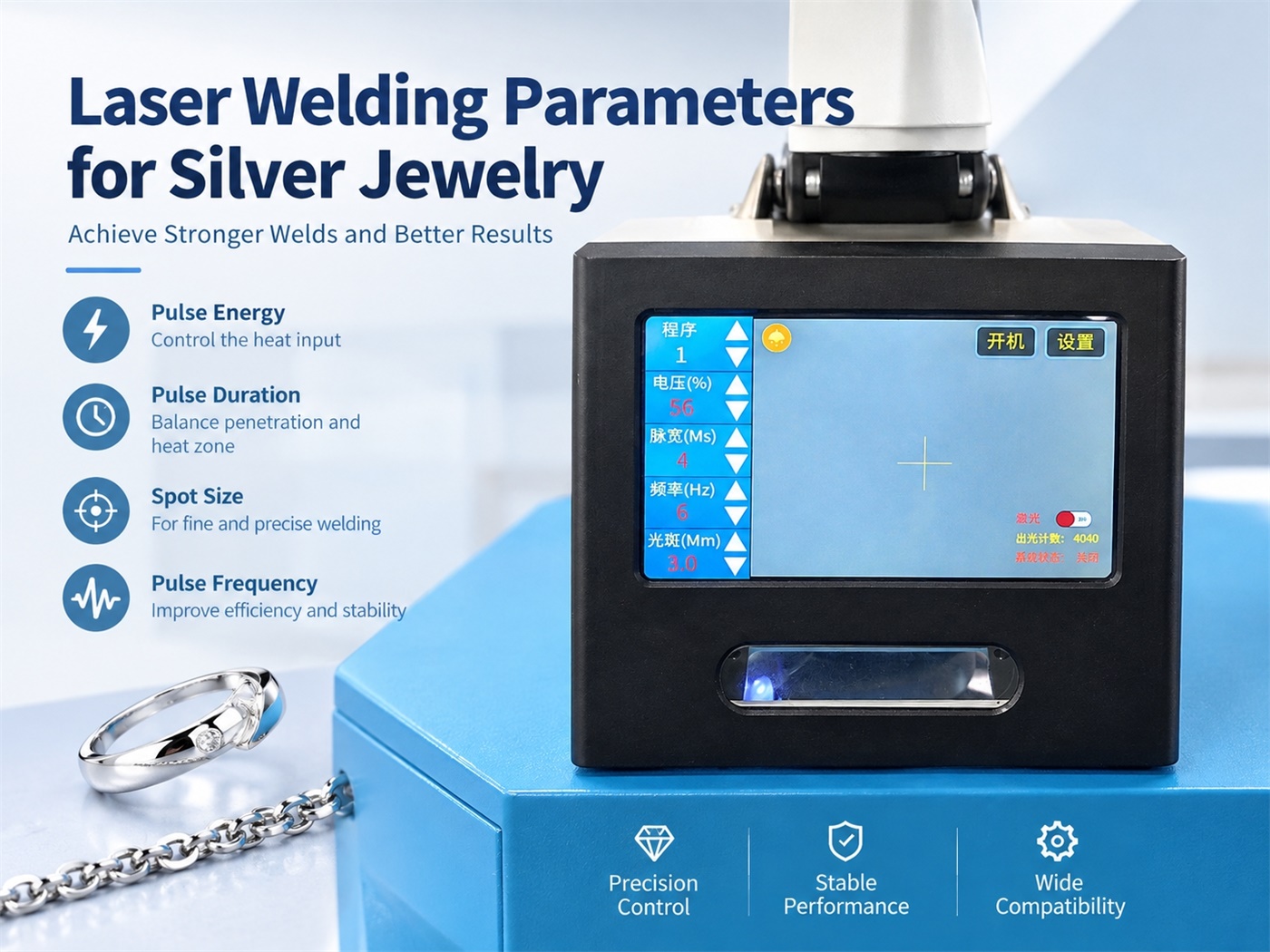
Laser welding silver jewelry requires precise control of pulse energy, pulse duration, spot size, and frequency. Compared with gold, silver presents unique welding challenges due to its high thermal conductivity and reflectivity. Incorrect settings can lead to incomplete fusion, excessive heat loss, porosity, or unwanted melting.
For jewelry manufacturers, silversmiths, and repair professionals, understanding the right laser welding parameters is essential for achieving strong, clean, and visually appealing joints.
This guide explains how to set and optimize laser welding parameters for sterling silver and other silver alloys, with practical advice for repairing silver rings, chains, bracelets, and delicate jewelry components.
1. Why Is Silver Jewelry More Challenging to Laser Weld?
Silver is highly reflective and has excellent thermal conductivity. These properties make it more difficult to deliver and maintain sufficient heat in a localized welding area.
First, silver reflects a significant portion of incident laser energy, particularly at certain wavelengths and surface conditions. This can reduce energy absorption and make stable melting more difficult.
Second, silver rapidly conducts heat away from the welding point. Compared with metals that retain heat more locally, silver may require carefully adjusted pulse energy and duration to achieve sufficient penetration.
Sterling silver (925 silver) also contains alloying elements, typically copper, that influence its melting behavior and weld quality.
For these reasons, silver jewelry laser welding requires more than simply increasing laser power. Pulse energy, duration, spot size, surface preparation, and joint fit must work together.
2. Key Laser Welding Parameters for Silver Jewelry
A pulsed YAG jewelry laser welding machine typically allows operators to adjust several parameters that directly influence weld quality.
Pulse Energy
Pulse energy, measured in joules (J), determines the energy delivered in each laser pulse. Silver may require sufficient pulse energy to overcome reflection and heat dissipation.
However, excessive energy can cause spatter, surface damage, or burn-through, especially on thin silver chains and delicate components.
Pulse Duration
Pulse duration, measured in milliseconds (ms), controls how long the laser energy is applied.
A suitable pulse duration helps achieve stable melting while controlling heat distribution. Silver’s high thermal conductivity makes pulse duration particularly important when welding thin sections or small joints.
Spot Diameter
Spot diameter determines the area exposed to the laser beam. A smaller spot concentrates energy into a narrower area, making it useful for fine jewelry repair.
A larger spot distributes energy over a wider area and may be appropriate for broader joints or material buildup.
Pulse Frequency
Pulse frequency, measured in hertz (Hz), determines how many pulses are delivered per second.
Higher frequency can improve working speed during overlapping welds, but excessive frequency may cause heat accumulation. For delicate silver jewelry, frequency should be adjusted according to the joint size, pulse energy, and required welding speed.
3. Recommended Starting Parameters for Silver Jewelry Laser Welding
Silver laser welding settings vary depending on the laser machine, silver alloy, workpiece thickness, and joint geometry. A setting that works well for a thick sterling silver ring may be unsuitable for a fine chain link.
The following table provides a practical framework for parameter testing on a pulsed YAG jewelry laser welder.
| Silver Jewelry Application | Spot Diameter | Pulse Duration | Parameter Guidance |
|---|---|---|---|
| Fine silver chain | Small spot | Short pulse | Begin with conservative energy |
| Sterling silver ring repair | Small to medium spot | Moderate pulse | Increase energy gradually |
| Silver bracelet joints | Small to medium spot | Moderate pulse | Test penetration and heat accumulation |
| Thick sterling silver components | Medium spot | Moderate to longer pulse | Adjust energy for material thickness |
| Fine silver prongs | Small spot | Short, controlled pulse | Minimize heat transfer to nearby stones |
There is no universal joule or millisecond setting for these applications. Different jewelry laser welders may use different pulse-energy scales, voltage controls, and output characteristics.
As a historical reference, published jewelry laser-welding research reports pulse energizing voltages of approximately 300–400 V and pulse durations of 7–20 ms for 925/835 silver on a particular laser system. These values are machine-specific and should not be transferred directly to another welder.
Always begin with the manufacturer’s recommended settings and validate them on matching scrap silver before working on finished jewelry.
4. How to Adjust Laser Welding Parameters for Different Silver Alloys
Sterling Silver (925 Silver)
Sterling silver contains 92.5% silver, with the remaining portion typically consisting mainly of copper. It is widely used in rings, bracelets, chains, pendants, and other jewelry.
Its high thermal conductivity can make it difficult to maintain a stable weld pool. Begin with controlled pulse energy and adjust gradually until sufficient fusion is achieved.
Clean the welding area thoroughly and ensure close joint contact. For gap filling, compatible silver-based filler wire may help improve the joint and reduce the need for excessive energy.
Fine Silver (999 Silver)
Fine silver contains a higher percentage of silver than sterling silver and has different mechanical and thermal characteristics.
Because pure silver is highly reflective and conducts heat efficiently, the operator should not assume that sterling silver settings will produce the same result. Test pulse energy and duration on the specific material before production.
Argentium Silver
Argentium silver is a silver alloy that contains germanium and is designed to offer improved tarnish resistance compared with traditional sterling silver.
Its composition differs from conventional 925 silver, and welding behavior may vary accordingly. Use alloy-specific test pieces to establish suitable pulse energy, duration, and spot size rather than directly copying standard sterling silver settings.
5. How to Optimize Silver Jewelry Laser Welding Parameters
Finding the right parameters requires a systematic approach. The following steps can help jewelry workshops achieve more consistent welding results.
Step 1: Identify the Silver Alloy and Thickness
Confirm whether the workpiece is sterling silver, fine silver, Argentium silver, or another alloy. Check the thickness and joint geometry, as these factors influence the required energy and penetration.
Step 2: Clean and Prepare the Welding Area
Remove oil, polishing compounds, dirt, and other contaminants. Ensure that the joint edges fit closely together.
For reflective silver, surface preparation can also influence laser energy absorption. A controlled, lightly roughened test area may behave differently from a highly polished surface.
Step 3: Start with Conservative Parameters
Select a suitable spot diameter and pulse duration based on the machine manufacturer’s guidance. Begin at a conservative pulse-energy level and make test welds on matching scrap material.
Step 4: Increase Pulse Energy Gradually
If the weld shows incomplete fusion, increase pulse energy in small increments. Avoid making large changes to multiple parameters at once.
If the material melts excessively or develops spatter, reduce energy and reassess the spot size and pulse duration.
Step 5: Adjust Frequency and Pulse Overlap
For seam welding or multiple adjacent welds, adjust pulse frequency and overlap to achieve a consistent joint.
Excessive overlap can increase heat accumulation, particularly in thin silver components. Inspect the weld after each parameter adjustment.
Step 6: Inspect Weld Quality
Examine the weld under magnification. Look for incomplete fusion, cracks, pores, excessive material loss, and surface discoloration.
For valuable jewelry or load-bearing components, verify joint integrity using an appropriate inspection or strength-testing method.
6. Common Silver Laser Welding Problems and Solutions
| Welding Problem | Possible Cause | Recommended Adjustment |
|---|---|---|
| Incomplete fusion | Insufficient energy absorption or poor joint fit | Improve joint preparation and increase energy gradually |
| Burn-through | Excessive pulse energy | Reduce energy and reassess spot diameter |
| Excessive spatter | Excessive energy or unstable joint | Reduce energy and improve surface cleanliness |
| Porosity | Contamination, gaps, or unsuitable welding conditions | Clean the material and review joint fit and shielding |
| Wide heat-affected zone | Excessive total heat input | Reassess pulse duration, energy, and overlap |
| Inconsistent weld appearance | Variable surface condition or parameter instability | Standardize preparation and test settings |
Silver welding defects do not always have a single cause. Make controlled adjustments and evaluate the results instead of increasing laser power indiscriminately.
7. Why Use a Pulsed YAG Jewelry Laser Welding Machine for Silver?
A pulsed YAG jewelry laser welding machine offers localized energy delivery and adjustable welding parameters, making it suitable for detailed silver jewelry repair and manufacturing.
Compared with conventional torch-based soldering, laser welding can reduce the area exposed to heat. This can be particularly useful when repairing delicate silver components or working near heat-sensitive areas.
A microscope-equipped jewelry laser welder also allows operators to position the welding point accurately, which is important for small joints and intricate designs.
When selecting a jewelry laser welding machine for silver, consider:
-
Adjustable pulse energy and pulse duration
-
A suitable spot-size range for delicate jewelry
-
Stable output for repeatable welding
-
Microscope visibility and operator ergonomics
-
Compatibility with sterling silver and other silver alloys
The right machine should provide sufficient parameter flexibility to accommodate different silver thicknesses, joint types, and repair requirements.
8. Frequently Asked Questions About Silver Jewelry Laser Welding
What are the best laser welding parameters for sterling silver?
The best parameters depend on the silver alloy, material thickness, joint design, and laser machine. Pulse energy, duration, spot size, and frequency should be optimized through controlled testing on matching scrap silver.
Why is silver harder to laser weld than gold?
Silver has high thermal conductivity and high reflectivity at common laser wavelengths. These properties can reduce energy absorption and rapidly dissipate heat from the welding point, making parameter optimization more challenging.
Can a jewelry laser welding machine weld 925 sterling silver?
Yes. A suitable pulsed YAG jewelry laser welding machine can weld 925 sterling silver. Proper surface preparation, close joint fit, and alloy-specific parameter adjustment are important for achieving consistent results.
Should silver laser welding use higher energy than gold?
Not necessarily in every application. Silver may require adjustments to energy input because of its reflectivity and thermal conductivity, but the correct setting depends on the specific alloy, machine, spot size, and joint geometry. Excessive energy can cause spatter or burn-through.
Can laser welding repair silver chains without damaging nearby links?
Laser welding can be used to repair fine silver chains by applying energy to a localized area. However, the links may still melt or deform if the pulse energy or spot size is excessive. Use controlled pulses and inspect the joint under magnification.
Can laser welding be used on silver jewelry with gemstones?
Yes, in suitable cases, but caution is necessary. Nearby gemstones may be affected by heat conduction or thermal shock, even when the laser weld is localized. Assess the stone, setting, and mounting materials before welding, and use appropriate protection or remove the stone when necessary.
Conclusion
Laser welding parameters for silver jewelry must be carefully matched to the alloy, thickness, joint design, and machine configuration. Silver’s high reflectivity and thermal conductivity make pulse energy, duration, and spot-size optimization especially important.
For jewelry manufacturers and repair professionals, a flexible pulsed YAG jewelry laser welding machine can support a wide range of silver repair and manufacturing applications. By preparing the material properly, testing settings systematically, and inspecting each weld, operators can improve consistency and reduce the risk of defects.
Looking for a jewelry laser welding machine for silver jewelry repair or manufacturing? Explore Dowin Laser’s jewelry laser welding solutions to find a machine suited to your materials and production requirements.
Post time: Sep-22-2026
