
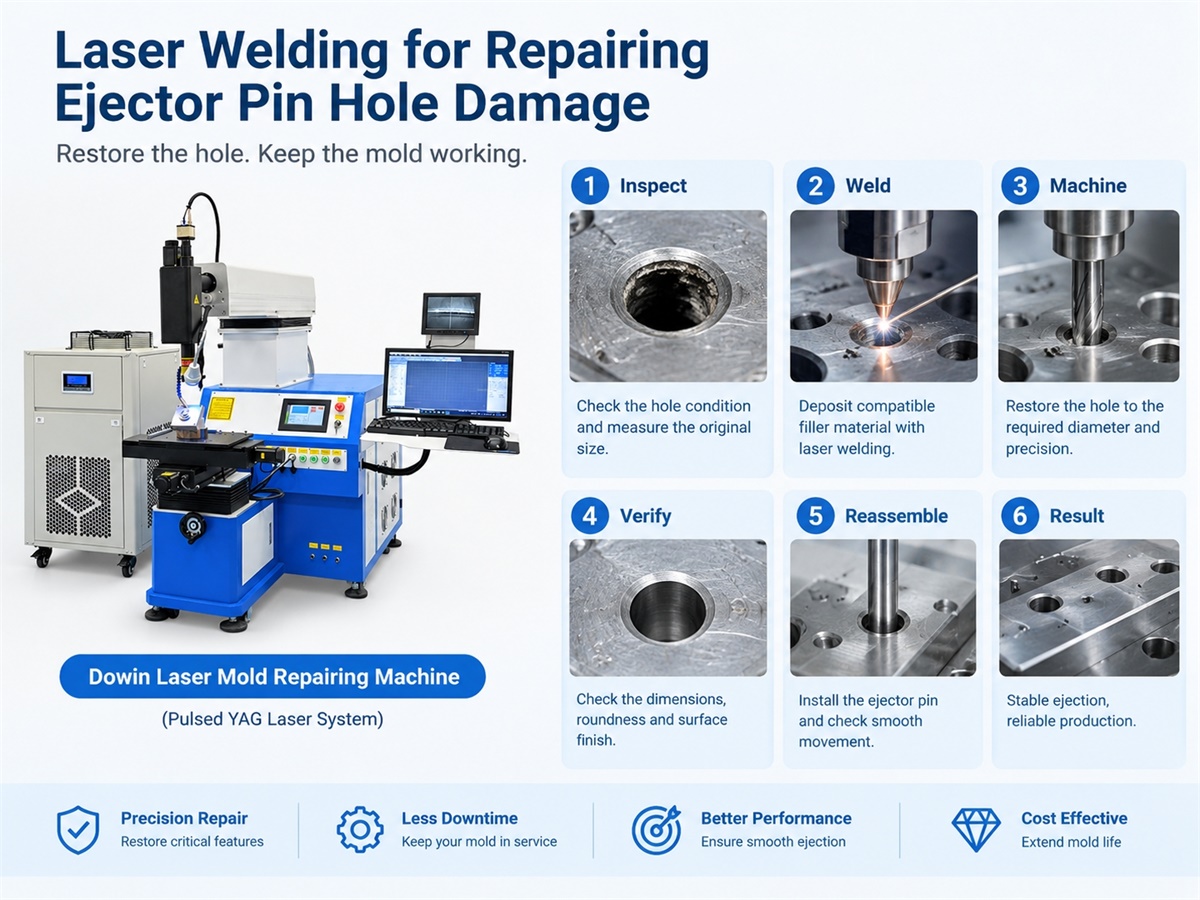
When ejector pin holes in plastic injection molds become worn, enlarged, chipped, or damaged around the opening, the resulting clearance problems can affect mold performance and molded part quality. Laser welding for ejector pin hole repair offers a potential solution when localized material buildup can restore the damaged steel and the hole can subsequently be machined to its original dimensions. Dowin provides laser mold repairing machines for mold maintenance applications, including pulsed YAG laser systems that can be evaluated for precision repairs involving ejector pin holes, worn edges, and other localized mold defects.
However, ejector pin hole repair requires more than filling missing material. The repaired hole must maintain its diameter, roundness, position, alignment, and sliding clearance. Excessive welding or inaccurate machining can cause ejector pins to bind, wear prematurely, or leave visible marks on molded plastic parts.
Why Do Ejector Pin Holes Become Damaged?
Ejector pins repeatedly move through their guide holes to push molded parts out of the mold. During production, the surrounding steel experiences mechanical contact, thermal cycling, and sometimes contamination from plastic residue or abrasive particles.
Several types of damage can develop over time.
1. Ejector Pin Hole Wear
Repeated movement can gradually wear the hole, particularly when the pin and hole are poorly aligned or lubrication and maintenance are inadequate.
As the clearance increases, the ejector pin may tilt or move laterally. This can produce uneven wear, inconsistent ejection, or witness marks on the molded part.
2. Chipped Edges Around the Hole
The entrance or exit of an ejector pin hole may develop chipped edges during mold assembly, maintenance, or accidental impact.
This damage can make the hole opening irregular and may affect the surrounding cavity or core surface if the hole is located near a molded-part surface.
3. Damage From Improper Reaming or Grinding
Previous maintenance can remove excessive material or leave an uneven bore. If the hole becomes oversized or loses its original alignment, simply installing a new ejector pin may not solve the problem.
4. Corrosion and Surface Damage
Moisture, corrosion, and contamination can damage the bore surface. If the damage is limited to a small area, localized repair may be possible. Extensive corrosion may require replacing the insert or using another machining-based solution.
Before repairing the hole, identify whether the problem is limited to the bore, affects the surrounding steel, or involves a larger alignment issue in the ejector system.
Can Laser Welding Repair an Oversized Ejector Pin Hole?
Yes, laser welding can be considered when an ejector pin hole has become oversized or locally damaged because of material loss. The basic process involves depositing compatible filler material onto the damaged region and then machining the hole back to the required dimensions.
The feasibility depends on the extent of wear, the thickness of the surrounding steel, the original mold material, and the ability to restore the bore accurately.
Laser welding is particularly worth evaluating when:
-
The damage is localized rather than extensive.
-
The original mold insert remains structurally sound.
-
The surrounding mold geometry is expensive or difficult to replace.
-
The repaired hole can be machined and inspected accurately.
-
The heat input can be controlled to suit the mold steel and its heat-treatment condition.
However, laser welding is not automatically the best option for every worn hole. A severely distorted bore, extensive cracking, or a damaged thin-wall insert may require replacement or a more comprehensive repair procedure.
What Makes Ejector Pin Hole Repair Difficult?
Unlike a simple surface defect, an ejector pin hole is a precision cylindrical feature. Its dimensions determine how the pin moves and how effectively the ejector system operates.
Maintaining the Original Hole Diameter
If a hole is enlarged through wear, the repair must restore enough material to allow the original bore diameter to be machined.
Too little deposited material may leave the hole oversized. Excessive deposition can increase machining time and may complicate the restoration of the original geometry.
The repair allowance should be established before welding begins.
Preserving Roundness and Straightness
A hole may appear correct at its entrance while remaining oversized, tapered, or irregular farther inside the bore.
The repair procedure must account for the full affected length, not just the visible opening.
Where the pin requires a close running fit, the bore should be inspected using suitable precision measurement methods after machining.
Controlling Heat Near the Bore
Ejector pin holes are often located close to cavity surfaces, core features, cooling channels, or other precision components.
Excessive heat input can affect local hardness, produce distortion, or create cracking in susceptible steels. The welding procedure must therefore be matched to the mold material and the location of the damage.
Protecting the Surrounding Mold Surface
When a hole is close to a parting surface or a molded-part surface, even a small dimensional change can affect mold fit or part appearance.
The repair must preserve the relationship between the hole and these neighboring features.
Step-by-Step: How to Repair Ejector Pin Hole Damage With Laser Welding
A reliable repair begins with dimensional inspection and ends with verification of both the bore and the ejector system.
Step 1: Inspect the Hole and Ejector Pin
Disassemble the relevant mold components and clean the damaged area.
Inspect the bore for wear, scoring, corrosion, cracks, and localized material loss. Check the ejector pin for bending, wear, and surface damage.
Measure the existing hole and pin, then compare the results with the original drawing or an undamaged equivalent feature.
This step is important because a worn pin may have contributed to the damage. Repairing the hole without correcting the underlying cause can lead to repeated failure.
Step 2: Determine the Required Repair Geometry
Establish the original bore diameter, straightness requirements, position, and intended clearance.
Determine whether the damage affects the entire bore or only a limited section near the opening.
If the hole is misaligned rather than simply oversized, material buildup alone will not correct the problem. The machining strategy must be capable of restoring the required axis and position.
Step 3: Prepare the Damaged Area
Remove oil, residue, rust, and other contaminants using an appropriate cleaning method.
If cracks are suspected, inspect their extent before welding. Cracked or severely damaged steel may require additional preparation or a different repair strategy.
Avoid unnecessary grinding that would remove more material from the already damaged bore.
Step 4: Select a Suitable Laser Welding Process
For localized mold damage, a pulsed YAG laser mold repair machine may be appropriate when its pulse control, spot size, filler-wire capability, and working access suit the repair.
Dowin’s YAG Mold Laser Spot Welding Machine lists DW-200W and DW-400W models. These are candidates to evaluate for precision mold repair, but suitability for a specific ejector pin hole must be confirmed against the mold steel, hole geometry, and required tolerance.
The machine’s rated power alone does not determine whether a successful repair is possible.
Step 5: Deposit Compatible Filler Material
Select filler material based on the original mold steel, its hardness, heat treatment, and service requirements.
Apply material to the damaged region in controlled increments, avoiding unnecessary heat input and excessive buildup.
For a bore with localized wear, the aim is to provide enough material for subsequent machining while minimizing the amount of surrounding steel affected.
Parameter selection should be validated for the specific steel and geometry rather than copied directly from a different mold repair.
Step 6: Machine the Bore to Its Required Dimensions
After the welded area has cooled and been processed according to the qualified repair procedure, restore the hole using suitable precision machining.
Depending on the bore and its tolerance, this may involve drilling, boring, reaming, grinding, or another appropriate finishing method.
The machining process must restore:
-
The specified hole diameter.
-
Bore roundness and straightness.
-
The original position and alignment.
-
The required surface finish.
-
The correct clearance for the ejector pin.
If the hole is particularly deep or the position tolerance is tight, specialized fixturing and precision machining may be necessary.
Step 7: Verify Pin Movement and Mold Operation
Measure the finished bore and inspect the surface for remaining defects.
Reinstall the ejector pin and check that it moves smoothly through its intended travel without binding or excessive lateral movement.
After reassembly, perform a controlled mold trial and inspect the molded parts for ejector marks, scratches, deformation, and other signs of uneven ejection.
If the problem persists, check pin alignment, the ejector plate, guide components, and other possible causes rather than assuming the weld repair has failed.
Laser Welding vs. Replacing an Ejector Pin Hole Insert
The most economical repair depends on the severity of the damage, the insert design, and the required dimensional accuracy.
| Factor | Laser welding and machining | Insert replacement |
|---|---|---|
| Localized wear | Often worth evaluating | May be unnecessary |
| Chipped hole entrance | Potentially suitable | Depends on the extent of damage |
| Extensive bore damage | Requires careful assessment | May be more reliable |
| Severe cracking | Not suitable without a qualified repair assessment | Often worth considering |
| Tight positional tolerances | Depends on machining and inspection capability | Can be restored through precision manufacturing |
| Downtime and cost | Depends on repair and finishing time | Includes manufacturing, fitting, and validation |
For a replaceable insert, replacement may be more straightforward than rebuilding a severely damaged bore. For an expensive mold with localized damage, laser welding may reduce the need to manufacture a new component.
The decision should account for the total repair cost, dimensional risk, and production downtime.
Common Mistakes in Ejector Pin Hole Repair
Welding Without Measuring the Original Bore
Without reliable reference dimensions, the repair may restore the appearance of the hole without restoring its actual size or alignment.
Better practice: Record the original specifications and establish measurable acceptance criteria before welding.
Using Incompatible Filler Material
A filler that is unsuitable for the mold steel may create cracking risks or produce a repaired area with inappropriate mechanical properties.
Better practice: Confirm metallurgical compatibility and the requirements for post-weld processing.
Applying Excessive Heat
Excessive heat input may affect the surrounding steel or create distortion, especially near thin sections and precision surfaces.
Better practice: Develop a suitable welding procedure and validate it on representative material where practical.
Skipping Precision Machining
Laser welding restores missing material but does not automatically create a finished cylindrical bore.
Better practice: Include bore machining and dimensional verification in the repair plan.
Ignoring the Original Cause of Wear
If misalignment, contamination, or a damaged ejector pin caused the problem, repairing the hole alone may provide only temporary improvement.
Better practice: Inspect the entire ejector system and correct the underlying issue before returning the mold to production.
How to Choose a Laser Mold Repair Welding Machine
When evaluating equipment for ejector pin hole repair, focus on the actual repair conditions rather than maximum power alone.
Pulse control: The system should provide suitable energy adjustment for localized material deposition.
Spot size and stability: Consistent energy delivery helps the operator control buildup around small features.
Filler-wire compatibility: The machine and welding arrangement should accommodate the wire sizes and materials required by the mold steel.
Working access: The welding head and viewing system must reach the damaged area without obstructing the surrounding mold structure.
Thermal control: The repair procedure should account for the mold steel’s hardness, heat treatment, and cracking sensitivity.
Finishing capability: The shop must have an appropriate method for restoring the bore diameter, roundness, and alignment after welding.
Dowin’s official mold repair welding equipment page is a starting point for reviewing available configurations. When requesting a recommendation, provide the mold steel grade, original and measured hole diameters, bore depth, damage location, and required tolerance.
Frequently Asked Questions
Can laser welding repair an oversized ejector pin hole?
Yes, in selected cases. Compatible filler material can rebuild localized material loss, after which the hole is machined to the specified diameter. The repair is only suitable when the remaining mold structure and the achievable dimensional accuracy meet the requirements.
Can laser welding repair a cracked ejector pin hole?
Possibly, but the crack must be inspected before repair. Its depth, location, and cause determine whether welding is appropriate. Cracks extending into critical sections or associated with extensive damage may require insert replacement.
Will laser welding affect mold hardness?
It can. Welding produces a localized thermal cycle that may change the microstructure or hardness of susceptible mold steels. The extent depends on the steel grade, initial heat treatment, welding parameters, and any required post-weld treatment.
Does laser welding eliminate the need for reaming?
No. Laser welding deposits material; it does not guarantee a finished bore. Depending on the damage and the required tolerance, reaming, boring, grinding, or another precision finishing process may be necessary.
How can I prevent ejector pin holes from wearing again?
Inspect pin alignment, pin condition, lubrication requirements, contamination, and the fit of the ejector system. Correcting the original wear mechanism is essential to prevent repeat damage.
Conclusion
Laser welding can be a practical option for repairing localized ejector pin hole damage in plastic injection molds, particularly when the original mold insert is valuable and sufficient material can be rebuilt for accurate machining.
The key is to treat welding as one stage of a complete repair process. Inspection, compatible filler selection, controlled material deposition, precision bore machining, and final ejector movement checks are all necessary to achieve a reliable result.
For mold makers evaluating Dowin equipment, a representative repair test and dimensional verification are the best ways to establish whether a particular laser welding system is suitable for the damaged hole and the mold’s production requirements.
Post time: Oct-26-2026
