
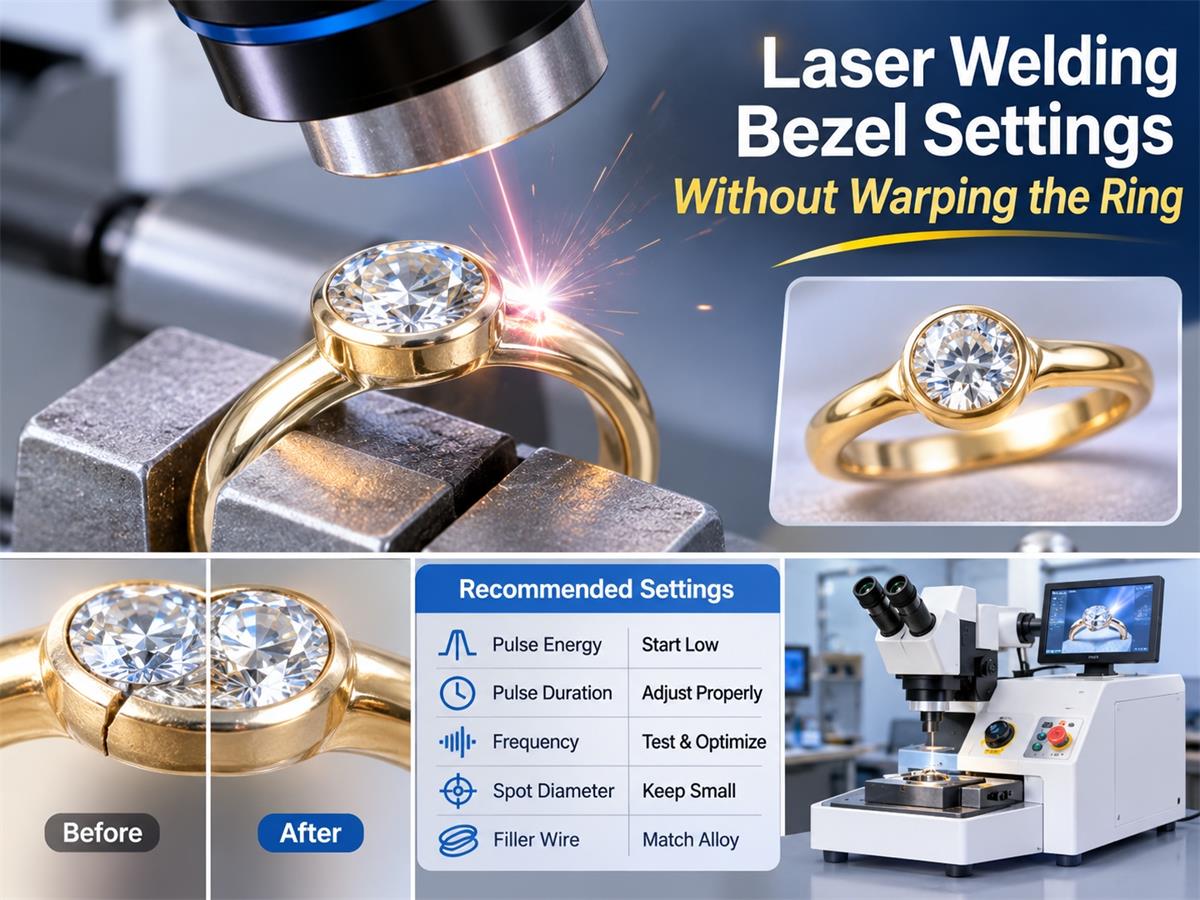
Bezel settings are widely used in jewelry manufacturing because they provide secure protection for gemstones while creating a clean, elegant appearance. However, repairing or modifying a bezel setting can be challenging, especially when working with thin gold or silver rings. Excessive heat may distort the ring, loosen the gemstone, or damage nearby solder joints. A jewelry laser welding machine provides a more controlled way to repair bezel settings by concentrating energy on a small welding area instead of heating the entire ring.
1. Why Is Bezel Setting Welding So Difficult?
Unlike ordinary ring shank repairs, bezel welding requires controlling heat around a relatively thin metal structure. The bezel wall is often much thinner than the surrounding ring body, making it particularly sensitive to excessive laser energy.
Jewelry repair technicians commonly encounter several problems:
- Ring deformation: Excessive heat can cause thin ring sections to expand, contract, or lose their original shape.
- Bezel wall collapse: Applying too much energy to a thin bezel can melt or burn through the metal.
- Gemstone damage: Heat-sensitive gemstones may crack, discolor, or suffer internal damage during welding.
- Unwanted melting: The surrounding decorative details, prongs, or previous solder joints may be affected.
- Visible welding marks: Incorrect parameters can create uneven welds that require additional polishing.
The main challenge is not simply joining two pieces of metal. It is creating a strong, localized weld while preserving the original geometry and appearance of the jewelry.
2. How Does Laser Welding Prevent Ring Warping?
Traditional torch soldering distributes heat across a relatively large area. When repairing a delicate bezel setting, this can increase the risk of heating the entire ring and affecting nearby components.
Laser welding works differently. It delivers concentrated energy to a small target area within a short period. This allows the technician to control where the metal melts and reduce unnecessary heat exposure to surrounding areas.
Three characteristics make laser welding particularly useful for bezel repairs:
- Small spot size: The operator can focus energy on the joint rather than heating the entire bezel.
- Adjustable pulse energy: Welding energy can be adjusted according to the metal thickness and joint condition.
- Localized heat input: The surrounding ring structure experiences less thermal exposure compared with conventional torch soldering.
However, laser welding does not completely eliminate thermal risks. The correct pulse parameters, welding position, and heat-management technique are still essential.
3. Recommended Laser Welding Settings for Bezel Repairs
There is no universal laser setting for every bezel repair. The appropriate parameters depend on the metal type, bezel thickness, joint gap, and distance from the gemstone.
For a jewelry laser welder, technicians should pay particular attention to the following parameters:
| Parameter | Recommended Approach | Purpose |
|---|---|---|
| Pulse energy | Start with low energy and increase gradually | Prevent excessive melting |
| Pulse duration | Adjust according to material thickness | Control heat penetration |
| Frequency | Test different frequencies on matching scrap metal | Control welding continuity and heat accumulation |
| Spot diameter | Use a small, controlled spot | Protect adjacent metal areas |
| Filler wire | Match the base metal alloy whenever possible | Improve joint quality and appearance |
Important: Avoid copying welding parameters from another jewelry repair without testing. A setting suitable for a thick gold ring may burn through a thin bezel wall.
4. Step-by-Step: How to Laser Weld a Bezel Setting
Step 1: Inspect the Ring and Identify the Joint
Before welding, inspect the bezel wall, ring shank, and gemstone setting. Determine whether the problem is a cracked bezel, a detached bezel-to-ring joint, or a damaged section of the bezel wall.
Also identify the gemstone material. Diamonds, sapphires, and rubies generally tolerate heat differently from emeralds, opals, pearls, and other heat-sensitive stones. Even heat-resistant gemstones can be damaged by localized thermal shock or internal inclusions.
Step 2: Protect the Gemstone
Whenever possible, remove the gemstone before welding. This is the safest approach when the repair involves the bezel wall directly or requires substantial welding energy.
If removing the stone is not practical, the technician must carefully evaluate the gemstone’s heat sensitivity and use an appropriate protection strategy. Do not assume that a small laser spot makes welding around an installed gemstone automatically safe.
Step 3: Clean the Welding Area
Remove dirt, oxidation, polishing compounds, and other contaminants from the joint. Clean metal surfaces help produce more consistent welds and reduce the possibility of porosity or contamination.
For cracked or separated joints, ensure that the two metal surfaces are properly aligned before welding.
Step 4: Adjust the Laser Parameters
Start with conservative energy settings. Use a matching piece of scrap metal with similar thickness and alloy to test the welding effect before working on the actual ring.
Check the penetration depth, weld appearance, and heat-affected area. Increase the pulse energy only when necessary to achieve adequate fusion.
Step 5: Apply Short, Controlled Welds
Position the laser spot precisely along the damaged joint. Apply individual pulses or short overlapping welds rather than concentrating excessive energy in one location.
Allow sufficient cooling between welds when necessary. Avoid repeatedly firing at the same point, as accumulated heat can gradually deform the thin bezel structure.
Step 6: Inspect and Finish the Repair
After welding, inspect the joint under magnification. Check for cracks, incomplete fusion, excessive material buildup, and any changes in the bezel shape.
Once the repair is satisfactory, perform careful finishing and polishing. If the gemstone was removed, reinstall it only after the repaired area has cooled and passed inspection.
5. Which Jewelry Laser Welder Is Suitable for Bezel Settings?
For jewelry repair workshops, choosing a machine with precise pulse control and a suitable optical system is more important than simply selecting the highest power rating.
A YAG pulse jewelry laser welder is a practical option for localized repairs involving gold, silver, platinum, and other jewelry metals, provided that the machine is configured for the specific material and application.
For example, Dowin offers a 150W jewelry spot laser welding machine designed for precision jewelry repair.
Its main features include:
- 150W YAG laser source: Suitable for a range of jewelry spot-welding applications.
- Adjustable spot diameter: Approximately 0.2–2 mm for different welding requirements.
- Microscope observation: Helps operators accurately position the laser spot on small repair areas.
- LED shadowless lighting: Improves visibility when working with intricate jewelry structures.
- Compact desktop design: Suitable for jewelry repair shops and production workshops.
The machine’s adjustable parameters and microscope-assisted operation make it useful for detailed repairs, including bezel joints, ring cracks, prong repairs, and small metal connections.
Explore the 200W YAG pulsed jewelry laser welder if your workshop also handles applications requiring higher pulse energy.
6. Common Mistakes When Laser Welding Bezel Settings
Even with a suitable laser welding machine, improper operation can still damage delicate jewelry. Here are five mistakes worth avoiding.
Using Too Much Pulse Energy
High energy does not necessarily mean better welding. Thin bezel walls can melt quickly. Always begin with conservative settings and increase energy gradually after testing.
Welding Too Close to a Heat-Sensitive Gemstone
Localized laser energy reduces overall heat exposure, but the gemstone can still experience thermal damage. Evaluate whether stone removal is necessary before starting.
Applying Too Many Pulses in One Area
Repeated pulses can cause heat accumulation. Move progressively along the joint and allow cooling when required.
Ignoring the Metal Alloy
Different gold alloys and silver compositions have different melting and welding characteristics. White gold, yellow gold, rose gold, and platinum should not automatically share identical settings.
Skipping Sample Testing
Testing on scrap metal before repairing an expensive ring is a simple way to reduce unnecessary risks. Match the sample material and thickness as closely as possible to the actual jewelry.
7. FAQ: Laser Welding Bezel Settings
Can you laser weld a bezel setting without removing the gemstone?
Sometimes, but it depends on the gemstone, its heat sensitivity, the welding location, and the required energy. Removing the gemstone is generally the safer option when welding directly beside the setting. Never assume that every gemstone can withstand laser welding.
What laser power is suitable for bezel setting repairs?
A 150W pulsed YAG jewelry laser welder can handle many precision jewelry repair applications. However, the actual welding result depends on pulse energy, pulse duration, spot size, and material thickness rather than the rated power alone.
Can laser welding repair a thin gold bezel?
Yes. Laser welding is particularly useful for localized repairs on thin gold components because the energy can be concentrated on the damaged area. Careful parameter adjustment is essential to prevent burn-through.
Does laser welding leave visible marks on a bezel setting?
Laser welding can produce a relatively small weld area, but the repaired joint may still require polishing and finishing. The final appearance depends on the welding technique, filler material, and operator experience.
Is laser welding better than torch soldering for bezel repairs?
For localized repairs near delicate jewelry structures, laser welding often offers better control over heat input. Torch soldering can still be suitable for larger joints or repairs where broader heating is acceptable. The best method depends on the specific repair.
Conclusion
Laser welding bezel settings without warping the ring requires more than choosing the right machine. Technicians must understand the metal thickness, gemstone sensitivity, pulse energy, and heat accumulation during the repair process.
A properly configured YAG jewelry laser welder provides precise energy control for repairing delicate bezel structures while minimizing unnecessary heating of surrounding metal. For jewelry workshops handling frequent ring repairs, investing in a microscope-equipped laser welding machine can improve repair accuracy and workflow efficiency.
Looking for a suitable machine for your jewelry repair business? Explore Dowin Jewelry Laser Welding Machines or contact our team for machine specifications and welding sample testing.
Post time: Nov-18-2026
