
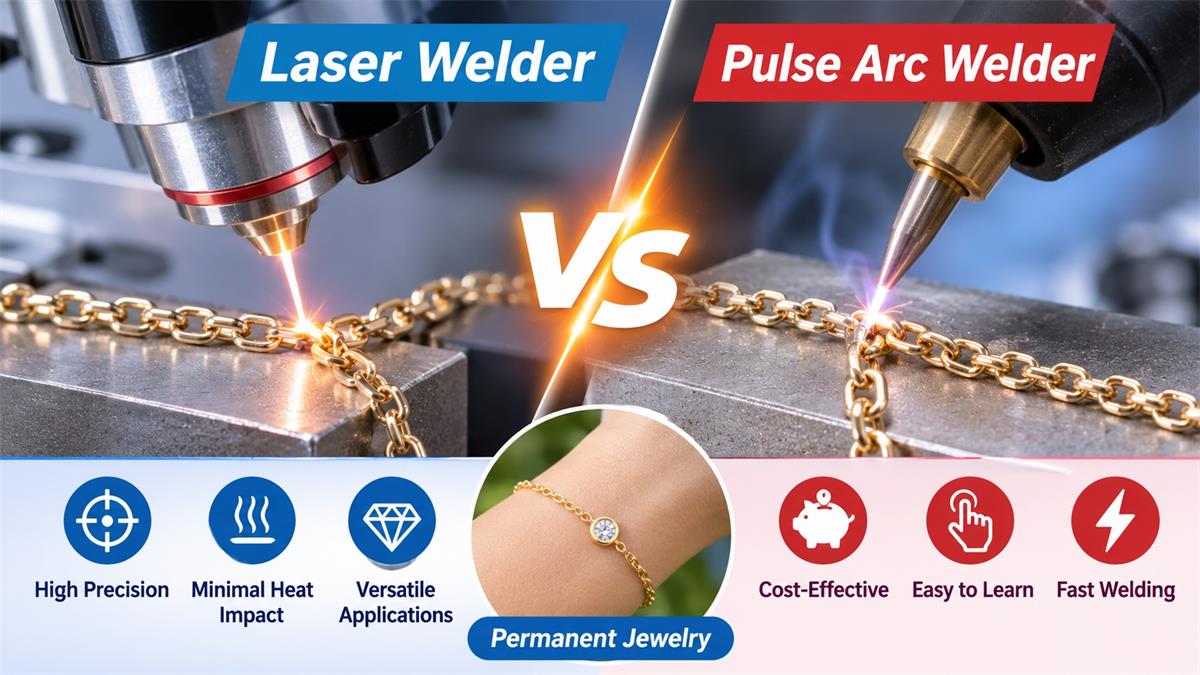
Permanent jewelry has become a popular service in jewelry stores, boutiques, and custom jewelry studios. Unlike traditional bracelets with clasps, permanent jewelry is typically connected directly around the customer’s wrist, ankle, or neck using a small welded jump ring. Choosing between a laser welder and a pulse arc welder is an important decision for jewelry businesses. Both machines can create small metal connections, but they work differently and offer different advantages. If you are also considering equipment for broader jewelry repair applications, explore the Dowin Jewelry Laser Welding Machine.
1. What Is a Pulse Arc Welder for Permanent Jewelry?
A pulse arc welder, also called a micro TIG welder or pulse arc jewelry welder, uses a short electrical discharge to create a localized welding arc between an electrode and the metal workpiece.
For permanent jewelry, the operator typically brings the two ends of a small jump ring together and uses the electrode to create a weld that closes the connection.
Pulse arc welding is widely used in permanent jewelry studios because of several practical advantages:
- Low equipment cost: Pulse arc machines are generally more affordable than professional jewelry laser welding systems.
- Easy operation: Basic jump-ring welding can be learned relatively quickly with proper training.
- Compact design: Many machines are small enough for jewelry counters, mobile services, and boutique studios.
- Fast connections: A short electrical pulse can complete a small jump-ring connection quickly.
- Simple setup: Many systems require relatively little installation space.
For a jewelry business primarily offering simple bracelet and anklet connections, a pulse arc welder can be a practical starting point.
2. What Is a Laser Welder for Permanent Jewelry?
A jewelry laser welder uses concentrated laser energy to melt and fuse metal at a precisely selected location. Unlike pulse arc welding, laser welding does not require an electrode to make electrical contact with the workpiece.
The operator positions the metal under a microscope or suitable viewing system, focuses the laser beam on the joint, and applies controlled laser pulses to create the weld.
Laser welding offers several advantages:
- Localized heat input: Energy is concentrated in a small area, helping reduce unnecessary heating of surrounding components.
- Precise positioning: The operator can target small joints and delicate metal structures.
- Non-contact welding: There is no welding electrode touching the metal during laser operation.
- Flexible applications: The same equipment can be used for jewelry repair, chain connections, small cracks, and other precision welding jobs.
- Controlled weld deposits: With suitable parameters and filler wire, operators can repair or build up small metal areas.
For jewelry businesses that want to provide more than basic permanent bracelet services, laser welding offers greater flexibility across different repair and fabrication applications.
3. Laser Welder vs Pulse Arc Welder: Key Differences
| Comparison | Laser Welder | Pulse Arc Welder |
|---|---|---|
| Working principle | Concentrated laser energy | Electrical arc discharge |
| Electrode contact | Non-contact | Uses an electrode |
| Heat input | Highly localized | Localized electrical arc |
| Welding precision | High, with optical positioning | Depends on electrode positioning and operator skill |
| Jump ring welding | Suitable | Suitable |
| Fine jewelry repair | Very suitable | Application-dependent |
| Equipment investment | Generally higher | Generally lower |
| Additional applications | Crack repair, prong repair, chain repair, and precision welding | Primarily small electrical arc welding applications |
| Learning curve | Requires laser parameter training | Requires control of pulse energy and electrode positioning |
One important point: neither technology automatically guarantees a perfect weld. Metal type, jump-ring thickness, joint preparation, machine settings, and operator experience all affect the final result.
4. Which Machine Produces Better Welds on Permanent Jewelry?
Weld quality is one of the most important considerations for permanent jewelry businesses. Customers expect bracelets and anklets to remain securely connected during normal daily activities.
Pulse Arc Welding Results
A properly adjusted pulse arc welder can create strong connections on small gold and silver jump rings. However, the result depends on electrode positioning, contact conditions, pulse energy, and the geometry of the joint.
If the electrode is poorly positioned or the pulse energy is unsuitable, problems such as incomplete fusion, excessive melting, or visible weld marks may occur.
Laser Welding Results
Laser welding allows the operator to concentrate energy on the joint without direct electrode contact. This can be useful when working with delicate chains, small metal components, or jewelry that requires a more controlled weld location.
With appropriate pulse settings, laser welding can produce small, clean welds. However, excessive energy can still cause burn-through, porosity, or deformation, particularly on very thin jump rings.
For both methods, always test the actual chain and jump-ring combination before offering the service to customers. A visually attractive connection is not necessarily a mechanically reliable connection.
5. Which Machine Is Better for Gold and Silver Permanent Jewelry?
Different jewelry metals have different melting characteristics and welding requirements. The machine should be selected according to the materials commonly used in your business.
14K and 18K Gold
Both laser and pulse arc welding can be used for suitable gold jump rings. However, gold alloys have different compositions, and their welding behavior can vary according to the percentage of gold, silver, copper, and other alloying elements.
Laser welding provides precise energy delivery, which can be advantageous when working with delicate gold chains. Pulse arc welding can also be effective for standard jump-ring connections when the machine is properly adjusted.
Sterling Silver
Sterling silver has high thermal conductivity, which means heat can spread quickly away from the welding area. This makes energy control particularly important.
Both technologies can weld suitable sterling silver components. Laser welding may offer an advantage when a small, localized heat input is needed, although reflectivity and joint preparation must also be considered.
Gold-Filled and Plated Jewelry
Gold-filled and plated jewelry require additional attention. Their surface layers and underlying materials may respond differently to concentrated heat.
Before welding, identify the actual material structure and test whether the process damages the surface finish. Do not assume that a machine suitable for solid gold will automatically produce good results on plated products.
6. Is a Laser Welder Worth the Extra Investment?
This depends on the services your jewelry business plans to offer.
If you only connect simple jump rings for permanent bracelets and anklets, a pulse arc welder may provide sufficient functionality at a lower initial investment.
However, consider a laser welder if your business also handles:
- Gold and silver chain repairs.
- Broken necklace and bracelet connections.
- Fine jewelry component repairs.
- Small cracks in rings and other jewelry parts.
- Prong and setting repairs where appropriate.
- Custom jewelry fabrication and precision spot welding.
In these situations, a laser welding machine can serve more purposes than a dedicated permanent jewelry welder.
For example, Dowin offers a 150W desktop YAG jewelry laser welder with microscope observation and LED shadowless lighting. Its design is intended for precision jewelry welding and repair applications.
View the machine specifications here: Dowin 150W Jewelry Laser Welding Machine.
7. Common Mistakes When Choosing a Permanent Jewelry Welder
Many new jewelry businesses focus only on machine price or advertised power. However, several other factors are equally important.
Choosing Based Only on Wattage
A higher wattage rating does not automatically mean better results on tiny jump rings. Pulse energy, pulse duration, spot size, and parameter adjustment are all important.
Ignoring the Chain Material
Different chain designs and metal compositions require different welding approaches. A machine should be tested with the actual materials used in your permanent jewelry service.
Ignoring Operator Training
Even a precision machine requires proper operation. Poor positioning, unsuitable settings, and inadequate joint preparation can all result in weak connections.
Not Testing Weld Strength
Do not judge a permanent jewelry connection only by its appearance. Test sample joints for fusion quality and mechanical strength using an appropriate inspection procedure before working on customers.
Ignoring Customer Safety
Permanent jewelry welding must never be performed while the bracelet or chain is being worn. Remove the jewelry from the customer’s body, position it securely, and follow the machine manufacturer’s laser or electrical safety requirements.
8. Which Welder Should You Buy for Your Jewelry Business?
Here is a simple recommendation based on different business models:
| Business Type | Recommended Equipment | Reason |
|---|---|---|
| Permanent bracelet startup | Pulse arc welder | Lower initial investment and suitable for basic jump-ring connections |
| Mobile permanent jewelry service | Compact pulse arc welder | Portable setup for simple on-site services |
| Professional jewelry repair shop | Laser welder | More versatile precision repair applications |
| Custom jewelry manufacturer | Laser welder | Controlled welding for different jewelry components |
| Permanent jewelry plus repair services | Laser welder | Can support a wider range of welding and repair tasks |
The best machine is not necessarily the most expensive one. It is the machine that matches your actual workload, materials, repair requirements, and business development plans.
9. Frequently Asked Questions
Can a laser welder replace a pulse arc welder for permanent jewelry?
Yes, a suitable laser welder can perform small jump-ring welding applications. However, machine configuration, pulse settings, and operator experience must be appropriate for the chain material and thickness.
Is pulse arc welding strong enough for permanent bracelets?
Yes. A properly prepared and correctly welded jump ring can provide a reliable connection. The strength depends on complete fusion, material compatibility, and joint quality rather than the welding method alone.
Does laser welding leave a visible mark on permanent jewelry?
Laser welding can create a small and localized weld area. With appropriate settings and finishing, the connection can be made less noticeable. The final appearance depends on the chain material, joint geometry, and operator skill.
Can a 150W YAG laser welder weld small gold chains?
A 150W YAG jewelry laser welder is designed for precision jewelry welding and can be suitable for many small gold chain repair applications. Actual suitability for permanent jewelry jump rings should be confirmed through sample testing, because very thin chain components require careful energy adjustment.
Which is easier for beginners: laser welding or pulse arc welding?
Pulse arc welding is often easier to get started with for basic permanent bracelet connections. Laser welding requires training in optical positioning and laser parameter adjustment, particularly when handling delicate jewelry components.
Can both machines weld 14K and 18K gold?
Both technologies can weld suitable 14K and 18K gold components. However, alloy composition, component thickness, and joint design influence the results. Always test the specific material before production.
Conclusion
When comparing a laser welder vs a pulse arc welder for permanent jewelry, the biggest difference is their working principle and application flexibility.
Pulse arc welders are a practical choice for businesses focused mainly on connecting permanent bracelets and anklets. Laser welders offer more precise, non-contact energy delivery and broader applications in professional jewelry repair and fabrication.
If your business plans to expand beyond basic permanent jewelry services, a dedicated jewelry laser welding machine may be a worthwhile long-term investment. Explore the Dowin 150W YAG Jewelry Laser Welder to learn more about its precision welding capabilities.
“`
Post time: Nov-23-2026
