
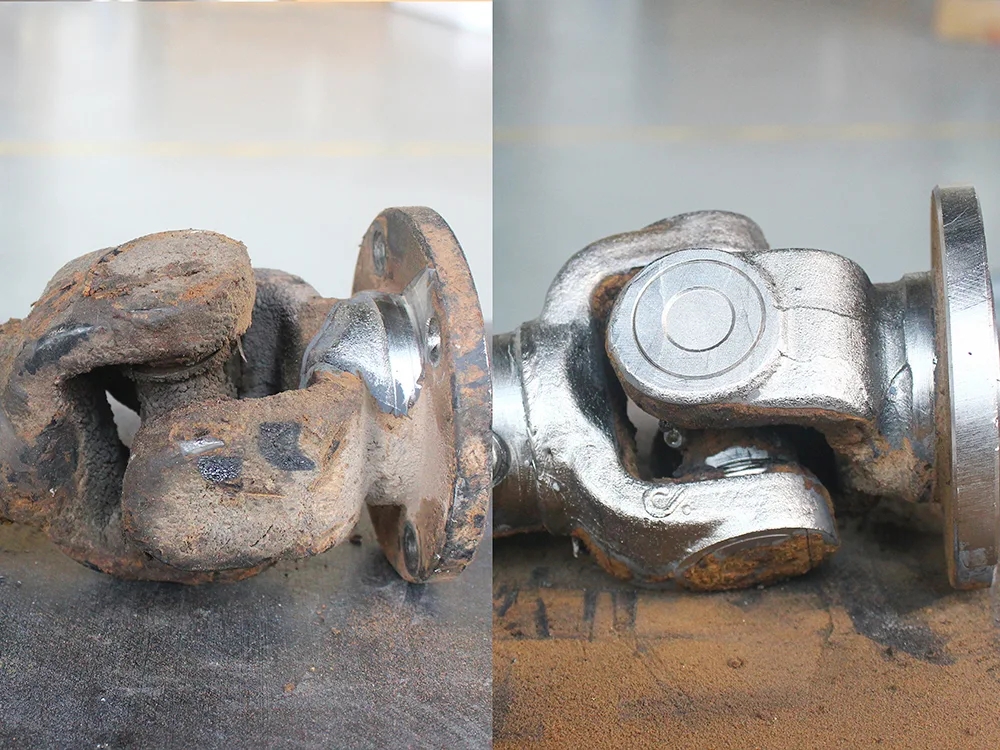
In the global fight against corrosion—a problem costing over $2.5 trillion annually—a clear technological winner is emerging: laser rust removal machines. While traditional methods still exist, the data, performance metrics, and regulatory trends all point in one direction:
Laser-based rust removal is not an upgrade. It is a replacement.
Why Rust Removal Needed Reinvention
Rust is not just oxidation—it is progressive structural decay. In industries such as automotive, shipbuilding, energy, and heavy manufacturing, corrosion directly translates into:
- Reduced mechanical strength
- Increased maintenance cycles
- Higher operational risk
- Shortened asset lifespan
Legacy methods—sandblasting, chemical stripping, manual grinding—were built for a different era. They are:
- Aggressive: removing both rust and base metal
- Polluting: generating dust, chemicals, and hazardous waste
- Uncontrolled: dependent on operator skill
In a precision-driven industrial landscape, these limitations are critical failures.
Laser Rust Removal: Controlled Energy, Targeted Results
Laser rust removal machines operate using high-energy pulsed beams that interact selectively with rust layers. The principle is simple but powerful:
Rust absorbs laser energy more efficiently than the underlying metal—allowing precise removal without substrate damage.
Core Advantages
- Non-contact cleaning
No mechanical force, no micro-cracks, no deformation - Micron-level precision
Ideal for high-value components and tight tolerances - Zero consumables
No abrasives, no chemicals, no secondary waste - Environmentally compliant
Minimal emissions, aligned with global green regulations - Digital control
Repeatable parameters ensure consistent, automated outcomes
This is not cleaning—it is material-level editing.
Data Confirms the Shift
Industry adoption is accelerating:
- The laser cleaning market is growing at 10%+ CAGR, outpacing most traditional surface treatment technologies
- In high-end manufacturing sectors, over 40% of new maintenance investments now consider laser systems
- Environmental regulations are eliminating solvent-based and high-dust processes, especially in Europe and advanced Asian markets
The conclusion is direct:
Laser rust removal is becoming the default choice where precision and compliance matter.
Where Laser Rust Removal Dominates
1. Automotive Manufacturing
From chassis to engine components, laser systems remove rust without altering tolerances—critical for safety and performance.
2. Aerospace & High-Precision Engineering
In industries where microns matter, laser cleaning ensures zero substrate damage, something no abrasive method can guarantee.
3. Shipbuilding & Marine Maintenance
Laser systems are increasingly used for targeted rust removal in sensitive areas, reducing over-blasting and material fatigue.
4. Mold & Tooling Industry
Precision molds benefit from non-destructive cleaning, extending lifespan and maintaining surface integrity.
5. Infrastructure Restoration
Bridges, pipelines, and steel structures can be treated with localized precision, avoiding unnecessary material loss.
Breaking the Biggest Misconception: Cost
Laser rust removal machines are often labeled as “expensive.” This is a superficial assessment.
A deeper cost analysis reveals:
- Up to 70–80% reduction in labor time
- Elimination of consumable materials
- Reduced rework and scrap rates
- Extended equipment lifespan
Traditional methods appear cheaper only because their hidden costs are ignored.
Laser technology does not increase cost—it reallocates it into efficiency and precision.
A Necessary Mindset Shift
The resistance to laser rust removal is not technical—it is conceptual.
Many industries still operate under outdated assumptions:
- That visible abrasion equals effectiveness
- That manual processes ensure better control
- That innovation introduces unnecessary risk
These beliefs are no longer valid.
Precision, automation, and sustainability are now the defining metrics of industrial quality.
Laser systems align with all three.
The Future: Autonomous Laser Cleaning Systems
Laser rust removal is evolving rapidly beyond standalone machines:
- AI-integrated systems that adjust parameters based on surface conditions in real time
- Robotic laser arms for fully automated cleaning خطوط
- IoT-enabled monitoring to predict and treat corrosion before it spreads
This leads to a new paradigm:
Rust is no longer removed after it appears—it is managed continuously and intelligently.
Final Insight
Laser rust removal machines are not just tools—they are a signal.
A signal that industry is moving away from force-based processes toward energy-based precision systems.
A signal that sustainability is no longer optional—it is engineered into the process.
And most importantly, a signal that the future of maintenance is not about reacting to damage—
but about controlling matter with accuracy, before damage defines the outcome.
Post time: Apr-08-2026
