
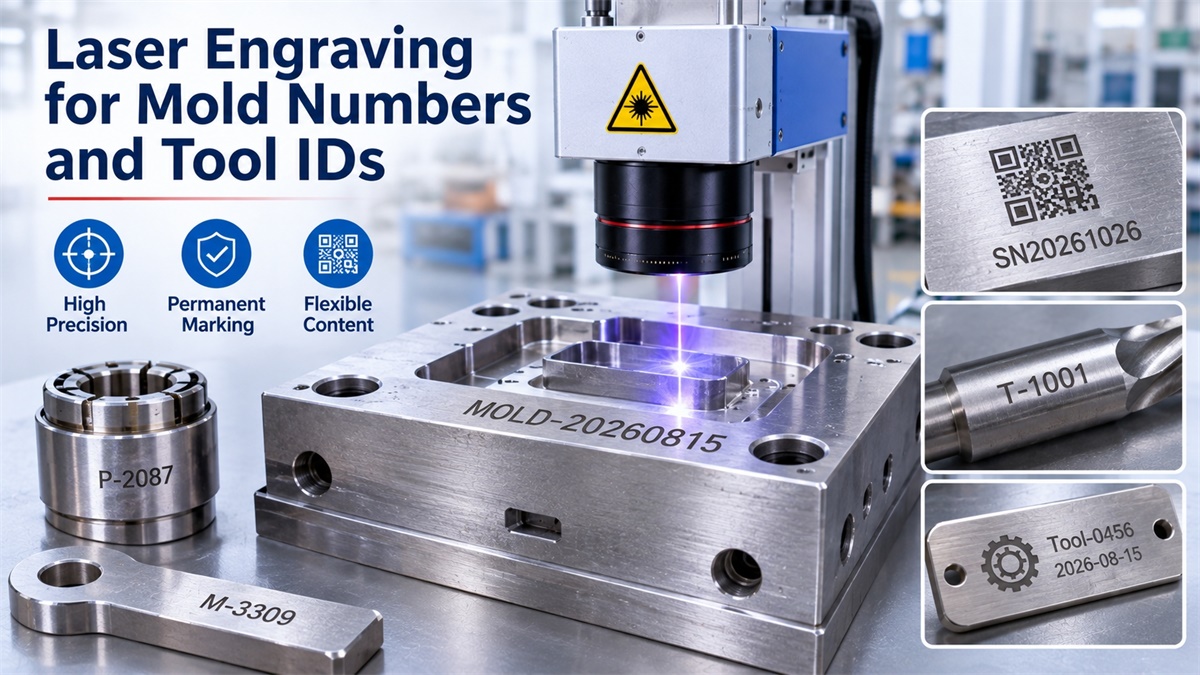
Mold numbers and tool identification marks are essential for manufacturing management, maintenance, and product traceability. Injection molds, stamping dies, cutting tools, and precision tooling often require permanent identification, including serial numbers, model codes, company logos, QR codes, and manufacturing dates.
Traditional methods such as mechanical engraving and stamping can be time-consuming, especially when different molds require customized identification. A fiber laser marking machine provides a more flexible solution by engraving identification information directly onto metal surfaces without physical contact.
For manufacturers working with steel molds and industrial tools, fiber laser technology is particularly suitable. The required laser configuration depends on whether the application involves simple surface identification or deeper engraving.
1. What Information Should Be Engraved on Molds and Tools?
Industrial identification marks serve several purposes beyond displaying a serial number.
Common marking content includes:
-
Mold identification numbers.
-
Tool serial numbers.
-
Part numbers and model codes.
-
Manufacturing dates.
-
Cavity identification numbers.
-
Company logos.
-
QR codes and Data Matrix codes.
-
Maintenance and inspection references.
For example, an injection mold may require a mold number, cavity number, and manufacturing identification code. These markings help operators identify the correct tooling during production, maintenance, and storage.
For expensive industrial tools, unique serial numbers also make asset management and maintenance records easier to organize.
2. Why Use Fiber Laser Engraving for Mold Numbers?
Fiber laser marking is widely used for metal identification because it can process materials such as tool steel, stainless steel, carbon steel, and aluminum.
Compared with traditional mechanical engraving, fiber laser marking offers several advantages:
No physical contact: The laser processes the surface without a mechanical engraving tool touching the workpiece.
Flexible content: Operators can change serial numbers, text, logos, and codes through marking software without manufacturing new engraving plates.
Fine identification: Small characters and detailed graphics can be marked on suitable flat metal surfaces.
Repeatability: Saved marking files and processing parameters help maintain consistency across repeated production orders.
Permanent identification: Laser marking can create surface changes or recessed characters, depending on the processing method.
One important consideration is the mold’s functional surface. Identification should normally be placed on a designated non-functional area to avoid affecting cavity geometry, polishing quality, or mold performance.
3. What Laser Power Is Suitable for Mold and Tool Identification?
The required power depends mainly on the desired marking depth and production efficiency.
| Laser Power | Typical Application |
|---|---|
| 20W | Mold numbers, logos, and basic identification |
| 30W | General steel marking and engraving |
| 50W | More demanding engraving and faster material removal |
| 60W–100W | Specialized deeper engraving applications |
For ordinary mold numbers and tool IDs, a 20W or 30W fiber laser is often sufficient.
If manufacturers need deeper recessed serial numbers that can withstand repeated cleaning and surface wear, 50W or higher-power systems deserve consideration.
However, laser power alone does not determine engraving depth. Steel hardness, pulse characteristics, scanning speed, hatch spacing, and the number of passes all influence the result.
4. Surface Marking vs. Deep Engraving
Not every mold identification application requires deep engraving.
Surface marking
Suitable for mold numbers, company logos, dates, and basic identification information. It is generally faster and requires less material removal.
Deep engraving
Suitable when identification must be recessed into the steel surface. Multiple laser passes gradually remove material to achieve the required depth.
For example, a mold manufacturer may only need a clearly visible serial number on the side of a mold. A tool manufacturer working in a high-wear environment may require deeper identification.
The required depth should be determined by the expected wear, cleaning, and maintenance conditions.
5. How to Achieve Clear and Consistent Mold Identification
Several factors influence the final marking quality.
-
Surface preparation: Remove oil, dust, and contaminants before marking.
-
Character size: Ensure numbers remain readable after engraving.
-
Focus position: Maintain correct focus throughout the marking process.
-
Hatch spacing: Adjust filling density to achieve consistent material removal.
-
Multiple passes: Use repeated scanning when deeper engraving is required.
-
Positioning fixtures: Keep molds and tools stable during processing.
For deep engraving, a roughing process followed by a finishing pass can improve character definition.
If QR codes or Data Matrix codes are required, verify their readability using an appropriate scanner rather than relying only on visual inspection.
6. Which Dowin Fiber Laser Marking Machine Should You Consider?
For mold numbers and tool identification, the most relevant starting point is a fiber laser marking machine designed for metal processing.
Dowin DW-20FDE Desktop Fiber Laser Marking Machine
Product: <a href=”https://www.dowinlaser.com/factory-supply-fiber-laser-engraving-machine-desktop-small-enclosure-model-fiber-laser-marking-machine-dowin-product/” target=”_blank” rel=”noopener”>DW-20FDE Desktop Fiber Laser Marking Machine</a>
Suitable for: Standard mold numbers, tool IDs, serial numbers, and metal identification.
Relevant specifications:
-
20W standard power, optional 30W and 50W.
-
Raycus fiber laser source.
-
1064nm wavelength.
-
110 × 110mm standard marking area.
-
Optional 150 × 150mm and 175 × 175mm areas.
-
Air-cooled operation.
Why recommend it?
Its compact enclosed structure is suitable for workshops that regularly mark smaller molds, tools, and metal components. The different power options also allow buyers to select a configuration according to their marking requirements.
For deeper engraving requirements, evaluate a higher-power deep engraving configuration rather than assuming this standard desktop model will meet every depth specification.
You can also explore the <a href=”https://www.dowinlaser.com/laser-marking-machine/” target=”_blank” rel=”noopener”>Dowin Laser Marking Machine Collection</a> for additional fiber laser configurations, including deep engraving systems.
7. Frequently Asked Questions
1. Can a fiber laser engrave numbers on hardened steel molds?
Yes. Fiber laser marking machines can mark many hardened steel materials. The required parameters depend on steel hardness, surface treatment, and desired engraving depth.
2. Is 20W enough for mold number marking?
For ordinary mold numbers, serial numbers, and logos, 20W is often sufficient. Deeper engraving or higher production efficiency may require more power.
3. Can laser engraving replace mechanical engraving on molds?
For many identification applications, yes. Fiber laser marking offers flexible digital content and non-contact processing. However, applications requiring substantial material removal may still need specialized engraving equipment or mechanical machining.
4. Can QR codes be engraved on mold surfaces?
Yes. Fiber laser machines can mark QR codes and Data Matrix codes on suitable mold surfaces. Code dimensions and marking contrast should be tested to ensure reliable scanning.
5. Does deep laser engraving damage the mold?
Laser engraving removes or modifies material locally. If performed on a critical cavity surface or precision working area, it may affect mold geometry or surface quality. Identification should be positioned in an appropriate non-functional area.
Conclusion
Laser engraving provides an efficient way to identify injection molds, stamping dies, cutting tools, and industrial equipment.
For ordinary mold numbers and tool IDs, a 20W–30W fiber laser marking machine is often a practical choice. For deeper identification marks and more demanding wear conditions, higher-power deep engraving systems should be evaluated.
The best equipment should be selected according to the actual steel material, required engraving depth, character size, and production requirements. Testing representative mold samples before purchasing is the most reliable way to confirm the result.
Post time: Nov-04-2026
