
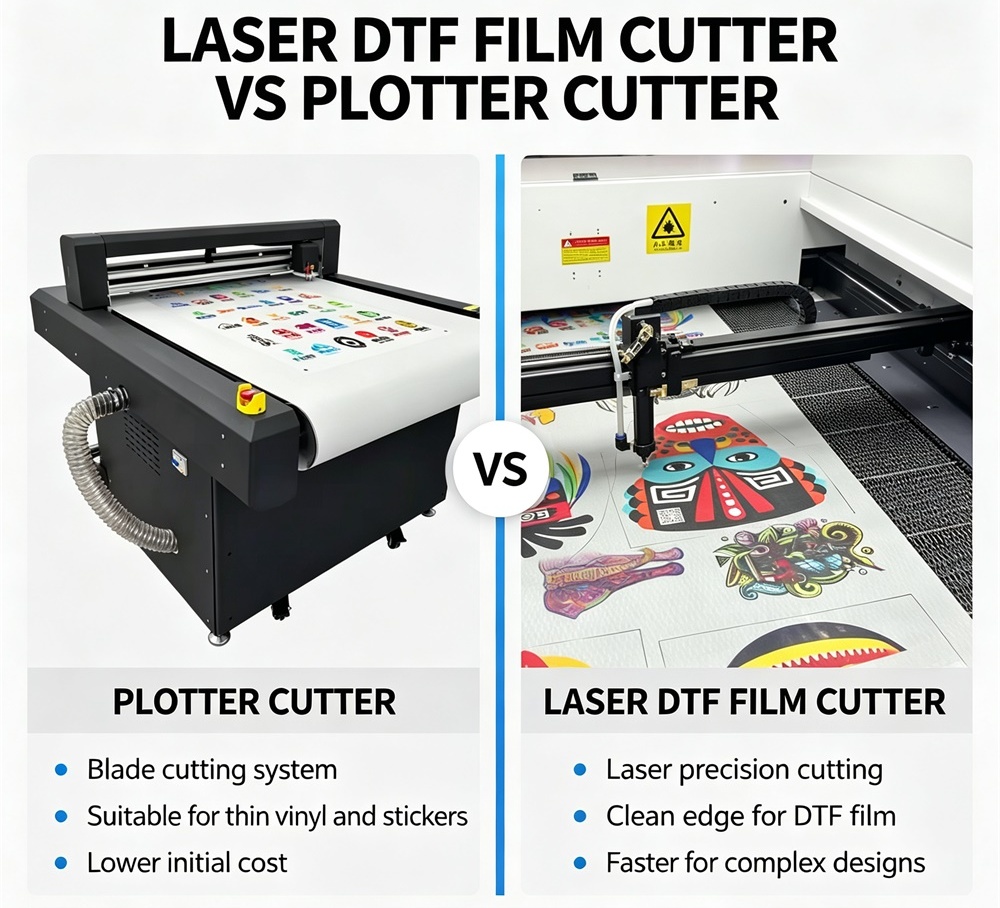
When producing DTF transfers, the cutting method directly affects production speed, labor costs, and overall efficiency. Plotter cutters are widely used for small-scale production, but laser DTF film cutters offer significant advantages when production volume increases.
1. Plotter Cutter: Low Cost, but Limited Speed
A plotter cutter is relatively simple and affordable, making it suitable for small workshops and low-volume DTF orders.
However, the cutting process usually requires MARK point registration and CCD positioning. The machine needs to identify multiple registration points for each sheet, which takes additional time.
For large or complex designs, blade cutting can also become slower and may cause the DTF film to move slightly during processing. Blades wear out over time and need regular replacement. Poor blade adjustment can also lead to incomplete or uneven cutting.
For example, a typical 60 cm, 4-head DTF printer can produce around 20 m² of printed film per hour. If the cutting machine cannot keep up, multiple printers may need to wait for the cutting process, increasing equipment and labor costs.
2. Laser DTF Film Cutter: Faster and More Automated
A laser DTF film cutter uses a vision camera system instead of relying on traditional MARK points for normal production.
It supports two main cutting modes:
Template Matching Cutting
A sample is scanned once to create a digital template. During mass production, the camera automatically identifies matching patterns and performs positioning cutting. Combined with automatic feeding, it allows continuous production with minimal manual operation.
Real-Time Contour Cutting
The camera detects the outer contour of the printed artwork in real time and automatically generates the cutting path. No preset template is required, making it suitable for sampling and orders with frequently changing designs.
If the printed artwork has no clear outer border, an outer contour should be added so the vision system can identify the cutting boundary.
3. Laser vs. Plotter Cutter: Key Differences
| Feature | Plotter Cutter | Laser DTF Film Cutter |
|---|---|---|
| Cutting method | Blade | Laser |
| MARK points | Usually required | Normally not required |
| Positioning | CCD/registration points | Vision recognition |
| Blade replacement | Required | No blade replacement |
| Complex designs | Can be slower | Fast and flexible |
| Automatic feeding | Available on some models | Supported |
| Mass production | Limited by positioning and blade cutting | Better suited |
| Model changes | Requires adjustment | Real-time contour cutting available |
4. Which DTF Businesses Should Choose a Laser Cutter?
DTF Printing Businesses
If you are already operating a DTF printer, our laser cutter can be added directly to your existing production workflow.
It helps you cut printed DTF films more efficiently, especially when you have many different designs or a growing number of orders.
Ideal for:
- DTF printing shops
- DTF transfer businesses
- Custom T-shirt printing
- Small and medium DTF production companies
DTF Transfer Manufacturers
For customers producing large quantities of ready-to-press DTF transfers, cutting efficiency is especially important.
Our DTF Film Laser Cutter is designed to help reduce manual cutting work and provide more consistent results for repeated production.
It is suitable for businesses that need to process a large number of customized designs every day.
DTF Printer Distributors
If you sell DTF printers and related equipment, our laser cutter can be added to your existing product portfolio.
We can supply the machine directly as a complementary solution for your DTF customers, helping you offer a more complete DTF printing and cutting solution.
Custom Apparel Businesses
Our machine is also suitable for businesses producing:
- Custom T-shirts
- Hoodies
- Sportswear
- Workwear
- Team uniforms
- Personalized clothing
It is particularly useful when you need to process many different graphics, names, numbers, or logos.
Garment Manufacturers
For larger garment factories, our DTF laser cutter can be integrated into a higher-volume production workflow.
It can help improve cutting efficiency when producing customized apparel and reduce the amount of manual work required.
Why Choose Our DTF Film Laser Cutter?
As the manufacturer, we can provide more than just the machine. We can help customers select the appropriate configuration according to their DTF printer, film size, production volume, and cutting requirements.
Our goal is to provide a complete workflow:
DTF Printing → Powder Application → Curing → Laser Cutting → Finished DTF Transfer
If you are looking to increase DTF transfer production efficiency, our DTF Film Laser Cutter can be integrated into your existing workflow as a dedicated automatic cutting solution.
5. Choosing the Right Laser DTF Cutter
For small workshops and low-volume production, a 9070 single-head or dual-head laser cutter can be a practical choice. The 9070 single-head model can cut around 15 m²/h, while the dual-head version can reach approximately 20 m²/h.
For higher production requirements, a 1215 dual-head rack-drive laser cutter can reach around 60 m²/h. This means one machine can approximately support the output of three 60 cm, 4-head DTF printers under typical production conditions.
An enclosed or open configuration can be selected according to the customer’s production environment and safety requirements.
Conclusion
A plotter cutter can be a cost-effective solution for small-volume DTF production, but its blade cutting, registration process, and limited speed can become bottlenecks as production grows.
For businesses running multiple DTF printers or handling large volumes of transfer film, a laser DTF film cutter provides faster cutting, vision-based positioning, automatic feeding, and lower blade maintenance, making it a more scalable solution for professional DTF production.
Post time: Aug-20-2026
