
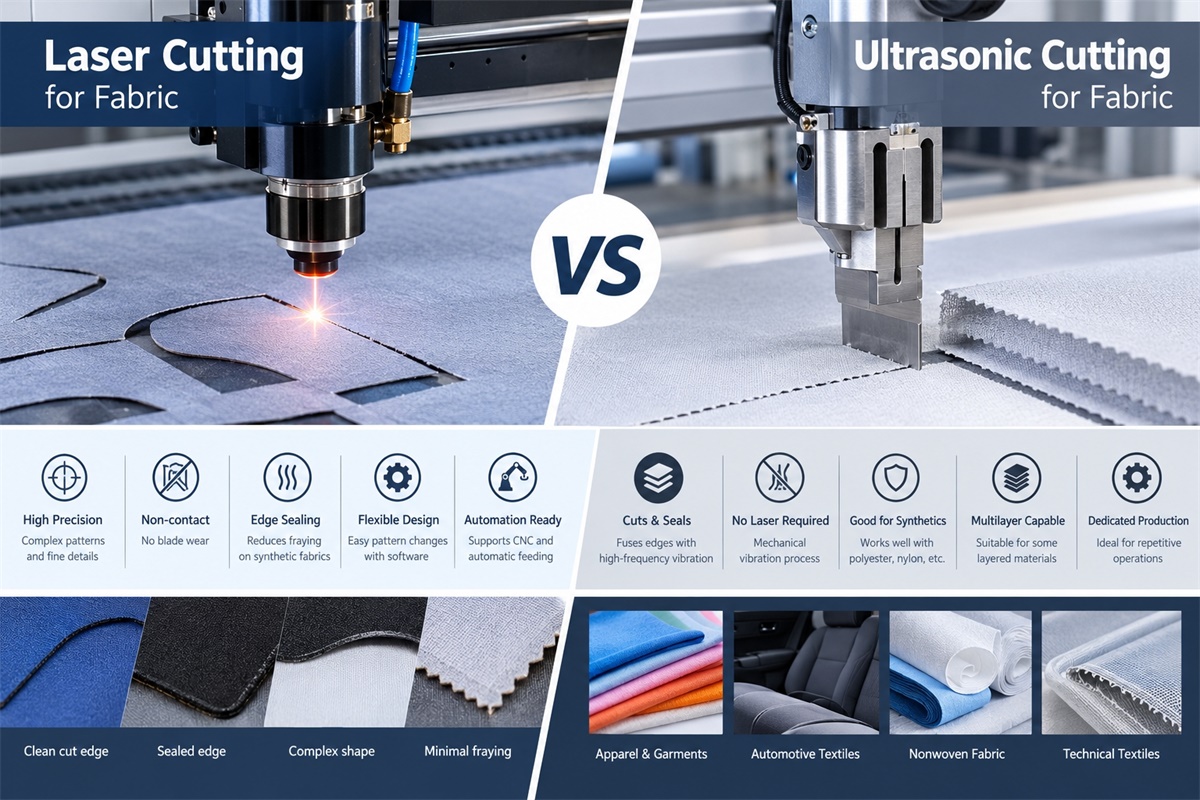
For manufacturers working with polyester, nylon, nonwoven fabric, and other synthetic textiles, understanding the differences between laser cutting and ultrasonic cutting can help reduce material waste, improve product consistency, and lower long-term operating costs. A fabric auto-feeding laser cutting machine is worth considering when continuous cutting, complex patterns, and automated production are important.
1. What Is Laser Cutting for Fabric?
Laser fabric cutting uses a focused laser beam, commonly generated by a CO2 laser source, to cut textile materials along a programmed path. The laser melts, vaporizes, or thermally decomposes the material in a narrow cutting zone, depending on its composition and the processing parameters.
Unlike mechanical cutting tools, a laser does not need to touch the fabric directly. This reduces tool wear and allows manufacturers to process intricate shapes without changing physical cutting blades.
Main advantages of laser fabric cutting
-
High precision: Suitable for complex patterns, small details, and intricate contours.
-
Non-contact processing: No blade pressure or mechanical cutting force is applied to the fabric.
-
Reduced fraying: Thermal cutting can seal the edges of many thermoplastic synthetic fabrics, including polyester and nylon.
-
Flexible design changes: CAD files can be modified without manufacturing new dies or custom cutting tools.
-
Automation compatibility: Camera positioning, conveyor systems, and automatic feeding can support continuous production.
-
Consistent cutting quality: Properly configured systems can maintain repeatable cutting paths across production batches.
Laser cutting is widely applicable to apparel components, automotive textiles, technical fabrics, nonwoven materials, banners, upholstery, and customized textile products.
However, thermal processing requires careful parameter control. Excessive laser power or slow cutting speeds can cause discoloration, melted edges, smoke, or heat damage. Natural fibers such as cotton may char rather than form a clean, sealed edge.
2. What Is Ultrasonic Cutting for Fabric?
Ultrasonic fabric cutting uses high-frequency mechanical vibration, typically transmitted through a vibrating blade or sonotrode, to cut material. Frictional and mechanical energy generates localized heat, which can soften or fuse thermoplastic fibers while the material is being separated.
This makes ultrasonic cutting particularly useful for certain synthetic fabrics and multilayer textile assemblies where a clean edge or fused seam is desirable.
Main advantages of ultrasonic fabric cutting
-
Simultaneous cutting and edge sealing: Suitable thermoplastic fibers can fuse along the cut edge.
-
No laser beam required: The process uses mechanical vibration rather than an optical laser source.
-
Effective for selected synthetic textiles: Polyester, nylon, and some coated or laminated materials may be processed successfully.
-
Potential for multilayer processing: Certain ultrasonic systems can cut and seal multiple layers, depending on material thickness and configuration.
-
Suitable for specialized production lines: Ultrasonic cutting is used in applications such as web processing, narrow textile strips, and selected technical textile products.
Ultrasonic cutting also has limitations. Cutting quality depends on the material, vibration frequency, tool geometry, pressure, and feed speed. Tool wear, uneven sealing, material deformation, and restrictions on complex cutting paths may affect performance.
Not every fabric is suitable for ultrasonic cutting. Natural fibers, thick composites, and certain multilayer materials may require different processing methods or extensive parameter testing.
3. Laser Cutting vs Ultrasonic Cutting: Key Differences
| Comparison factor | Laser cutting | Ultrasonic cutting |
|---|---|---|
| Cutting method | Focused laser beam | High-frequency mechanical vibration |
| Cutting precision | Excellent for intricate programmed contours | Depends on tool design and cutting configuration |
| Edge sealing | Effective on many thermoplastic synthetic fabrics | Effective on suitable thermoplastic materials |
| Complex patterns | Highly flexible with CNC control | Depends on machine configuration and tool movement |
| Tool contact | Non-contact cutting | Physical contact with a vibrating cutting tool |
| Tool wear | No cutting blade wear | Cutting tools can wear over time |
| Material thickness | Depends on laser power and material properties | Depends on ultrasonic power, tool design, and material |
| Automation | Compatible with CNC, vision systems, and automatic feeding | Compatible with automated web and production-line systems |
| Best-fit applications | Complex shapes, nested patterns, and flexible cutting tasks | Selected edge-sealing, strip-cutting, and specialized textile operations |
| Main concerns | Heat damage, fumes, and possible edge discoloration | Tool wear, material compatibility, and consistent sealing |
Neither technology is universally better. The right choice depends on the material and the actual cutting operation.
4. Which Method Is Better for Polyester and Nylon Fabric?
Polyester and nylon are thermoplastic synthetic materials, so both laser cutting and ultrasonic cutting can be suitable. However, their performance differs according to the required shape and production process.
Laser cutting for polyester
CO2 laser cutting is useful for polyester fabrics that require detailed shapes, repeated patterns, or automated cutting. The thermal process can fuse the cut edge and reduce fraying, especially when the laser parameters are correctly adjusted.
Common applications include:
-
Polyester garments and textile accessories
-
Upholstery and decorative fabrics
-
Industrial polyester fabrics
-
Flags, banners, and printed textiles
-
Polyester-based technical textiles
For printed polyester, testing is important because excessive heat can discolor the surface or affect coatings.
Ultrasonic cutting for polyester
Ultrasonic cutting is worth considering when the production task involves straight cuts, narrow strips, or edge sealing integrated into a specialized manufacturing line.
For example, manufacturers producing polyester webbing or selected textile components may benefit from a process that cuts and fuses the material in one operation.
What about nylon?
Nylon can also be processed using either technology, but its melting behavior, thickness, weave, and surface treatment affect the final result.
Laser cutting may be preferable for intricate shapes, while ultrasonic cutting may be advantageous for specific sealing operations. A practical material test should evaluate edge strength, visible deformation, cutting consistency, and production speed before a machine is selected.
5. Which Method Is Better for Nonwoven Fabric?
Nonwoven fabric is used in filtration, medical products, automotive interiors, protective products, packaging, and disposable textiles.
Laser cutting can process many nonwoven materials without mechanical pressure, making it useful for detailed shapes and automated batch production. Synthetic nonwovens may also benefit from thermal edge sealing.
Ultrasonic cutting is particularly relevant to selected nonwoven production processes where cutting and bonding can be combined. It may be suitable for certain disposable products, filtration components, and synthetic nonwoven assemblies.
However, nonwoven materials vary significantly. Polypropylene, polyester, cellulose-based fibers, and blended materials respond differently to heat and vibration.
The most suitable method should be selected according to:
-
Fiber composition and melting behavior
-
Material thickness and density
-
Required edge strength
-
Cutting shape and dimensional tolerance
-
Whether bonding and sealing are needed
-
Production volume and automation requirements
For manufacturers processing large sheets or complex nested patterns, laser cutting may provide greater flexibility. For dedicated production lines requiring simultaneous cutting and bonding, ultrasonic technology may be more appropriate.
6. Cutting Speed and Production Efficiency
Cutting speed is one of the most important factors when comparing industrial fabric cutting technologies. However, the maximum speed stated in a machine specification does not necessarily represent real production output.
Ultrasonic cutting can be highly efficient for repetitive operations with a fixed cutting path or continuous material feed. Once the production line is configured, it can perform consistent cutting and sealing operations with limited intervention.
Laser cutting can be efficient for automated production involving multiple shapes, frequent design changes, or complex cutting layouts. CNC control eliminates the need for physical cutting dies and allows manufacturers to change patterns through software.
Actual throughput depends on several variables:
-
Material thickness and construction
-
Cutting length and geometric complexity
-
Number of layers being processed
-
Machine acceleration and positioning speed
-
Loading, unloading, and material alignment
-
Inspection and finishing requirements
For high-volume textile manufacturing, compare the number of finished parts produced per hour rather than evaluating cutting speed alone. A machine that cuts faster but requires additional handling or finishing may not deliver the lowest cost per part.
7. Which Technology Offers Lower Operating Costs?
The initial purchase price is only one part of the total cost of fabric cutting. Maintenance, labor, consumables, material waste, energy consumption, and production downtime should also be considered.
Laser cutting costs
Laser systems generally eliminate the need for physical cutting blades, although optical components and other machine parts require maintenance. Exhaust ventilation and filtration may also be necessary to manage smoke and processing emissions.
For complex patterns, laser cutting can reduce the need for dies and simplify production changeovers. Automated nesting can also improve material utilization.
Ultrasonic cutting costs
Ultrasonic systems require maintenance of the vibrating tool, horn, and associated components. Tool wear and the need to replace or adjust components can influence long-term operating costs.
For dedicated cutting tasks, ultrasonic equipment may offer an efficient production solution. However, equipment configured for one operation may be less flexible when the product design changes substantially.
How to compare the real cost
Use the following calculation for both technologies:
Cost per finished part = Total production cost ÷ Number of acceptable finished parts
Include labor, electricity, maintenance, consumables, material waste, rejected parts, and downtime in the total production cost.
A short production trial using the same material and finished-part specifications is usually more informative than comparing machine prices alone.
8. When Should You Choose a Laser Fabric Cutting Machine?
A laser fabric cutting machine is a strong candidate when your production requirements include:
1. Complex cutting patterns
Laser systems can follow intricate digital paths without requiring custom mechanical dies. This is useful for customized textiles, garment components, and technical fabric shapes.
2. Frequent design changes
Manufacturers can update cutting patterns in software, making laser cutting suitable for small batches, product variations, and customized orders.
3. Automatic feeding and continuous production
Automatic feeding systems can reduce manual material handling and improve production consistency. For roll-fed textile manufacturing, a conveyor-based laser cutting machine may be worth evaluating.
4. Reduced fraying on synthetic fabrics
Thermal cutting can seal the edges of many polyester and nylon fabrics, reducing the need for additional edge-finishing operations. The result depends on fiber composition and process settings.
5. High flexibility across different products
A CNC laser system can switch between cutting designs without replacing a physical cutting die, provided the materials fall within the machine’s processing capabilities.
For manufacturers seeking to automate textile cutting, explore the Dowin fabric auto-feeding laser cutting machine range and evaluate the machine configuration against your fabric width, cutting area, required accuracy, and production volume.
9. When Is Ultrasonic Cutting the Better Choice?
Ultrasonic cutting may be the better option when the manufacturing process is built around a specific cutting and sealing operation rather than flexible, complex shapes.
Consider ultrasonic technology if:
-
You mainly produce straight cuts or narrow strips.
-
Edge sealing is a central production requirement.
-
Cutting and bonding need to occur in the same operation.
-
Your material has been proven compatible with ultrasonic processing.
-
Your production line uses dedicated tooling and repetitive movements.
For example, a manufacturer producing a large volume of consistent synthetic textile strips may find ultrasonic cutting efficient. However, if the same factory frequently switches between complex product designs, a programmable laser system may offer greater flexibility.
The best choice should be based on sample testing, production trials, and the cost of producing acceptable finished parts.
10. How to Test Fabric Before Buying a Cutting Machine
Before investing in either technology, ask the supplier to process your actual material samples.
A useful test should include:
-
Material identification: Confirm the fiber composition, weave, coating, and thickness.
-
Cutting quality: Inspect edge smoothness, fraying, melting, discoloration, and deformation.
-
Dimensional accuracy: Measure finished parts against the required tolerances.
-
Production speed: Test realistic patterns rather than a single short straight line.
-
Multilayer performance: If you process multiple layers, confirm that all layers meet the required specifications.
-
Automation performance: Evaluate feeding, alignment, unloading, and repeatability.
-
Operating cost: Record consumables, labor requirements, waste, and maintenance considerations.
For laser processing, also assess smoke extraction and the effects of heat on the fabric. For ultrasonic processing, inspect edge consistency and the durability of the fused area.
A machine should be selected only after the finished samples meet the actual production requirements.
Conclusion: Laser Cutting or Ultrasonic Cutting?
Laser cutting and ultrasonic cutting both have important roles in textile manufacturing, but they solve different production problems.
Laser cutting is generally more attractive for complex patterns, flexible CNC processing, frequent design changes, and automated cutting of many textile shapes. Ultrasonic cutting is particularly useful for selected applications where cutting and edge sealing or bonding can be integrated into a specialized production process.
For manufacturers that need flexible cutting, detailed contours, and automated fabric handling, a CO2 laser fabric cutting machine is worth evaluating. For repetitive cutting and sealing operations, ultrasonic technology may be the more suitable solution.
The final decision should be based on actual fabric samples, required edge quality, production throughput, and total operating cost rather than the machine’s advertised speed alone.
Frequently Asked Questions
1. Is laser cutting better than ultrasonic cutting for fabric?
Laser cutting is often better for complex shapes, digital pattern changes, and flexible CNC production. Ultrasonic cutting can be better for specialized operations that require simultaneous cutting and sealing. The best method depends on the material and application.
2. Can ultrasonic cutting seal fabric edges?
Yes. Ultrasonic cutting can fuse the edges of suitable thermoplastic synthetic fabrics through localized heat generated by high-frequency vibration. The sealing quality depends on the material and processing parameters.
3. Does laser cutting prevent fabric from fraying?
Laser cutting can reduce fraying by thermally sealing the edges of many synthetic fabrics, including polyester and nylon. However, natural fibers such as cotton may char, and some materials may still require additional finishing.
4. Is CO2 laser cutting suitable for nonwoven fabric?
Yes, CO2 laser cutting can process many nonwoven materials, especially synthetic varieties. The appropriate power and speed depend on the material’s composition, thickness, and required edge quality.
5. Which method is faster for industrial fabric cutting?
There is no universal winner. Ultrasonic cutting can be efficient for repetitive operations, while laser cutting can deliver high productivity for automated, complex cutting tasks. Compare finished parts per hour under realistic production conditions.
6. Can laser cutting process multiple layers of fabric?
Yes, some laser cutting systems can process multiple layers, but the practical layer count depends on material thickness, density, laser power, cutting speed, and the required edge quality. Testing is necessary before setting production parameters.
7. What should I consider before buying a fabric cutting machine?
Evaluate material compatibility, cutting accuracy, edge quality, actual throughput, automation, maintenance, safety requirements, and total cost per finished part. Request a sample test using your own fabric before making a purchasing decision.
Post time: Oct-19-2026
