
Choosing between laser cutting and die cutting for fabric depends on your production volume, design complexity, material type, and budget. Both methods are widely used in textile manufacturing, garment production, embroidery, footwear, and fabric accessory processing. However, they differ significantly in tooling costs, cutting flexibility, edge quality, and automation.
For manufacturers handling frequent design changes, intricate patterns, or printed textiles, laser cutting offers several practical advantages. Die cutting can remain a cost-effective choice for large batches of identical shapes. Understanding these differences will help you select the right fabric cutting technology for your business.
1. What Is Laser Cutting for Fabric?
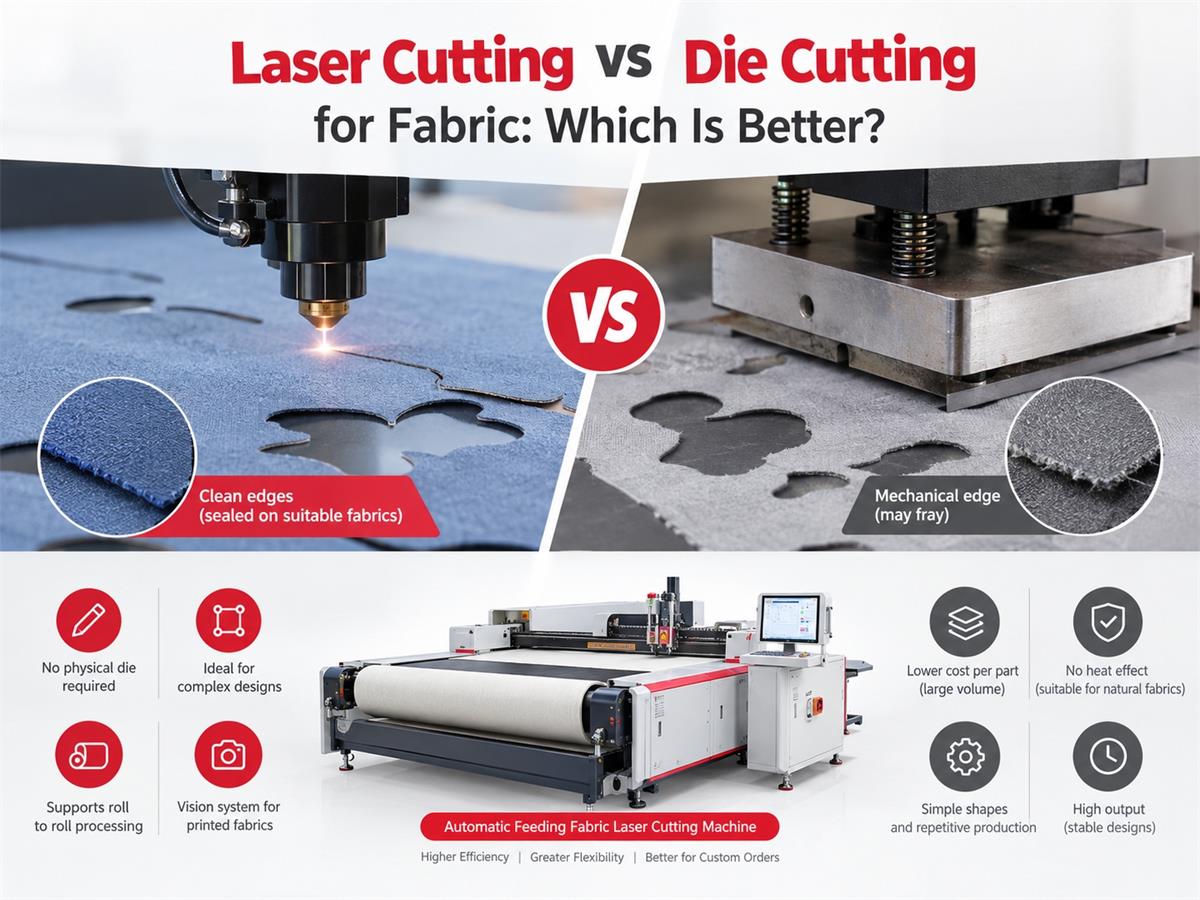
Laser cutting uses a focused laser beam to cut fabric according to a digital design. A CO2 laser cutting machine is commonly used for non-metallic materials, including many textiles, synthetic fabrics, felt, leather, and certain technical fabrics.
The cutting path is controlled by software, allowing manufacturers to process complicated contours, small holes, narrow slots, and detailed patterns without manufacturing a physical cutting die.
For roll materials, an automatic feeding system can continuously move fabric through the cutting area. A vision camera can also identify printed patterns and guide the laser along their contours, which is particularly useful for printed garments, woven labels, embroidery patches, and textile logos.
Learn more about Dowin’s automatic fabric laser cutting machine for roll-to-roll processing and automated textile cutting applications.
2. What Is Die Cutting for Fabric?
Die cutting uses a specially manufactured cutting die to press, stamp, or cut fabric into a predetermined shape. Depending on the application, the equipment may use steel-rule dies, flatbed presses, or rotary dies.
The die acts as a physical template. Once it has been produced and installed, the machine can repeatedly cut the same shape across large quantities of material.
Die cutting is commonly used for fabric components, garment accessories, shoe parts, textile pads, labels, and other products that require consistent shapes in repeated production runs.
However, each new design may require a new die. This creates additional tooling costs, storage requirements, and setup time when product designs change frequently.
3. Laser Cutting vs Die Cutting: Key Differences
The following comparison highlights the main differences between the two technologies.
| Comparison | Laser Cutting | Die Cutting |
|---|---|---|
| Cutting method | Focused laser beam | Physical cutting die |
| Tooling cost | No physical die required | Die manufacturing required |
| Complex designs | Excellent for intricate contours | Depends on die complexity |
| Design changes | Usually updated digitally | May require a new die |
| Small production runs | Often economical | Tooling can increase costs |
| Large repeated batches | Depends on cutting speed and automation | Often highly cost-effective |
| Edge treatment | Can seal edges on suitable synthetic fabrics | Usually leaves mechanically cut edges |
| Contact with fabric | Non-contact cutting | Physical contact or pressing |
| Printed pattern cutting | Vision systems can follow printed contours | Requires accurate registration and suitable tooling |
| Wear and maintenance | Laser optics, motion components, and exhaust require maintenance | Dies wear and may require replacement |
| Shape flexibility | High | Limited by the manufactured die |
Actual performance depends on fabric composition, thickness, machine configuration, cutting geometry, and production requirements. Neither method is automatically faster or cheaper in every application.
4. Cutting Quality: Which Method Produces Better Fabric Edges?
Cutting quality is one of the most important factors when choosing a fabric cutting machine.
Laser cutting
Laser cutting can produce clean, precise edges without physically pulling or pushing the fabric. On suitable synthetic materials, the heat can seal the cut edge and reduce fraying.
This is particularly useful for polyester textiles, certain synthetic blends, woven labels, intricate decorative patterns, and components with small internal details.
However, laser cutting is a thermal process. Natural fabrics such as cotton may char, discolor, or develop dark edges depending on the material and cutting parameters. Some coated, laminated, or heat-sensitive textiles may also deform or release undesirable fumes.
Before selecting a machine, test the actual fabric for edge quality, discoloration, shrinkage, and ventilation requirements.
Die cutting
Die cutting does not rely on a laser beam, so it avoids heat-related discoloration and thermal damage. It can be suitable for cotton, felt, foam-backed textiles, and other materials that respond well to mechanical cutting.
Its limitations may appear when cutting very intricate shapes, narrow internal details, or multiple designs requiring frequent tooling changes. Blade condition, die accuracy, material movement, and the pressure applied can all affect the final result.
Which is better? Laser cutting is often preferable for intricate designs and suitable synthetic fabrics that benefit from sealed edges. Die cutting may be better when thermal effects must be avoided and the product geometry is simple and repetitive.
5. Production Efficiency: Which Method Is Faster?
Production speed depends on the number of parts, cutting complexity, material layout, and machine configuration.
Die cutting can achieve high output when manufacturing thousands of identical shapes. Once the die is installed and the material is positioned correctly, repeated cutting can be extremely efficient. However, preparing new dies and changing tooling can slow production when orders vary.
Laser cutting eliminates the need to manufacture a physical die. Operators can switch between digital designs with relatively little setup, making it suitable for customized products, short production runs, and manufacturers processing multiple orders.
For continuous textile production, automatic feeding can further reduce manual handling. Fabric moves through the machine as cutting proceeds, improving workflow efficiency and reducing the need to reposition material after each batch.
For example, Dowin’s DW-1610AF conveyor belt automatic feeding CO2 laser cutting machine is designed for roll materials and can also process flat materials. For printed textiles requiring contour recognition, a camera-equipped automatic fabric laser cutting machine offers another option.
When comparing production speeds, evaluate the complete process rather than just the cutting head. Feeding, unloading, positioning, material alignment, and finished-part handling can all affect actual output.
6. Which Method Is More Cost-Effective?
The total cost of fabric cutting includes more than the initial machine price. Tooling, labor, maintenance, material waste, production speed, and order frequency all influence the final cost per part.
Laser cutting costs
Laser cutting requires an initial investment in the machine, ventilation, and other necessary equipment. Ongoing expenses may include electricity, laser tube replacement, optical components, maintenance, and exhaust filtration.
However, it eliminates physical cutting dies and allows manufacturers to update designs digitally. For businesses with many product variations or frequent custom orders, this can reduce tooling expenses and production preparation time.
Automatic feeding and camera positioning may also help reduce manual handling and improve material utilization, depending on the application.
Die cutting costs
Die cutting requires the purchase and maintenance of cutting dies in addition to the machine itself. This can increase initial setup costs, particularly when a business offers numerous product shapes.
On the other hand, the tooling cost can be spread across a large quantity of identical parts. For stable, high-volume production, die cutting may achieve a lower cost per piece.
Break-even considerations
Suppose a manufacturer receives frequent orders for small batches of different textile designs. Producing a new die for each design may make mechanical cutting less economical.
By contrast, a manufacturer producing one standard fabric component in very large quantities may benefit from a dedicated die.
There is no universal break-even quantity. To make a reliable comparison, calculate the cost of tooling, labor, machine operation, setup, material waste, and maintenance for your actual production requirements.
7. Which Materials Are Suitable for Laser Cutting and Die Cutting?
Material compatibility should be evaluated before selecting either technology.
| Fabric or Material | Laser Cutting | Die Cutting |
|---|---|---|
| Polyester | Often suitable; edges may be sealed | Suitable |
| Nylon | Often suitable, but melting and edge quality require testing | Suitable |
| Cotton | Possible, but charring may occur | Suitable |
| Felt | Often suitable depending on composition | Suitable |
| Fleece | Often suitable, depending on fiber composition | Suitable |
| Denim | Suitable for many applications with parameter testing | Suitable |
| Genuine leather | Often suitable; smoke and discoloration need evaluation | Suitable |
| Synthetic leather | Often suitable if the material is laser-safe | Suitable |
| Embroidered labels | Excellent for intricate contours and suitable materials | Suitable for repeated standard shapes |
| Laminated or coated fabrics | Requires careful material and emissions testing | Depends on layer structure and cutting requirements |
These are general guidelines rather than guarantees. Fabric construction, dyes, coatings, adhesives, and fiber blends can significantly affect the result.
Never laser-cut unknown materials without checking their composition and safety requirements. PVC and other chlorine-containing materials must not be processed with a laser because they can release hazardous corrosive gases.
8. Why Automatic Feeding and Vision Systems Matter
For textile factories, the cutting method is only part of the production decision. Automation can be equally important.
Automatic feeding for roll fabrics
An automatic feeding system moves fabric from a roll onto the cutting area, supporting continuous processing and reducing repetitive manual positioning.
This is especially useful for garment components, textile accessories, decorative fabric shapes, and other products manufactured from long rolls.
For applications requiring a larger working area, the DW-1820S large fabric laser cutting machine with vision is one model to evaluate. Select the working area, number of laser heads, and feeding configuration according to your fabric width and expected output.
Vision cutting for printed fabrics
Printed fabric introduces an additional challenge: the cutting line must follow the printed design rather than simply follow a fixed position on the material.
A camera-based laser cutting system can capture printed contours and generate cutting paths from the detected shapes. This can reduce the need for manually preparing separate cutting files for every printed design.
Typical applications include sublimation-printed textiles, embroidered patches, woven labels, garment logos, and customized textile decorations.
Vision systems are particularly valuable when printed patterns vary in position or orientation. Their actual accuracy depends on the camera, software, contrast between the pattern and background, fabric distortion, and machine calibration.
9. When Should You Choose Laser Cutting?
Laser cutting is worth considering if your business has one or more of the following requirements:
-
Frequent design changes: You need to process different shapes without manufacturing new dies.
-
Intricate contours: Your products contain small holes, detailed outlines, or complex decorative patterns.
-
Printed fabric cutting: You need camera recognition to follow printed shapes.
-
Customized orders: You handle small batches, samples, personalized products, or many product variations.
-
Continuous roll processing: You want to combine laser cutting with automatic fabric feeding.
-
Reduced fraying: You process suitable synthetic fabrics that benefit from heat-sealed edges.
For these applications, a CO2 fabric laser cutting machine with an appropriate working area and feeding configuration may offer greater flexibility than traditional die cutting.
10. When Is Die Cutting the Better Choice?
Die cutting remains a strong option for manufacturers that prioritize repeatable, high-volume production of standard shapes.
Consider die cutting when:
-
You manufacture very large quantities of the same component.
-
Your designs remain stable over long production periods.
-
The material is sensitive to heat or unsuitable for laser processing.
-
The required shape can be cut efficiently using a physical die.
-
Your existing production line already uses mechanical cutting equipment.
-
Your cost analysis shows that tooling expenses are offset by high production volume.
In these situations, die cutting can provide a straightforward and economical manufacturing process.
11. How to Choose the Right Fabric Cutting Machine
Before purchasing equipment, evaluate the following factors.
1. Fabric type and thickness
Identify the exact fiber composition, coating, thickness, and number of layers you intend to process. Request cutting samples before confirming your equipment configuration.
2. Production volume
Estimate your daily output, average order size, and number of different designs. Large repeated orders may favor die cutting, while diverse orders may favor laser cutting.
3. Fabric width and feeding method
For roll materials, check the maximum feeding width and whether the machine supports automatic conveying. Ensure that the working area accommodates your product dimensions.
4. Cutting accuracy
If you process printed fabric, embroidery, or irregular contours, determine whether a vision system is necessary. Ask the supplier to demonstrate cutting on your actual samples.
5. Edge quality
Check for fraying, melting, discoloration, smoke marks, and distortion. The best method is the one that consistently meets your product’s quality requirements.
6. Total operating cost
Compare the machine investment, tooling, labor, consumables, maintenance, material waste, and output. Calculate the cost per acceptable finished part rather than relying only on the purchase price.
7. Safety and ventilation
Laser equipment requires appropriate guarding, exhaust extraction, and material-specific safety checks. Die-cutting equipment also requires suitable guarding and operator protection.
Conclusion: Laser Cutting or Die Cutting for Fabric?
Laser cutting and die cutting serve different production needs. Die cutting is often a practical choice for high-volume manufacturing of identical fabric components, while laser cutting offers greater flexibility for intricate designs, customized orders, printed textiles, and automated roll processing.
For manufacturers looking to reduce tooling changes and automate textile cutting, a fabric laser cutter with automatic feeding or camera positioning is worth evaluating.
Dowin provides several fabric laser cutting configurations, including automatic feeding laser cutting machines, conveyor belt CO2 laser cutters, and camera-equipped fabric cutting machines.
The most suitable option depends on your material, product geometry, output target, and budget. Test your actual fabric, compare production costs, and choose a configuration that meets your manufacturing requirements.
Post time: Oct-12-2026
