
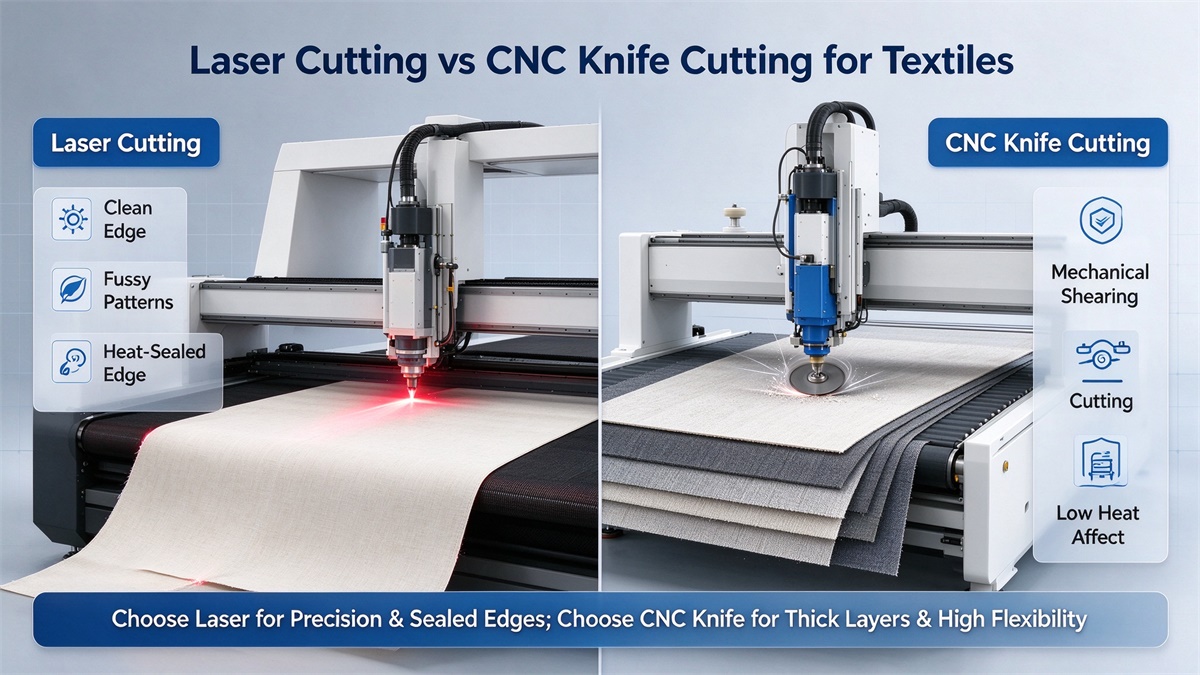
Choosing between laser cutting and CNC knife cutting for textiles depends on the fabric type, production volume, edge quality, and cutting accuracy required. Both technologies are widely used in textile manufacturing, garment production, upholstery, technical fabrics, and custom fabric processing.
However, they work in different ways. A laser cutting machine uses a focused beam of light to cut material, while a CNC knife cutting machine uses a physical blade to separate the fabric. Understanding these differences helps manufacturers select the right equipment for their production needs.
1. How Does Laser Cutting Work on Textiles?
A fabric laser cutting machine uses a focused laser beam to heat and separate material along a programmed cutting path. CO2 laser cutting machines are commonly used for textiles because their wavelength is well suited to many nonmetallic materials.
The cutting head follows a digital design, allowing the machine to produce complex shapes, fine details, and repeatable patterns without a physical cutting blade.
For synthetic fabrics such as polyester and nylon, the laser can melt and seal the cut edges at the same time. This helps reduce fraying, although the final edge quality depends on the fabric composition, weave, thickness, and laser settings.
Laser cutting is commonly used for:
-
Polyester and nylon fabrics
-
Synthetic upholstery materials
-
Decorative textiles and fabric patterns
-
Technical fabrics and textile components
-
Custom shapes and intricate designs
-
Heat transfer materials and selected textile films
Natural fabrics such as cotton can also be laser cut, but they do not melt to form sealed edges. Depending on the material and settings, discoloration, scorching, or charred edges may occur.
2. How Does CNC Knife Cutting Work on Textiles?
A CNC knife cutting machine uses a computer-controlled blade to cut fabric according to a digital pattern. Depending on the machine, it may use an oscillating knife, drag knife, rotary knife, or other specialized cutting tool.
Because the process is mechanical rather than thermal, it is suitable for many materials that are sensitive to heat.
CNC knife cutting is commonly used for:
-
Cotton and linen fabrics
-
Natural fiber textiles
-
Thick upholstery fabrics
-
Foam-backed textile materials
-
Multilayer fabric cutting
-
Nonwoven materials
-
Composite textile structures, depending on the blade and machine configuration
Some CNC knife systems can cut multiple fabric layers in a single operation. Their performance depends on blade design, material compression, fabric stability, and the machine’s cutting capacity.
3. Laser Cutting vs CNC Knife Cutting: Key Differences
The most important differences involve edge finishing, material compatibility, cutting geometry, and production requirements.
| Comparison Factor | Laser Cutting | CNC Knife Cutting |
|---|---|---|
| Cutting method | Focused laser beam | Physical cutting blade |
| Edge sealing | Possible on suitable synthetic fabrics | No heat-sealed edge |
| Natural cotton and linen | Possible, but scorching may occur | Often a practical choice |
| Polyester and nylon | Can provide clean, sealed edges | Cuts without thermal effects |
| Intricate patterns | Excellent for fine details | Depends on blade and geometry |
| Small holes and sharp details | Often highly suitable | Limited by blade geometry |
| Multilayer cutting | Depends on material and machine setup | Often advantageous with suitable equipment |
| Tool wear | No cutting blade to replace | Blades require inspection and replacement |
| Material distortion | Possible heat-related distortion | Possible stretching or displacement |
| Operating considerations | Fume extraction and laser safety | Blade safety and tool maintenance |
Neither technology is universally superior. The best choice depends on the fabric and the required finished result.
4. Which Cutting Method Produces Better Fabric Edges?
Edge quality is one of the biggest reasons manufacturers choose between laser and knife cutting.
Laser Cutting: Clean Edges on Suitable Synthetic Fabrics
When cutting polyester, nylon, and other thermoplastic textiles, laser energy can melt the fibers along the cutting line. This creates a sealed edge that helps prevent fraying.
For products such as polyester labels, decorative fabric panels, synthetic upholstery components, and intricate textile shapes, edge sealing can reduce the need for additional finishing.
However, excessive laser power or slow cutting speeds can cause discoloration, hardened edges, smoke deposits, or other defects. Parameter testing is essential.
CNC Knife Cutting: No Heat-Affected Edge
A CNC knife cuts through the fabric mechanically without creating a heat-affected zone.
This is particularly useful for cotton, linen, and other natural fabrics that do not form a melted edge. It also avoids heat-related discoloration and thermal damage.
However, cut edges may fray depending on the weave and material. Additional finishing, such as stitching, binding, or overlocking, may be required.
5. Which Machine Is Better for Different Fabric Types?
The correct cutting method should be selected according to the material rather than fabric thickness alone.
Polyester fabric: Laser cutting is often attractive when sealed edges and intricate shapes are important. CNC knife cutting is useful when thermal effects must be avoided or when several layers need to be processed together.
Nylon fabric: Both methods can work. Laser cutting may seal suitable nylon edges, but the material can melt, shrink, or discolor if the settings are unsuitable.
Cotton fabric: CNC knife cutting is often preferred for clean, non-charred edges. Laser cutting remains possible for certain designs, but scorching and smoke-related marks must be evaluated.
Linen fabric: CNC knife cutting is generally suitable because it avoids thermal damage. Laser cutting may be used for specialized applications if edge discoloration is acceptable or can be controlled.
Nonwoven fabric: Both technologies may be suitable. The best option depends on fiber composition, thickness, layer count, and whether edge sealing is desirable.
Foam-backed textiles: CNC knife cutting may be preferable for thicker or multilayer structures, while laser cutting requires careful testing of the foam composition and its thermal and fire hazards.
6. Which Is Better for High-Precision Textile Cutting?
Both laser and CNC knife systems can provide high cutting accuracy when properly configured.
Laser cutting is particularly effective for intricate shapes, narrow slots, small openings, and complex digital patterns. Because there is no physical cutting blade, the system avoids blade deflection and blade wear as sources of cutting variation.
CNC knife cutting is also capable of precise cutting, especially for larger pattern pieces, textile panels, and applications where mechanical cutting is appropriate.
Actual accuracy depends on the machine structure, motion system, fabric feeding, material tension, nesting software, and cutting parameters. Soft fabrics may stretch or shift during processing, so material handling is important for both technologies.
7. Which Method Is More Efficient for Textile Production?
Production efficiency depends on the complete workflow rather than cutting speed alone.
Laser cutting eliminates the need to replace cutting blades during normal operation, but manufacturers must account for extraction systems, lens maintenance, and cleaning when processing materials that produce smoke or residue.
CNC knife cutting requires blade maintenance, but it can be highly productive when cutting larger fabric pieces or multiple layers in one cycle.
For manufacturers processing synthetic fabrics with complex patterns, laser cutting can reduce secondary edge-finishing work. For factories handling large volumes of natural fabric or multilayer materials, CNC knife cutting may provide a more suitable workflow.
To compare actual productivity, evaluate cutting time, loading and unloading, material waste, edge finishing, maintenance, and the number of parts produced per shift.
8. What About DTF Film and Heat Transfer Materials?
Textile production often involves more than cutting fabric itself. Printing businesses may also need to cut DTF film, heat transfer vinyl, TPU film, and other transfer materials.
These materials have different processing requirements from conventional textiles.
A CNC knife cutter or specialized film cutter is often a practical option for heat-sensitive transfer films because it cuts mechanically without exposing the material to a laser’s concentrated heat. Some workflows require kiss cutting, in which the cutter passes through the film while leaving the backing layer intact.
Laser cutting can be appropriate for certain films, but compatibility, fumes, fire risk, adhesive behavior, and edge quality must be assessed before processing. PVC-containing materials should not be laser cut because they can release hazardous and corrosive gases.
For DTF and heat transfer production, choose equipment designed for the specific film structure and required cutting method.
9. How to Choose the Right Textile Cutting Machine
Before purchasing a textile cutting machine, consider these practical questions:
What materials do you process most frequently? Synthetic fabrics with intricate patterns may favor laser cutting, while natural fabrics and multilayer cutting may favor CNC knife systems.
Do you need sealed edges? If fraying is a major concern and the fabric is suitable for thermal cutting, laser technology can provide an advantage.
How many layers do you cut at once? If your workflow requires multiple fabric layers, compare the actual cutting capacity of suitable CNC knife systems with the capabilities of the proposed laser machine.
How complex are your patterns? Laser cutting is attractive for fine details, small holes, and complicated contours. Knife cutting remains effective for many standard garment and upholstery patterns.
What finishing operations are required? A machine that cuts quickly but requires extensive cleaning, edge finishing, or rework may not deliver the best overall productivity.
10. Is a CO2 Laser Fabric Cutting Machine Worth Buying?
For businesses working with synthetic textiles, decorative fabrics, labels, and intricate cut patterns, a CO2 laser fabric cutting machine can be a valuable production tool.
Its main advantages include non-contact cutting, flexible digital pattern processing, no blade replacement, and the ability to seal edges on suitable thermoplastic fabrics.
A laser machine is not necessarily the best option for every textile application. Natural fibers, multilayer materials, and heat-sensitive fabrics may be better suited to CNC knife cutting or another mechanical process.
The most reliable purchasing decision comes from testing representative samples of your own materials before committing to a machine.
Conclusion
Laser cutting and CNC knife cutting serve different needs in textile manufacturing. Laser cutting is particularly useful for intricate patterns and thermoplastic fabrics where sealed edges are desirable. CNC knife cutting is often better suited to natural fabrics, heat-sensitive materials, and applications requiring multilayer cutting.
For manufacturers processing a wide range of textiles, the right technology depends on material compatibility, edge requirements, production volume, and finishing costs.
If your production focuses on synthetic fabrics and detailed digital designs, a CO2 laser fabric cutting machine is worth evaluating. If you mainly process cotton, linen, or multiple fabric layers, a CNC knife cutting system may be the more practical investment.
Frequently Asked Questions
Is laser cutting better than knife cutting for fabric?
Laser cutting is often better for intricate patterns and edge sealing on suitable synthetic fabrics. Knife cutting is often preferable for natural fabrics, heat-sensitive materials, and some multilayer applications.
Can a laser cutter cut cotton fabric?
Yes. A CO2 laser can cut cotton, but cotton does not melt to seal the edges. Scorching, discoloration, and char formation can occur, so testing and parameter adjustment are necessary.
Does laser cutting prevent fabric from fraying?
It can prevent or reduce fraying in suitable thermoplastic fabrics by melting the fibers along the edge. It does not provide the same benefit on natural fibers such as cotton and linen.
Can CNC knife cutters cut multiple layers of fabric?
Yes. Some CNC knife cutting systems are designed for multilayer cutting. The maximum layer count depends on the machine, blade type, fabric thickness, compression, and material stability.
Which machine is better for textile businesses?
A CO2 laser cutting machine is worth considering for synthetic textiles, detailed patterns, and applications that benefit from sealed edges. A CNC knife cutter is often suitable for natural textiles, multilayer cutting, and heat-sensitive materials. The best choice depends on the actual production workflow.
Post time: Oct-10-2026
