
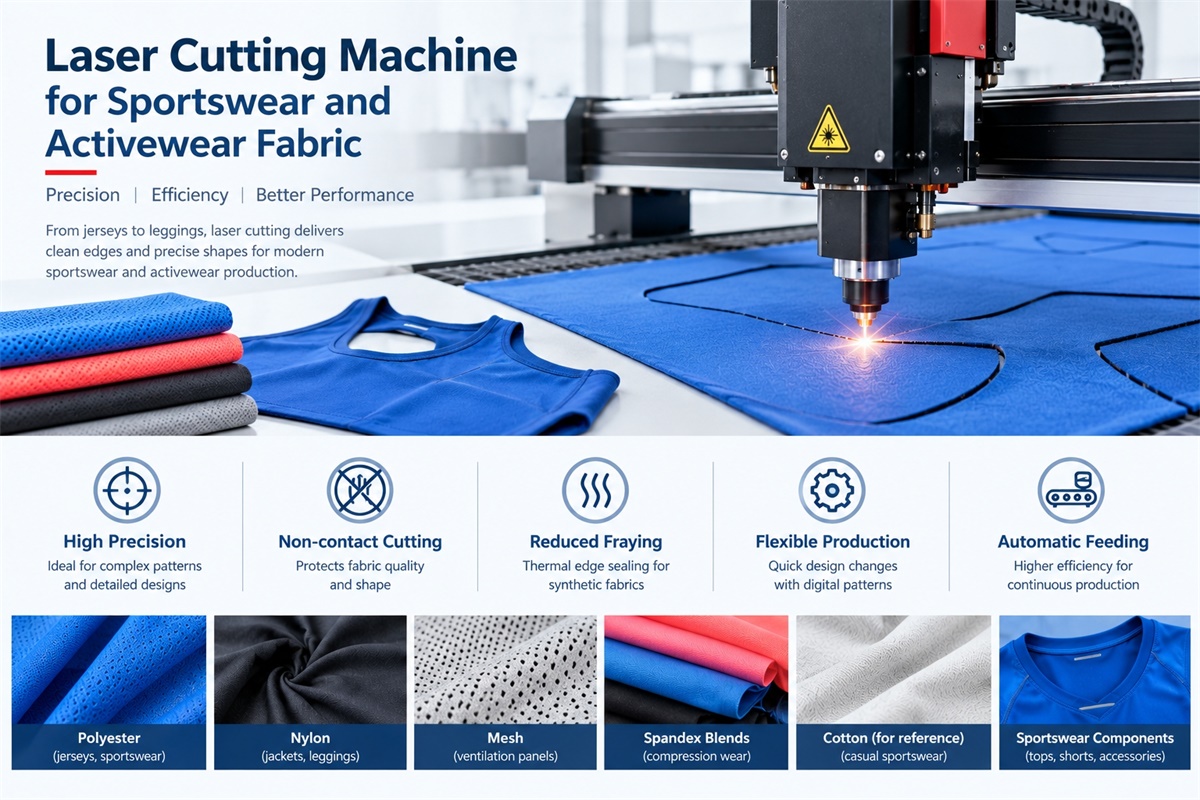
Sportswear and activewear manufacturers need fabric cutting solutions that deliver precise shapes, consistent edges, and efficient production. From polyester jerseys and nylon leggings to spandex-based compression garments, modern sportswear uses a wide range of stretch fabrics and performance textiles. Traditional cutting methods can handle many of these materials, but high-volume production and complex garment designs often require greater flexibility and accuracy.
A laser cutting machine for sportswear and activewear fabric uses a focused laser beam to cut textile materials according to digital patterns. It can process many synthetic fabrics without direct tool contact, making it useful for intricate garment panels, ventilation holes, logos, and customized sportswear components.
For manufacturers processing fabric rolls, an automatic feeding system can also help streamline continuous cutting operations. A fabric auto-feeding laser cutting machine is worth evaluating when production efficiency, repeatable patterns, and reduced manual handling are important.
1. Why Do Sportswear Manufacturers Use Laser Cutting?
Sportswear production involves more than cutting basic garment shapes. Manufacturers often need to process stretch fabrics, create detailed ventilation patterns, maintain consistent dimensions, and minimize waste from expensive performance materials.
Laser cutting offers several practical advantages.
High precision for complex garment patterns
Laser cutting machines follow digital cutting paths, allowing manufacturers to produce detailed contours and repeated shapes. This is useful for sleeves, collars, shoulder panels, side inserts, and other sportswear components.
The cutting design can be modified in software without manufacturing a new physical die. This flexibility is particularly valuable for brands producing multiple sizes, seasonal collections, and customized garment designs.
Reduced fraying on synthetic fabrics
Many sportswear materials contain thermoplastic fibers, such as polyester and nylon. When the laser parameters are properly adjusted, the heat can fuse the edges of these fabrics and reduce fraying.
However, edge sealing is not guaranteed for every textile. Fabric composition, weave, coatings, and processing conditions influence the result. Excessive heat may also cause discoloration, hard edges, or melting.
Non-contact processing
Unlike mechanical cutting blades, a laser beam does not press directly against the fabric. This reduces mechanical disturbance during cutting and can help maintain the shape of lightweight materials.
Nevertheless, thin and elastic fabrics still require proper support, stable positioning, and suitable tension control to prevent distortion.
Flexible production for customized sportswear
Sportswear brands frequently change colors, patterns, sizes, and product designs. Laser cutting makes it possible to update cutting paths digitally, reducing the time required to prepare new patterns.
This is especially useful for customized team uniforms, branded athletic apparel, and small-batch performance garments.
2. Which Sportswear Fabrics Can a Laser Cutting Machine Process?
Sportswear uses different combinations of fibers and fabric structures. Before selecting a laser cutting machine, manufacturers should understand how their materials respond to thermal processing.
Polyester sportswear fabric
Polyester is widely used in football jerseys, running shirts, training shorts, cycling apparel, and other performance garments.
CO2 laser cutting can process many polyester fabrics with good contour accuracy. Properly adjusted parameters may also create sealed edges that reduce fraying.
Typical applications include:
-
Football and basketball jerseys
-
Running shirts and shorts
-
Team uniforms
-
Printed polyester sportswear
-
Lightweight athletic garment panels
For sublimation-printed polyester, test the fabric before production. Excessive heat may affect the print or cause discoloration along the cutting edge.
Nylon fabric
Nylon is commonly found in sports jackets, lightweight outerwear, windbreakers, and certain athletic accessories.
Laser cutting can produce precise shapes in many nylon textiles. However, nylon’s melting behavior and surface treatments can affect edge quality, so power and speed must be adjusted according to the material.
Spandex and elastane blends
Spandex, also known as elastane, is used in leggings, compression garments, yoga pants, and fitted sportswear. It is frequently blended with polyester or nylon.
These fabrics require particular care because stretching, heat, and uneven tension can affect cutting accuracy.
A laser cutting machine may process suitable spandex blends, but the fabric should be tested for edge distortion, melting, elasticity changes, and dimensional stability. For highly elastic materials, a stable cutting surface and controlled fabric feeding are especially important.
Mesh and ventilation fabrics
Mesh fabrics are widely used in sports jerseys, running apparel, shoes, and athletic accessories.
Laser cutting can create precise outlines and, depending on the mesh construction, detailed openings or decorative patterns. Very open structures may require special attention to positioning and support.
Cotton and cotton blends
Cotton is used in casual sportswear, training shirts, and some lifestyle apparel. Unlike thermoplastic synthetic fibers, cotton does not melt and seal in the same way.
Laser cutting can cause browning or charring, particularly on light-colored cotton. If the application requires an unmarked edge, mechanical cutting may be a better choice.
Practical recommendation: Prepare samples of your actual polyester, nylon, spandex, and mesh fabrics before purchasing a machine. A successful test should evaluate both the cut edge and the fabric’s performance after cutting.
3. Laser Cutting vs. Traditional Fabric Cutting for Sportswear
Sportswear manufacturers can choose between laser cutting, rotary blade cutting, CNC knife cutting, and other textile cutting methods. Each method has different strengths.
| Feature | Laser cutting | Mechanical cutting |
|---|---|---|
| Cutting precision | Excellent for detailed contours | Depends on blade, machine, and material |
| Complex patterns | Highly flexible with digital control | Possible, depending on the cutting system |
| Edge sealing | Possible with suitable synthetic fabrics | Generally requires separate finishing if sealing is needed |
| Tool wear | No cutting blade wear | Blades require maintenance or replacement |
| Material contact | Non-contact cutting | Physical contact with the cutting tool |
| Natural fabrics | May cause scorching or discoloration | Often suitable without thermal damage |
| Design changes | Digital path modification | May require tool or setup changes, depending on the system |
| Main concerns | Heat damage and smoke extraction | Blade wear, pressure, and fabric movement |
Laser cutting is particularly attractive when a manufacturer needs complex shapes, frequent design changes, and clean edges on suitable synthetic fabrics.
Mechanical cutting remains a practical choice for many garment factories, especially when processing large quantities of natural fabrics or multiple layers of material.
The best solution depends on the required output, material characteristics, and total production cost.
4. Can Laser Cutting Improve Sportswear Production Efficiency?
Production efficiency depends on more than the speed at which a laser head moves. The entire process includes material preparation, feeding, cutting, unloading, inspection, and garment assembly.
A laser cutting system can improve efficiency in several ways.
Digital pattern processing
Manufacturers can import cutting patterns and modify them without making new physical cutting dies. This reduces setup requirements when producing different garment sizes or designs.
Consistent repeated cutting
A properly configured CNC system can repeat the same cutting path across multiple production batches. This helps maintain consistency between garment components.
Automatic fabric feeding
For factories processing long rolls of sportswear fabric, automatic feeding can reduce manual handling and improve production continuity.
Depending on the machine configuration, a conveyor and feeding system can transport fabric into the cutting area while the laser processes programmed patterns.
However, stretch fabrics may require controlled tension and alignment to prevent the material from extending or shifting during feeding.
Reduced secondary finishing
When cutting compatible synthetic textiles, laser edge sealing may reduce the need for additional fraying control. Whether this eliminates a finishing step depends on the garment design and the required edge quality.
To measure actual productivity, compare the number of acceptable garment panels produced per hour rather than relying only on the advertised maximum cutting speed.
5. Is a CO2 Laser Cutting Machine Suitable for Activewear?
CO2 laser cutting is commonly used for non-metallic materials, including many textile fabrics. It is therefore a relevant technology for manufacturers evaluating automated sportswear cutting.
A CO2 laser fabric cutting machine may be suitable for:
-
Polyester jerseys and training garments
-
Nylon sportswear components
-
Selected spandex and elastane blends
-
Mesh panels and decorative textile details
-
Printed athletic apparel
-
Synthetic textile accessories
The appropriate configuration depends on the thickness and structure of the material, the required cutting width, pattern complexity, and production volume.
What about stretch fabrics?
Stretch fabrics present a special challenge because they can deform during handling. Even a highly accurate laser cannot compensate for material that is stretched or incorrectly positioned before cutting.
To achieve consistent results, manufacturers should consider:
-
A stable cutting surface
-
Controlled feeding tension
-
Reliable fabric alignment
-
Suitable pattern compensation where necessary
-
Testing under actual production conditions
If the activewear material contains heat-sensitive coatings, bonded layers, or laminated structures, additional testing is required to ensure that the laser does not damage the surface or separate the layers.
6. How Much Laser Power Is Needed for Sportswear Fabric?
There is no single laser power that is ideal for every sportswear material.
Thin polyester fabric may require relatively little energy, while denser textiles or multilayer materials may need different settings. Higher power can support faster cutting under suitable conditions, but excessive energy can increase the risk of melting, discoloration, or hard edges.
When selecting laser power, evaluate four factors.
Fabric composition: Polyester, nylon, spandex blends, and coated textiles respond differently to heat.
Fabric thickness: Thicker or denser materials may require more energy or slower processing.
Required cutting speed: Production targets determine how quickly the machine must complete each cutting path.
Edge quality: Fine garment details may require carefully balanced power and speed rather than maximum laser output.
Ask the supplier to test your actual materials using representative garment patterns. The test should demonstrate the recommended settings, edge quality, and achievable production speed.
7. How to Choose an Automatic Sportswear Fabric Cutting Machine
If your factory processes fabric rolls or produces sportswear in large quantities, an automatic fabric cutting machine may help reduce manual handling and support consistent production.
Consider the following specifications before selecting a model.
Working width
Choose a usable cutting width that accommodates your widest fabric roll and typical cutting layout. The correct width can reduce repositioning and improve pattern arrangement.
Feeding system
Confirm whether the machine supports continuous roll feeding and whether its feeding mechanism can handle elastic, slippery, or lightweight fabrics without excessive stretching.
Cutting accuracy
Check dimensional consistency across repeated garment panels, including small contours, corners, and detailed features.
Software compatibility
The machine should fit your existing digital pattern workflow. Confirm the supported file formats and whether the software allows convenient pattern adjustments and nesting.
Exhaust and filtration
Laser cutting produces fumes and airborne particles that depend on the fabric and processing conditions. Appropriate exhaust ventilation and filtration are important for factory safety and equipment cleanliness.
Maintenance and support
Evaluate the availability of replacement parts, installation assistance, operator training, and technical support.
For manufacturers looking to automate textile processing, explore the Dowin fabric auto-feeding laser cutting machine range. Compare the available configurations with your sportswear fabric width, cutting requirements, and daily production target.
8. How to Reduce Fabric Waste When Cutting Sportswear
Sportswear materials can represent a significant production cost, especially when using specialized performance textiles or printed fabrics. Reducing cutting waste can improve overall manufacturing efficiency.
Optimize pattern nesting
Arrange garment panels efficiently within the available fabric width. Digital nesting can help reduce unused spaces between cutting patterns.
Maintain consistent fabric feeding
Uneven tension or material misalignment can cause cutting errors and rejected panels. Proper feeding and alignment are particularly important for elastic fabrics.
Test the cutting parameters
Excessive laser power can damage the material, while insufficient energy may result in incomplete cuts. Test different parameter combinations to find a reliable balance.
Inspect the first production batch
Check edge quality, dimensions, and fabric condition before processing the entire order. Early inspection can prevent repeated defects.
Separate incompatible materials
Different fabrics may require different cutting parameters. Grouping materials by composition and thickness can reduce setup errors and improve consistency.
Although laser cutting can improve pattern flexibility, material utilization still depends on garment design, nesting quality, fabric defects, and production planning.
9. Applications of Laser Cutting in Sportswear Manufacturing
Laser cutting can support a wide range of athletic apparel and performance textile applications.
<PRIVATE_PERSON> Football and basketball uniforms: Precise garment panel cutting for printed polyester jerseys, shorts, and team apparel.
Running and training apparel: Cutting lightweight polyester fabrics and selected elastic textile blends for shirts, shorts, and fitted garments.
Yoga and compression wear: Processing suitable nylon-spandex and polyester-spandex fabrics, subject to thermal and elasticity testing.
Ventilation panels: Producing detailed mesh components and selected perforated textile designs.
Custom sportswear: Supporting personalized garment patterns, customized shapes, and short production runs.
Sports accessories: Cutting compatible synthetic fabrics for bags, protective covers, and textile components.
For every application, the finished product requirements should determine whether laser cutting is appropriate. Fabric stretch, edge appearance, wash durability, and garment assembly requirements should all be evaluated.
10. Common Mistakes When Buying a Sportswear Laser Cutting Machine
Choosing a machine based only on laser power
Power alone does not determine cutting quality or production capacity. Material tests and realistic production trials are more useful.
Ignoring fabric stretch
Elastic materials may deform during feeding or positioning. Confirm that the machine can handle the actual fabric without introducing unacceptable dimensional errors.
Overlooking heat damage
A clean cut on polyester does not guarantee an equally clean result on cotton, coated fabrics, or blended textiles. Test each important material separately.
Buying a machine without checking the working width
An undersized cutting area may create additional handling steps and reduce production efficiency.
Comparing advertised speeds instead of finished output
Production capacity should include feeding, cutting, unloading, and inspection. Ask for a demonstration using realistic garment patterns.
Ignoring smoke extraction
Textile laser cutting requires suitable exhaust arrangements, and certain coatings or material treatments can generate hazardous fumes. Verify material suitability and ventilation requirements before production.
Conclusion
A laser cutting machine for sportswear and activewear fabric can help manufacturers produce precise garment panels, process complex patterns, and automate the cutting of many synthetic textiles.
CO2 laser cutting is particularly worth considering for polyester jerseys, nylon components, mesh details, and selected stretch fabrics. However, spandex blends, coated materials, and natural fibers require careful testing because heat can affect edge quality and material performance.
When choosing a machine, focus on fabric compatibility, working width, feeding stability, cutting accuracy, production capacity, software, and total operating cost.
For manufacturers seeking more efficient roll-fed textile production, a Dowin automatic fabric feeding laser cutting machine is one option to evaluate. Request a cutting test using your actual sportswear fabrics and garment patterns before making a purchasing decision.
Frequently Asked Questions
1. Can a laser cutting machine cut sportswear fabric?
Yes. CO2 laser cutting machines can process many sportswear textiles, including polyester, nylon, mesh, and selected stretch fabric blends. The correct parameters depend on the material and required edge quality.
2. Can laser cutting cut spandex and elastane fabric?
Laser cutting can process certain spandex and elastane blends, but the results depend on fiber composition, fabric structure, and heat sensitivity. Test for melting, edge distortion, and changes in elasticity before production.
3. Does laser cutting prevent fraying on polyester sportswear?
Laser cutting can thermally seal the edges of many polyester fabrics, reducing fraying. Excessive heat may cause melting or hard edges, so the cutting parameters must be adjusted carefully.
4. Is a CO2 laser suitable for cutting football jerseys?
A CO2 laser can be suitable for many polyester football jersey fabrics. It can produce precise outlines for garment panels, but printed materials should be tested for heat-related discoloration and edge quality.
5. Is automatic feeding useful for sportswear production?
Yes, particularly for factories processing continuous fabric rolls or repetitive garment patterns. However, elastic materials require suitable tension control and alignment to maintain dimensional accuracy.
6. How can I reduce waste when laser cutting activewear?
Use efficient pattern nesting, maintain stable fabric feeding, optimize laser parameters, and inspect initial samples before full production. These measures can reduce unused material and cutting defects.
7. What should I test before buying a sportswear laser cutting machine?
Test your actual fabric types, including the thinnest and most elastic materials. Evaluate edge quality, dimensional accuracy, fabric discoloration, elasticity, cutting speed, feeding stability, and repeatability across multiple garment panels.
Post time: Oct-20-2026
