
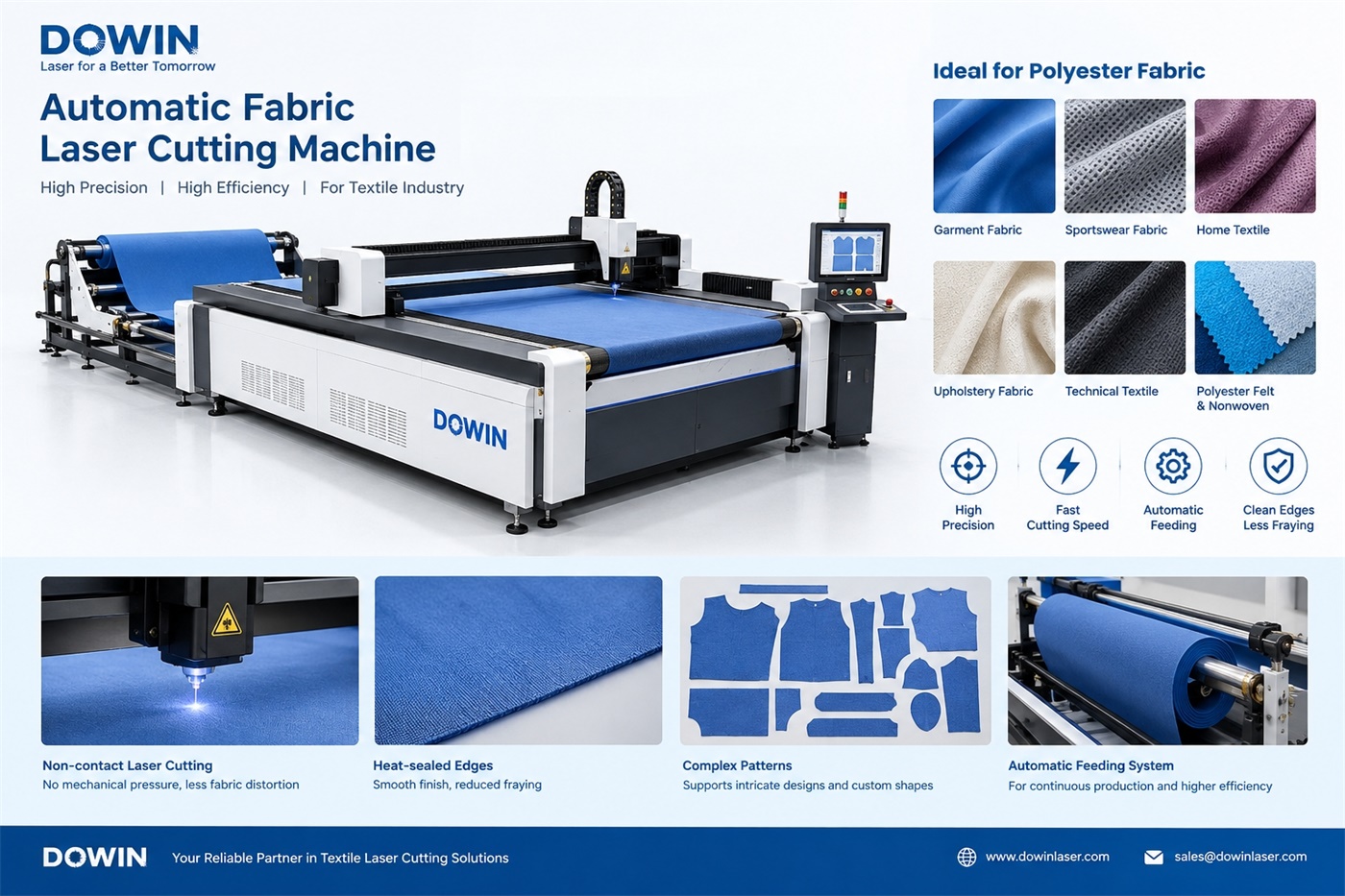
Polyester is one of the most widely used synthetic fabrics in garment manufacturing, sportswear, home textiles, upholstery, and industrial textile production. Its durability, dimensional stability, and versatility make it suitable for a wide range of products. However, cutting polyester fabric efficiently while maintaining clean, consistent edges can be challenging, especially in high-volume production.
A laser cutting machine for polyester fabric offers an alternative to traditional mechanical cutting. By using a focused laser beam, manufacturers can cut intricate patterns, process repeated designs, and, under suitable conditions, seal the edges of polyester fabric to reduce fraying.
But not every laser cutting machine is suitable for every polyester material. Fabric thickness, weave structure, coating, laser power, cutting speed, and production requirements all influence the final result.
This guide explains how laser cutting works on polyester fabric, which machine features matter most, and how to choose the right solution for your textile production needs.
1. Can You Cut Polyester Fabric with a Laser?
Yes. Polyester fabric can generally be cut with a suitable laser cutting machine, provided that the fabric composition and construction are compatible with the process.
Polyester is a thermoplastic material. When exposed to a laser beam, its fibers absorb heat and melt or vaporize locally, allowing the material to separate along the cutting path.
One important advantage is the possibility of heat-sealed edges. As the laser cuts the fabric, the heat can fuse polyester fibers along the cut line, helping reduce fraying.
This is particularly useful when processing:
-
Polyester garment fabrics and sportswear textiles
-
Polyester mesh and lightweight woven fabrics
-
Decorative fabrics and certain upholstery materials
-
Polyester ribbons, labels, and narrow textile components
-
Synthetic technical textiles and selected industrial fabrics
-
Polyester felt and compatible nonwoven materials
The actual cutting result depends on the material’s construction and processing parameters. Some polyester fabrics may develop melted beads, stiff edges, discoloration, or heat-affected areas if the settings are unsuitable.
Before starting mass production, test a sample of the actual fabric to verify edge quality, cutting accuracy, and any changes in flexibility or appearance.
2. How Does a Laser Cutting Machine Cut Polyester Fabric?
A laser fabric cutting machine directs a concentrated beam onto the fabric surface. The material absorbs the laser energy, creating a narrow cutting path.
Unlike a knife or rotary blade, the laser does not need to press against or drag across the fabric. This non-contact process can reduce mechanical distortion, particularly when cutting delicate or lightweight textiles.
A typical polyester fabric laser cutting process involves five steps:
-
Prepare the fabric: Place the fabric on the cutting table or configure the automatic feeding system.
-
Create the cutting pattern: Import a digital design or cutting file into the machine software.
-
Set the laser parameters: Adjust power, speed, focus, and other relevant settings according to the fabric.
-
Execute the cutting path: The laser follows the programmed design to produce the required shapes.
-
Inspect the finished edges: Check for incomplete cuts, excessive melting, discoloration, and dimensional deviations.
For production environments, automated feeding and digitally controlled cutting can reduce manual handling and improve repeatability across batches.
However, the cutting process should always be tested on the intended fabric. Polyester blends, coated textiles, and multilayer materials may respond differently from standard polyester fabric.
3. What Are the Advantages of Laser Cutting Polyester Fabric?
Cleaner Edges with Reduced Fraying
One of the main reasons manufacturers consider laser cutting for polyester is its ability to fuse suitable synthetic fibers along the cut edge.
Traditional mechanical cutting separates the yarns but does not normally seal them. Depending on the weave, the exposed yarns may loosen during handling or subsequent processing.
Laser cutting can reduce this problem by locally melting the polyester fibers. The result may be a more stable edge with less need for additional finishing.
Nevertheless, heat-sealed edges are not always desirable. Some applications require a soft, flexible edge, so the finished fabric should be evaluated before selecting the process.
High Precision for Complex Patterns
Laser cutting is well suited to intricate shapes, curved outlines, small openings, and repeated patterns.
This is useful for manufacturers producing sportswear components, decorative textiles, fabric labels, and custom textile products. Digital cutting paths also make it easier to switch between designs without producing a physical cutting die.
Non-Contact Cutting
Because the laser does not physically press a blade against the fabric, it can reduce pulling and mechanical deformation during cutting.
This is particularly beneficial for lightweight polyester, mesh, and materials that are difficult to handle consistently with conventional cutting tools.
The fabric must still be supported and fed correctly. Wrinkles, airflow, and movement on the cutting bed can affect dimensional accuracy.
Consistent Results in Repeated Production
Once the cutting file and parameters have been validated, a laser cutting machine can repeat the same cutting path across multiple pieces.
When combined with appropriate material positioning and automatic feeding, this can improve production consistency and reduce operator-dependent variation.
Flexible Digital Production
Manufacturers can use digital designs to produce different patterns, sizes, and shapes without changing a physical blade or die.
This is useful for custom orders, short production runs, product development, and manufacturing environments where designs change frequently.
4. What Type of Laser Is Best for Polyester Fabric?
For many nonmetallic textile applications, a CO2 laser cutting machine is a practical option. CO2 lasers are widely used for cutting fabrics, leather, paper, wood, and various nonmetallic materials.
A suitable CO2 laser system can process many polyester fabrics, but the machine configuration should match the intended workload.
Key factors include:
-
Laser power: Must be sufficient to cut the material at the required speed without excessive thermal damage.
-
Cutting speed: Higher speeds may improve productivity, but excessive speed can result in incomplete cuts.
-
Focus and spot size: Affect the width and energy concentration of the cutting line.
-
Working area: Must accommodate the width and dimensions of the fabric or cutting patterns.
-
Motion system: Influences positioning accuracy and cutting consistency.
-
Material handling: Determines whether the machine is suitable for individual pieces, stacked materials, or continuous fabric rolls.
-
Exhaust and filtration: Help manage smoke, fumes, and airborne particles generated during cutting.
For most textile manufacturers, choosing a machine based on actual production samples is more reliable than selecting one based on laser power alone.
5. How Much Laser Power Do You Need for Polyester Fabric?
The required laser power depends on fabric thickness, density, construction, cutting speed, and the desired edge quality.
Thin polyester fabrics generally require less energy to cut than dense or multilayer materials. However, using excessive power can cause melted edges, discoloration, and unnecessary heat damage.
The following table provides a starting point for evaluating equipment rather than fixed machine specifications.
| Production requirement | What to prioritize |
|---|---|
| Thin polyester fabric | Fine control, suitable focus, and clean edges |
| Polyester mesh | Stable fabric support and consistent cutting |
| Dense polyester textiles | Adequate cutting energy and reliable material separation |
| Intricate textile patterns | Accurate motion control and a suitable laser spot |
| Large fabric panels | Adequate working area and efficient material handling |
| Continuous fabric production | Automatic feeding and stable cutting performance |
The correct settings should be established through sample testing. Test several combinations of power and speed while monitoring cut-through, edge melting, discoloration, and production time.
A machine that cuts successfully at a high speed but produces stiff or damaged edges may not be suitable for the finished product.
6. Automatic vs. Manual Polyester Fabric Laser Cutting
For businesses processing polyester fabric regularly, the material-handling system can be just as important as the laser source.
Manual or flatbed laser cutting is useful for individual fabric pieces, prototypes, custom designs, and small production batches.
Automatic fabric laser cutting is more suitable when manufacturers need to process repeated patterns, long fabric rolls, or larger production quantities. Depending on the machine configuration, automatic feeding can reduce the need for manual repositioning and help maintain a continuous workflow.
When comparing machines, consider the following:
-
Maximum fabric width and working area
-
Automatic feeding and fabric alignment
-
Cutting speed under real production conditions
-
Pattern complexity and positioning accuracy
-
Fabric tension and wrinkle control
-
Material waste and layout optimization
-
Operator workload and maintenance requirements
For textile factories that need to cut fabric rolls into repeated shapes, an automatic feeding system can be worth evaluating alongside the laser source and motion system.
Explore the Dowin automatic fabric laser cutting machine to review an industrial textile cutting solution.
7. Common Problems When Laser Cutting Polyester Fabric
Even when using a suitable machine, polyester fabric may develop edge defects if the cutting parameters or material handling are not properly controlled.
Melted Edges and Hard Beads
Excessive heat can cause molten polyester to accumulate along the cut line, creating a hard or raised edge.
How to improve it: Test a higher cutting speed with lower laser power while maintaining complete cutting. Adjust focus and airflow as needed. The objective is to separate the fibers cleanly without excessive melting. <Cite refs={["turn376851search5","turn376851search9"]}/>
Yellowing or Scorch Marks
Light-colored polyester is particularly sensitive to visible discoloration. Excessive heat, slow cutting, or unsuitable airflow may cause marks around the cutting path.
How to improve it: Check power and speed, ensure the fabric lies flat, and optimize the extraction system. Inspect the cut under the lighting conditions used for final quality control.
Incomplete Cutting
If the laser does not completely separate the fabric, some fibers may remain attached, making the pieces difficult to remove cleanly.
How to improve it: Check the focus, lens condition, material thickness, and cutting parameters. Increase cutting energy only as needed to achieve reliable separation.
Inconsistent Edges on Stretch Fabrics
Polyester-spandex blends and elastic knitted fabrics may stretch or shift during processing, affecting pattern dimensions.
How to improve it: Use suitable material support, control fabric tension, and verify the cutting path against the relaxed fabric dimensions. Test the finished pieces for dimensional stability.
8. What Should You Check Before Buying a Polyester Fabric Laser Cutter?
For industrial buyers, the best machine is not necessarily the one with the highest advertised laser power or maximum speed. It is the one that consistently meets the production requirements for your specific fabric.
Use this checklist when comparing suppliers.
-
Material compatibility: Can the machine cut your polyester fabric and any blends or coatings?
-
Edge quality: Does the finished edge meet your requirements for fraying, softness, and appearance?
-
Working width: Can the machine accommodate your fabric rolls and pattern dimensions?
-
Automation: Is automatic feeding necessary for your daily production volume?
-
Cutting accuracy: Can the machine maintain the required dimensions across repeated production runs?
-
Fume extraction: Is the extraction system appropriate for the materials and processing conditions?
-
Operating cost: Have you considered electricity, maintenance, consumables, labor, and downtime?
-
Sample testing: Can the supplier demonstrate the machine using your actual fabric?
For roll-to-roll production, also ask how the machine handles wrinkles, fabric tension, alignment, and changes in roll diameter.
A sample test should include straight cuts, sharp corners, intricate patterns, and any particularly demanding features found in your production designs.
9. Is a Polyester Fabric Laser Cutting Machine Worth It?
A laser cutting machine can be a worthwhile investment when your business needs accurate cutting, intricate patterns, repeatable production, or reduced fraying on suitable synthetic textiles.
The strongest business case often comes from combining several benefits: less manual handling, fewer cutting errors, reduced edge-finishing requirements, and more flexible digital production.
However, the return on investment depends on actual throughput, machine utilization, labor costs, material waste, and the finishing processes that remain necessary.
For example, a manufacturer cutting large quantities of polyester labels or decorative textile shapes may benefit from heat-sealed edges and automated pattern cutting. A business producing simple cotton panels may find conventional cutting more economical.
Before investing, compare the total cost per finished piece rather than considering the machine purchase price alone.
Frequently Asked Questions
Can a CO2 laser cut 100% polyester fabric?
Yes. A suitable CO2 laser can cut many 100% polyester fabrics. The required settings depend on fabric thickness, weave, density, and the desired edge finish.
Does laser cutting polyester fabric prevent fraying?
It can significantly reduce fraying because polyester fibers can melt and fuse along the cut line. The degree of edge sealing depends on the material and process settings. Excessive melting can also create hard edges or beads. <Cite refs={["turn376851search0","turn376851search7"]}/>
What laser power is best for polyester fabric?
There is no single power rating suitable for every polyester fabric. The appropriate power depends on the material, cutting speed, machine configuration, and required edge quality. Test cuts should be used to establish the correct settings.
Is laser cutting better than a rotary cutter for polyester?
Laser cutting is often advantageous for complex patterns, repeatable shapes, and automated production. A rotary cutter can be more economical for simple cuts, smaller workloads, or materials that are unsuitable for laser processing.
Can a laser cut printed polyester fabric?
Yes, many printed polyester fabrics can be laser cut. However, the process should be tested to ensure that heat does not damage the print, alter the color, or affect the coating. Printed patterns may also require a vision alignment system when the cut must follow the printed contours.
Is laser cutting safe for all polyester fabrics?
No. The base fiber alone does not establish whether a material is safe to laser cut. Coatings, adhesives, dyes, and other additives can change the hazards. Identify the complete material composition, consult the supplier’s safety information, and use appropriate extraction and machine safeguards. Never laser process unidentified or unsuitable coatings. <Cite refs={["turn376851search2","turn376851search7"]}/>
Can an automatic laser cutting machine process polyester fabric rolls?
Yes, machines configured with automatic feeding can process fabric rolls, subject to their working width, material-handling design, and production limits. Confirm that the system can maintain stable fabric positioning and consistent cut quality throughout the roll.
Conclusion
A laser cutting machine for polyester fabric can help textile manufacturers improve cutting precision, process complex patterns, and reduce fraying by sealing compatible synthetic fibers during cutting.
The key is selecting a suitable CO2 laser system, optimizing the cutting parameters, and ensuring that fabric handling and fume extraction meet the needs of the application.
For manufacturers processing large quantities of textile materials, automatic feeding can further improve workflow efficiency and repeatability.
If you are evaluating equipment for industrial textile production, explore the Dowin automatic fabric laser cutting machine and assess its suitability using samples of your actual polyester fabric.
Post time: Oct-15-2026
