
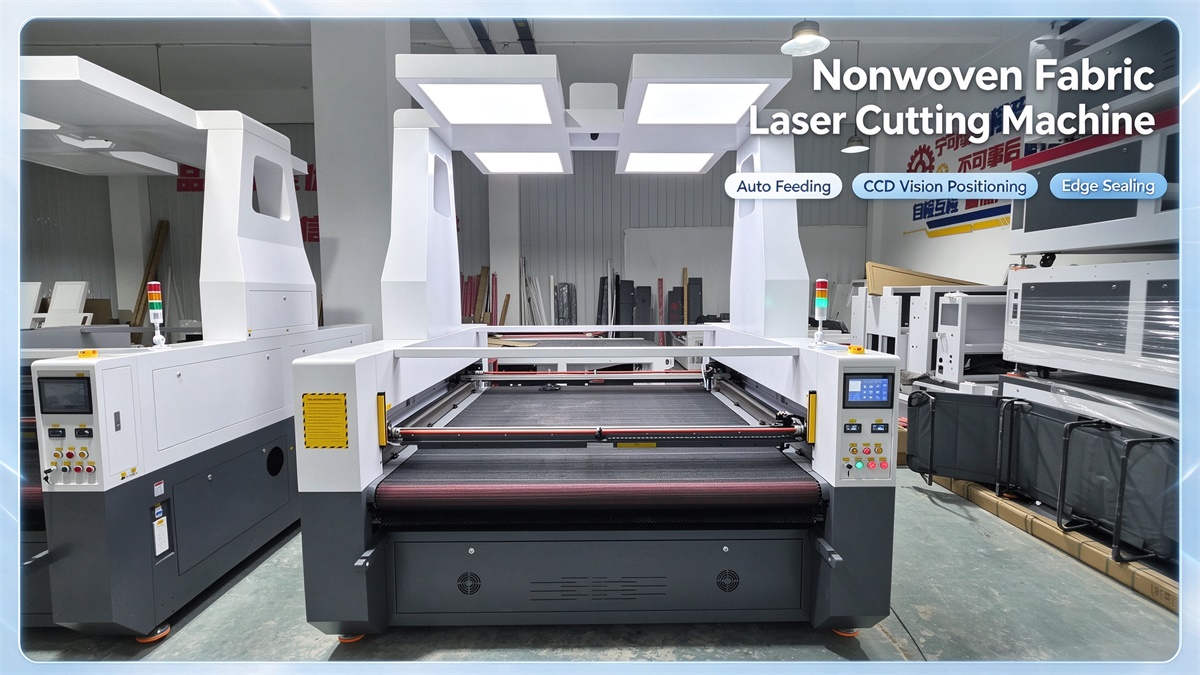
A laser cutting machine for nonwoven fabric provides a fast, precise, and flexible solution for cutting materials used in medical products, filtration systems, automotive interiors, protective clothing, packaging, and disposable hygiene products. Unlike mechanical cutting tools, a CO2 laser uses a focused beam to cut nonwoven materials without direct contact, reducing tool wear and allowing manufacturers to process complex shapes and intricate patterns. For businesses handling continuous rolls or large production orders, an automatic fabric laser cutting machine can help improve cutting consistency, reduce manual handling, and support more efficient production workflows.
However, not every nonwoven fabric responds to laser cutting in the same way. Polypropylene (PP), polyester (PET), viscose, and blended nonwoven materials have different melting points, thermal properties, thicknesses, and reactions to heat. Selecting the right laser power, cutting speed, exhaust system, and material-feeding method is essential for achieving clean edges without excessive melting, discoloration, or deformation. This guide explains how laser cutting works for nonwoven fabrics, which materials are suitable, and how to choose equipment for your production requirements.
1. What Is Nonwoven Fabric?
Nonwoven fabric is a sheet or web of fibers bonded together through mechanical, thermal, or chemical processes rather than conventional weaving or knitting. Depending on the manufacturing method, nonwoven materials can be lightweight and flexible or thick, dense, and durable.
Common nonwoven fabric types include:
-
Polypropylene (PP) nonwoven fabric: Widely used in shopping bags, medical masks, protective covers, packaging, and disposable products.
-
Polyester (PET) nonwoven fabric: Common in automotive interiors, filtration, insulation, and industrial applications.
-
Spunbond nonwoven fabric: Often used in agriculture, furniture protection, hygiene products, and reusable bags.
-
Meltblown nonwoven fabric: Frequently used in filtration media and specialized protective products.
-
Needle-punched nonwoven fabric: Used for geotextiles, carpets, sound insulation, and industrial felt.
-
Composite nonwoven fabric: Made from multiple layers or combined materials to achieve specific functional properties.
The material composition is particularly important when choosing a laser cutting process. Thermoplastic fibers such as PP and PET may melt along the cut line, potentially helping seal the edges. However, excessive heat can cause shrinkage, fused fibers, or unwanted deformation. Materials containing heat-sensitive coatings, adhesives, or mixed fibers require additional testing before production.
2. Can You Cut Nonwoven Fabric with a Laser?
Yes. A CO2 laser cutting machine can process many types of nonwoven fabric, provided that the material composition and thickness are suitable for the selected laser system.
The laser follows a programmed cutting path and concentrates energy on a narrow area, separating the material with minimal mechanical force. This makes laser cutting particularly useful for intricate contours, small holes, repeated shapes, and customized designs.
The main advantages include:
Precise cutting: A focused laser can produce detailed shapes and narrow cutting paths when the material and machine are properly configured.
No mechanical cutting pressure: Because the laser does not require a blade to press against the material, it avoids blade-related drag and deformation.
Flexible pattern changes: Operators can switch between digital cutting files without manufacturing a dedicated die for every design.
Potentially sealed edges: Thermoplastic nonwoven fibers may fuse along the cut edge, reducing loose fibers or fraying in suitable materials. The result depends on fiber composition and processing parameters.
Automation compatibility: A suitable conveyor or automatic feeding system can support continuous processing of roll materials and improve production consistency.
Nevertheless, laser cutting is not always the best option. Some materials may melt excessively, release hazardous fumes, or suffer heat damage. For applications requiring extremely high throughput, very thick materials, or minimal thermal influence, ultrasonic cutting, rotary cutting, or other mechanical methods may be more appropriate.
3. Why Choose a CO2 Laser Cutting Machine for Nonwoven Fabric?
CO2 laser systems are widely used for cutting many nonmetallic materials, including textiles, felt, foam, and certain synthetic fabrics. Their suitability for nonwoven fabric makes them worth considering for manufacturers producing customized components or processing flexible sheet materials.
High cutting flexibility
A CO2 laser can cut straight lines, curves, perforations, and complex outlines from digital designs. This is useful for medical product components, filtration shapes, automotive parts, and customized nonwoven products.
Reduced tool maintenance
Mechanical blades become dull and require replacement or sharpening. Laser cutting eliminates blade wear, although the laser system still requires routine maintenance, cleaning, optical inspection, and alignment.
Less material distortion from mechanical forces
Soft and lightweight nonwoven fabrics can shift or stretch when subjected to blade pressure. Laser cutting avoids this direct mechanical force, although proper material support and tension control remain important.
Better suitability for digital production
Manufacturers can adjust patterns and dimensions through design software, making the process suitable for small batches, frequent product changes, and customized orders.
Integration with automatic feeding
For large production volumes, automatic feeding can reduce repetitive manual positioning. A conveyor-based system can help maintain consistent material placement, provided that the fabric’s stretch, width, thickness, and surface characteristics are compatible with the equipment.
For manufacturers processing continuous fabric rolls, a dedicated automatic fabric cutting system is worth evaluating alongside the laser source itself. Feeding accuracy, working area, exhaust capacity, and software compatibility can be just as important as laser power.
4. Which Nonwoven Fabrics Are Suitable for Laser Cutting?
Not all nonwoven fabrics produce the same cutting results. The following table summarizes common materials and their typical applications.
| Material | Common applications | Laser cutting considerations |
|---|---|---|
| PP nonwoven | Shopping bags, medical disposables, packaging | Test for melting, shrinkage, and edge fusion |
| PET nonwoven | Automotive components, filtration, insulation | Optimize speed and power to control heat effects |
| Polyester felt | Crafts, acoustic panels, industrial pads | Check thickness and density before selecting power |
| Needle-punched fabric | Geotextiles, carpets, insulation | Thick materials may require slower speeds or multiple passes |
| Viscose nonwoven | Hygiene products, wipes, medical applications | Heat sensitivity and composition require testing |
| Multilayer nonwoven | Protective products, composite components | Verify that every layer is compatible with laser processing |
Important: Medical-grade materials and filtration media may require strict control over contamination, fiber structure, and functional performance. A visually clean cut does not automatically mean that the finished component meets its application requirements.
For meltblown filtration materials and other highly sensitive products, test whether laser processing changes filtration efficiency, pore structure, or other critical properties before adopting it for production.
5. What Laser Power Is Best for Nonwoven Fabric?
The appropriate laser power depends on material thickness, density, cutting speed, desired edge quality, and production volume. Higher power is not always better because excessive energy can cause melting, shrinkage, and discoloration.
For many nonwoven textile applications, CO2 laser machines in the 60W–150W range are worth evaluating. Thicker or denser materials and higher-throughput requirements may call for different configurations.
| Application | Equipment considerations |
|---|---|
| Thin, lightweight nonwoven sheets | Lower power may be sufficient for fine details |
| Standard PP or PET nonwoven | Match power and speed to fiber composition |
| Thick nonwoven felt | Evaluate higher power and slower cutting speeds |
| Large-scale roll processing | Prioritize feeding stability, cutting speed, and automation |
| Complex shapes and small components | Focus on motion accuracy, beam quality, and precise control |
These are general selection guidelines, not guaranteed power specifications. The best configuration should be determined through sample cutting using the actual material.
When comparing machines, ask the supplier to cut your fabric at the required production speed and demonstrate the finished edge quality. This is more reliable than selecting equipment based on laser power alone.
6. How to Achieve Clean Edges When Laser Cutting Nonwoven Fabric
Edge quality is one of the most important factors when processing synthetic nonwoven materials. Although thermal cutting can help reduce loose fibers, excessive heat may cause melted edges or distorted shapes.
Optimize laser power and cutting speed
Start with a moderate power setting and adjust the speed to achieve complete separation. Excessive power combined with a slow cutting speed can create a wide heat-affected area.
If the material does not cut through consistently, check focus, material thickness, beam condition, and motion speed before simply increasing the power.
Adjust the focal position
Correct focusing concentrates the laser energy in the cutting zone. An incorrect focal position may produce incomplete cuts, excessive kerf width, or inconsistent results across the material.
Use suitable air assistance
Air assistance can help remove debris and influence the cutting process. However, the optimal airflow depends on the fabric, machine configuration, and desired edge finish.
Maintain consistent material tension
Loose, wrinkled, or unevenly stretched fabric can produce inconsistent dimensions. Automatic feeding systems should maintain stable alignment without stretching or distorting the web.
Test different cutting parameters
Record the power, speed, focus position, and air-assistance settings for each material type. Repeatable parameter settings make it easier to maintain consistent quality across production batches.
7. Automatic Feeding vs. Manual Laser Cutting
For manufacturers processing nonwoven fabric in large quantities, the feeding method can significantly affect productivity.
| Feature | Manual feeding | Automatic feeding |
|---|---|---|
| Initial investment | Generally lower | Generally higher |
| Material handling | Requires operator intervention | Reduces repetitive handling |
| Long roll processing | More manual work | Better suited to continuous workflows |
| Production consistency | Depends heavily on operator positioning | Can improve consistency with proper setup |
| Best suited for | Samples, small batches, customized jobs | Repeated cutting and larger production runs |
Automatic feeding does not necessarily mean fully unattended production. Operators may still need to monitor material alignment, remove finished pieces, inspect cut quality, and manage roll changes.
For manufacturers handling long rolls of textile materials, an automatic system can reduce labor-intensive positioning and support a more standardized workflow.
8. What Industries Use Laser-Cut Nonwoven Fabric?
Laser-cut nonwoven components are used across several manufacturing sectors.
Medical and hygiene products: Nonwoven sheets may be processed into masks, protective components, and disposable product parts. Applications involving meltblown filtration media require additional performance validation.
Automotive manufacturing: Polyester nonwovens and felt materials are used in insulation, interior trim, acoustic components, and protective coverings.
Filtration: Nonwoven materials can be cut into filter layers, supporting structures, and customized shapes. The cutting process must not compromise filtration performance.
Packaging and reusable bags: PP nonwoven fabric can be cut into bag components, covers, and packaging shapes.
Furniture and acoustic products: Felt and other nonwoven materials are used in sound absorption, furniture protection, padding, and decorative components.
Industrial applications: Nonwoven materials are used in geotextiles, insulation, protective layers, and specialized industrial products.
Before processing any new material, confirm its fiber composition and review the safety data supplied by the manufacturer. Laser processing can generate smoke and potentially hazardous decomposition products, particularly from coatings, adhesives, or mixed-material composites. Use an appropriate exhaust and filtration system.
9. How to Choose a Laser Cutting Machine for Nonwoven Fabric
When evaluating a laser cutting machine, consider the following factors rather than focusing on the headline power rating.
1. Material compatibility
Identify the exact fiber composition, thickness, density, and any coatings or adhesive layers. Ask for sample tests using the same material that will be used in production.
2. Working area
Choose a working area that accommodates your material width and the dimensions of your cutting patterns. Roll-to-roll applications may require a different layout from sheet processing.
3. Cutting speed and accuracy
Request a practical demonstration using your required pattern and production speed. Verify that the finished parts meet dimensional tolerances.
4. Automatic feeding system
For roll materials, evaluate feeding accuracy, tension control, fabric alignment, and compatibility with the laser’s motion system.
5. Exhaust and fire protection
Thermal processing of textiles produces fumes and can create a fire risk. The machine should have appropriate extraction, filtration where necessary, and suitable fire-prevention measures. Never leave a laser cutter operating unattended.
6. Software and file compatibility
Check whether the controller supports your design workflow and the file formats used by your production team.
7. After-sales service
Ask about spare parts, maintenance requirements, training, and technical support. Reliable service can be particularly important when the machine is integrated into a production line.
For manufacturers that also cut woven textiles, felt, and other flexible materials, comparing several machine configurations through sample testing can help determine whether one system can cover multiple production needs.
10. Is Laser Cutting Better Than Die Cutting for Nonwoven Fabric?
Laser cutting and die cutting serve different production requirements.
Laser cutting is particularly useful for intricate designs, frequent pattern changes, and customized orders because it does not require a physical cutting die for each design. Die cutting, however, can be more economical for repetitive production of simple shapes at very high volumes, depending on tooling costs and cycle time.
Laser cutting offers greater digital flexibility, while die cutting may provide a faster production cycle for certain standardized parts. The best choice depends on order volume, material characteristics, cutting complexity, and acceptable unit cost.
For businesses with frequent product changes or multiple nonwoven product designs, a laser system may reduce tooling requirements. For large-scale production of identical components, a cost comparison should include equipment speed, labor, consumables, tooling, and material waste.
Frequently Asked Questions
1. Can a CO2 laser cut polypropylene nonwoven fabric?
Yes, many PP nonwoven fabrics can be cut using a CO2 laser. However, polypropylene is a thermoplastic material, so heat can cause melting, shrinkage, or fused edges. Test the material and optimize power and speed before production.
2. Does laser cutting seal the edges of nonwoven fabric?
It can. When suitable thermoplastic fibers melt and resolidify along the cutting line, the edges may become sealed and resist fraying. Results vary by material composition and processing parameters.
3. What thickness of nonwoven fabric can a laser cutter process?
There is no universal maximum thickness. Cutting capability depends on laser power, fabric density, fiber composition, and required speed. Test the thickest material in your production range before choosing a machine.
4. Is laser cutting suitable for medical nonwoven materials?
It can be suitable for certain components, but material compatibility and product performance must be validated. Applications involving filtration, sterile products, or other regulated medical uses may require additional testing and process controls.
5. Can a laser cutting machine process nonwoven fabric rolls automatically?
Yes. A compatible automatic feeding system can feed roll material into the cutting area and support repeated or continuous processing. Performance depends on fabric width, tension, alignment, cutting layout, and the machine’s automation design.
6. Does laser cutting damage nonwoven fabric?
Excessive heat can melt, shrink, discolor, or deform some materials. Appropriate power, speed, focus, and exhaust settings help reduce these risks. Sample testing is essential before full-scale production.
7. Is laser cutting more economical than mechanical cutting?
It depends on production volume, design complexity, tooling requirements, labor costs, and cycle time. Laser cutting can be advantageous for customized products and frequent design changes, while mechanical methods may be more economical for some high-volume, standardized parts.
Conclusion
A laser cutting machine for nonwoven fabric can help manufacturers produce precise shapes, process customized designs, and reduce mechanical handling. CO2 laser systems are worth evaluating for PP, PET, felt, and other compatible nonwoven materials, but cutting quality depends on the material itself and the selected process parameters.
For production involving continuous rolls or repeated cutting patterns, consider an automatic fabric laser cutting machine from Dowin Laser. Evaluate material compatibility, working area, feeding stability, cutting speed, exhaust capacity, and maintenance requirements before making a purchasing decision. Testing your actual fabric samples is the most reliable way to determine whether a particular machine meets your production needs.
Post time: Oct-16-2026
