
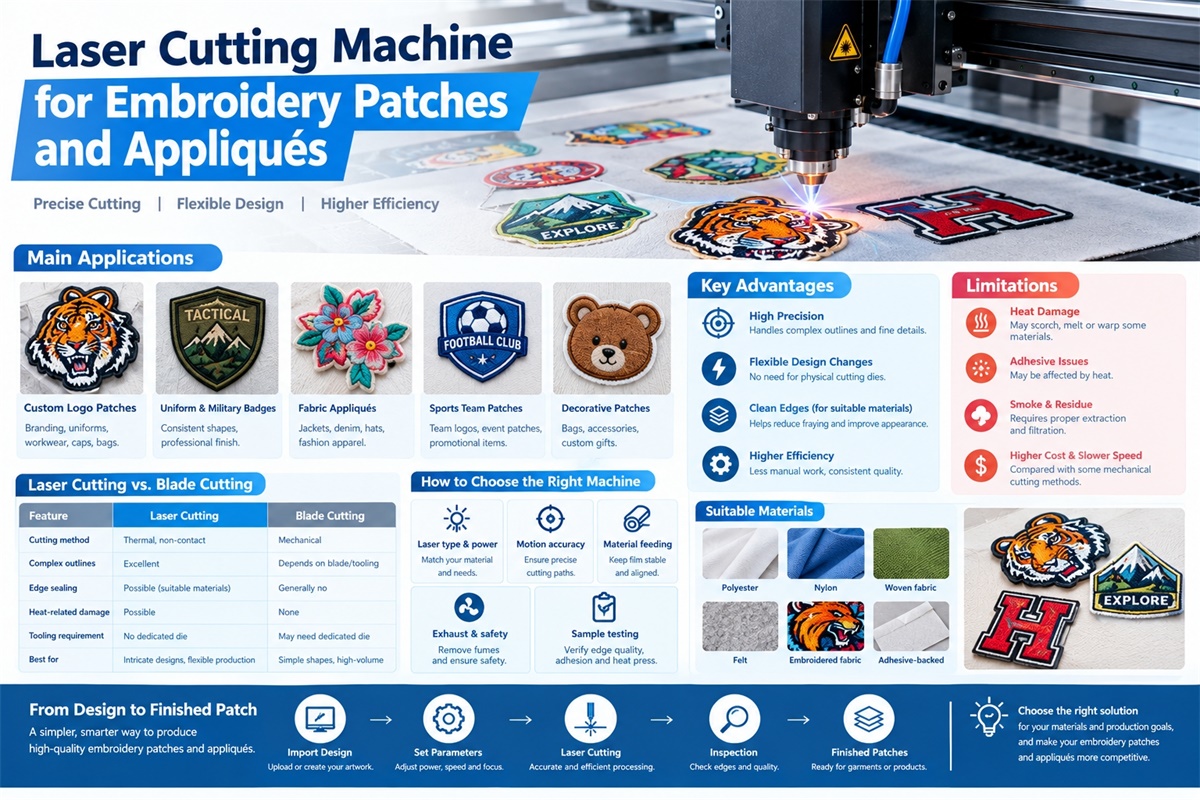
Embroidery patches and fabric appliqués require accurate cutting to achieve clean outlines, consistent shapes, and professional-looking edges. For manufacturers producing custom logos, embroidered badges, garment decorations, and promotional textiles, choosing the right cutting method can directly affect production efficiency and product quality.
A laser cutting machine for embroidery patches and appliqués uses a focused laser beam to follow programmed cutting paths, making it possible to process intricate shapes and customized designs without manufacturing a separate cutting die. Depending on the fabric composition, laser cutting can also seal the edges of suitable synthetic materials to help prevent fraying.
However, laser cutting is not ideal for every embroidery material. Thick embroidery, heat-sensitive fabrics, adhesive backings, and multilayer constructions require careful evaluation before production.
This guide explains the applications, advantages, limitations, and equipment selection considerations for laser cutting embroidery patches and appliqués.
1. What Is a Laser Cutting Machine for Embroidery Patches?
A laser cutting machine for embroidery patches is typically a CO2 laser system designed to cut fabric, embroidered material, or compatible textile composites according to digital patterns.
The machine directs a laser beam along a programmed path to separate the finished patch from the surrounding material. Depending on the application, manufacturers can process individual pieces or multiple designs arranged on a larger sheet.
Common applications include:
-
Embroidered clothing logos and uniform badges.
-
Custom sports team patches.
-
Military-style and tactical fabric patches.
-
Decorative appliqués for jackets, bags, and hats.
-
Fashion accessories and personalized textile products.
-
Promotional badges and branded merchandise.
Laser cutting is particularly useful when designs have irregular outlines, small details, or frequent shape changes. Instead of producing a dedicated die for every design, operators can modify the cutting path through software.
The final result depends on the fabric, embroidery density, backing material, cutting parameters, and machine configuration.
2. Main Applications of Laser Cutting for Embroidery Patches
2.1 Custom Logo Patches
Custom logos are widely used on workwear, sportswear, uniforms, caps, backpacks, and promotional products.
Many logos contain curved outlines, pointed corners, or irregular shapes that are difficult to trim consistently by hand. A laser cutting machine can follow these contours repeatedly, helping manufacturers maintain consistent dimensions across batches.
For businesses producing customized patches in different sizes, digital cutting also reduces dependence on dedicated physical cutting tools.
2.2 Embroidered Badges and Uniform Patches
Uniform badges often require consistent outlines and repeatable dimensions. A cutting machine must separate the embroidered design cleanly without damaging the stitching or backing.
Laser cutting can be suitable for compatible materials, but the operator must ensure that the laser does not burn exposed threads or damage adhesive layers.
For heat-sensitive or thick multilayer patches, a mechanical cutting method may be more appropriate.
2.3 Fabric Appliqués for Garments
Appliqués are decorative fabric shapes attached to garments through sewing, embroidery, or heat application.
Laser cutting can process appliqué shapes for:
-
T-shirts and sweatshirts.
-
Children’s clothing.
-
Sportswear and team apparel.
-
Denim jackets and fashion garments.
-
Bags, hats, and textile accessories.
When processing suitable synthetic fabrics, the laser can produce sealed edges that reduce loose fibers. This can be useful for appliqués with intricate outlines or small internal details.
However, edge sealing depends on the fabric’s thermal properties. Natural fibers such as cotton may scorch instead of forming a clean, sealed edge.
2.4 Multilayer Embroidery and Decorative Materials
Some patches combine embroidery with woven fabric, felt, synthetic backing, foam, or adhesive layers.
These constructions are more challenging because each layer may respond differently to laser energy. A setting that cuts the top layer cleanly may overheat the backing or damage the adhesive.
Before processing multilayer patches, test the complete material stack rather than evaluating the face fabric alone.
3. Why Use a Laser Cutting Machine for Embroidery Patches?
High Cutting Precision
A laser can follow complex digital paths without the physical blade pressure associated with mechanical cutting.
This is beneficial for irregular outlines, curved designs, and detailed appliqués, provided the material remains stable and the machine has suitable motion accuracy.
Flexible Design Changes
Traditional die cutting requires a physical tool for each shape. Laser cutting uses digital cutting paths, allowing operators to change dimensions or switch between designs without manufacturing a new die.
This flexibility is useful for personalized orders, short production runs, and businesses serving multiple customers.
Reduced Fraying on Suitable Synthetic Fabrics
When cutting compatible thermoplastic textiles, laser heat can fuse the fibers along the edge. This may reduce fraying and improve the finished appearance.
The effect is not universal. Cotton, wool, and other natural fibers may char or discolor instead of sealing cleanly.
Repeatable Production
Once the cutting path and processing parameters have been validated, a laser system can repeat the same design across multiple pieces.
Consistent feeding, stable positioning, and regular machine maintenance are important for maintaining repeatability during longer production runs.
Reduced Manual Trimming
Manual trimming can become a bottleneck when a factory produces large quantities of irregular patches.
Automated laser cutting can reduce repetitive handwork and help standardize the cutting process. Actual labor savings depend on loading, unloading, material preparation, inspection, and the complexity of the designs.
4. CO2 Laser vs. Mechanical Cutting for Embroidery Patches
Laser cutting is not always the best choice. Comparing it with mechanical cutting helps manufacturers select equipment based on their materials and production requirements.
| Feature | CO2 laser cutting | Mechanical cutting |
|---|---|---|
| Complex outlines | Suitable for intricate digital paths | Depends on blade, tooling, and machine control |
| Tooling requirements | No dedicated cutting die for each design | Some methods require dedicated tooling |
| Edge sealing | Possible on suitable synthetic fabrics | Generally does not seal fibers thermally |
| Heat-related damage | Possible, including scorching and melting | No laser-induced thermal damage |
| Thick multilayer patches | Requires material-specific testing | May be suitable with appropriate cutting equipment |
| Design changes | Digital path changes | Digital changes possible on CNC systems; dies may require replacement |
| Maintenance | Optics, laser source, motion system, and exhaust | Blades, tooling, and motion components |
| Best-fit applications | Detailed shapes and compatible textile materials | Heat-sensitive materials and suitable high-volume cutting workflows |
For thin synthetic appliqués and compatible patch materials, laser cutting can provide an advantage through digital flexibility and edge sealing.
For thick embroidered badges, heat-sensitive backing materials, or materials that char easily, mechanical cutting may provide better results.
5. How to Choose the Right Laser Cutting Machine
Choosing a laser cutting machine for embroidery patches requires more than selecting a particular laser power.
Laser Power and Cutting Speed
The correct power depends on material thickness, density, composition, and the number of layers being cut.
Excessive power can cause dark edges, melting, or damage to embroidery threads. Insufficient power may leave fibers connected or require repeated passes.
Test different power and speed combinations using the actual production material. The goal is to achieve complete separation with minimal thermal damage.
Working Area
The working area should accommodate the size of the fabric sheets, patch layouts, and number of pieces processed in each batch.
A larger work area may improve layout flexibility, but it does not automatically increase production speed. Motion performance, cutting path length, and material handling also matter.
Camera Recognition and Contour Cutting
Some production systems use cameras to recognize printed patterns or identify the position of designs before cutting.
This can be useful for printed appliqués and pre-positioned graphics. However, camera recognition is not necessary for every embroidered patch application.
If you need to cut around existing embroidery, ask the supplier how the machine locates the design and compensates for material movement.
Exhaust and Filtration
Laser cutting textiles can generate smoke, odors, and airborne residues. The extraction system must be suitable for the materials being processed.
Check that the machine has appropriate ventilation and that the fabric, backing, coatings, and adhesives are safe for laser processing. Unknown materials should not be cut until their composition and potential emissions have been evaluated.
Software Compatibility
The cutting software should support the design formats and workflow used by your production team.
Confirm how designs are imported, scaled, arranged, and converted into cutting paths. For repeated production, the ability to save validated parameters for different materials can simplify operation.
6. Common Problems When Laser Cutting Embroidery Patches
Burnt or Darkened Edges
This can occur when the laser applies too much heat or cuts too slowly. Reduce thermal input where possible and test the material again.
Dark edges may also result from the fabric composition, backing, or finishing treatment. Some materials cannot achieve an acceptable appearance through parameter adjustment alone.
Damaged Embroidery Threads
Raised threads and dense stitching may respond differently from the underlying fabric. If the cutting path passes too close to the embroidered details, heat can damage the design.
Keep the cutting path correctly aligned with the intended outline and test patches with different stitch densities.
Incomplete Cutting
If fibers or backing remain connected, check the focus, material thickness, cutting speed, and laser output.
Do not immediately increase power without checking these factors, because excessive heat can damage other layers.
Adhesive Backing Problems
Heat-activated adhesives may soften, melt, or leave residue during laser processing.
Test the patch after cutting and, where applicable, after the final heat-application process. A visually clean cut is not sufficient if the backing no longer performs correctly.
Inconsistent Patch Dimensions
Variation may result from material movement, unstable feeding, incorrect scaling, or inaccurate positioning.
Use a stable material support, verify the design dimensions, and check repeatability across several pieces before starting a large batch.
7. Which Materials Can Be Laser Cut for Patches and Appliqués?
Material compatibility is one of the most important factors in equipment selection.
| Material | Laser-cutting considerations |
|---|---|
| Polyester fabric | Often suitable for controlled laser cutting; test edge melting and sealing |
| Nylon fabric | May melt or shrink; requires careful parameter testing |
| Cotton fabric | Can scorch or char; edge sealing is generally not expected |
| Felt | Results vary with fiber composition, density, and binders |
| Woven patch fabric | Often suitable for testing, depending on fiber content and coatings |
| Embroidered fabric | Depends on thread, base fabric, stitch density, and backing |
| Adhesive-backed patches | Adhesive compatibility and heat effects must be evaluated |
| PVC-containing materials | Do not laser cut; heating PVC can release highly hazardous corrosive gases |
For any material containing coatings, adhesives, or unknown synthetic blends, obtain the material safety information before processing.
In particular, do not assume that a fabric is suitable simply because its base fiber can be laser cut. The complete construction must be evaluated.
8. How to Improve Production Efficiency
For manufacturers producing embroidery patches and appliqués in commercial quantities, efficiency depends on the complete workflow rather than the cutting operation alone.
Optimize the cutting layout. Arrange multiple designs efficiently on the material to reduce waste while maintaining adequate spacing between parts.
Standardize material-specific settings. Record validated power, speed, focus, and other parameters for each approved material.
Stabilize the material. Prevent wrinkles, shifting, and uneven contact with the cutting surface.
Inspect the first batch. Check dimensions, edge quality, thread integrity, and backing performance before continuing with the full order.
Maintain the machine. Follow the manufacturer’s maintenance schedule for optical components, exhaust systems, and motion components.
Measure actual throughput. Include material preparation, loading, unloading, inspection, and any required post-processing when comparing laser and mechanical cutting.
These practices help reduce rejected pieces and make production planning more predictable.
9. Is a Laser Cutting Machine Worth Buying for Embroidery Patches?
A laser cutting machine can be a worthwhile investment when your production involves complex shapes, frequent design changes, suitable synthetic textiles, or a need to reduce manual trimming.
It may be less attractive when most patches are thick, heat-sensitive, or easily damaged by thermal processing. A mechanical cutter may also be more economical for straightforward shapes produced in very large quantities.
Before purchasing, compare the following:
-
Material compatibility and edge quality.
-
Cutting accuracy and repeatability.
-
Production speed for your actual designs.
-
Material utilization and waste.
-
Labor requirements.
-
Exhaust and safety requirements.
-
Total equipment and maintenance costs.
For a reliable comparison, ask equipment suppliers to process representative samples from your own production line. Examine the finished pieces under normal inspection conditions rather than relying only on demonstrations.
Conclusion
A laser cutting machine for embroidery patches and appliqués provides a flexible way to produce detailed outlines, customized shapes, and repeatable textile components. It is particularly useful for suitable synthetic fabrics and production environments where digital design changes and reduced manual trimming are important.
However, heat-related damage, adhesive compatibility, and material safety must be considered before adopting laser cutting. For thick embroidery, natural fibers, and sensitive backing materials, mechanical cutting may remain the better option.
The most effective solution is to match the cutting method to the material, validate the process with real production samples, and evaluate the complete workflow before investing in equipment.
Frequently Asked Questions
1. Can a CO2 laser cut embroidery patches?
Yes, a CO2 laser can cut many compatible embroidered fabrics and patch materials. Results depend on the embroidery thread, base fabric, backing, thickness, and cutting parameters.
2. Does laser cutting prevent fraying on embroidery patches?
Laser cutting can seal the edges of suitable thermoplastic fabrics by melting their fibers. It generally does not provide the same effect on natural fibers such as cotton, which may scorch instead.
3. Is laser cutting suitable for thick embroidered patches?
It depends on the patch construction. Thick stitching, dense backing, and multiple adhesive layers can make cutting more difficult. Test the complete patch before production.
4. What laser power is best for cutting embroidery patches?
There is no universal power setting. The appropriate power depends on material composition, thickness, machine configuration, and cutting speed. Start with material-specific sample tests and optimize for clean separation with minimal heat damage.
5. Can a laser cutting machine cut patches with adhesive backing?
Some adhesive-backed materials may be compatible, but heat can affect the adhesive or create residue. Confirm material safety and test the finished patch’s bonding performance after cutting.
6. Is laser cutting better than die cutting for appliqués?
Laser cutting offers greater digital flexibility for changing shapes without dedicated dies. Die cutting can be efficient for repetitive high-volume production. The best method depends on design complexity, material compatibility, production quantity, and total cost.
Post time: Oct-22-2026
