
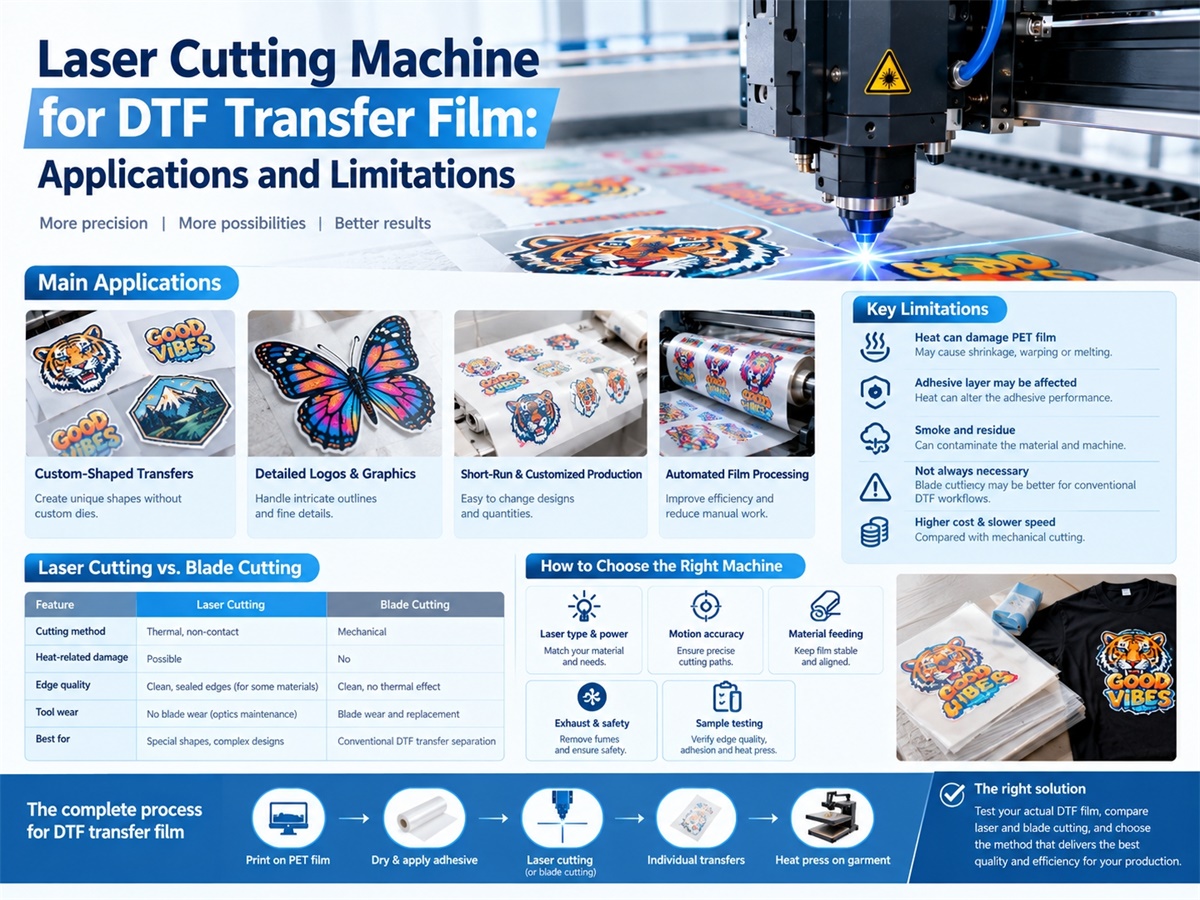
A laser cutting machine for DTF transfer film offers an alternative to manual trimming and mechanical cutting when manufacturers need to process detailed designs, irregular shapes, and customized heat transfer graphics. By using a focused laser beam to cut film along programmed paths, businesses can improve cutting precision and reduce repetitive manual work.
However, laser cutting is not suitable for every DTF film or transfer workflow. Heat-sensitive adhesive powder, PET film deformation, smoke residue, and edge quality can all affect the final result. Before investing in a laser cutting machine, it is important to understand which DTF applications benefit from laser processing and where its limitations become significant.
This guide explains how laser cutting works for DTF transfer film, its main applications, the technical challenges to consider, and how to choose the right cutting solution for your production needs.
1. What Is a Laser Cutting Machine for DTF Transfer Film?
A laser cutting machine for DTF transfer film uses a laser beam to cut printed transfer designs into specific shapes. Depending on the equipment configuration, it may process individual sheets, pre-printed film, or compatible roll materials.
Unlike a conventional blade cutter, a laser does not need to maintain physical contact with the film. The cutting path is controlled digitally, allowing the machine to follow complex outlines and repeated patterns.
For DTF production, laser cutting may be considered for applications such as:
-
Cutting custom-shaped DTF transfers.
-
Processing irregular graphics and detailed outlines.
-
Cutting printed transfer film into individual designs.
-
Producing customized logos, labels, and decorative graphics.
-
Automating repetitive cutting operations for suitable film materials.
The key consideration is that DTF transfer film is a multilayer material system, not simply a sheet of plastic. The PET carrier, printed ink, adhesive powder, and any applied coatings may respond differently to laser heat.
Consequently, a laser cutting machine must be evaluated according to the complete transfer material and the required finished result.
2. Main Applications of Laser Cutting for DTF Transfer Film
2.1 Custom-Shaped DTF Transfers
Standard DTF workflows often involve printing multiple graphics on a PET film roll and cutting the finished transfers into individual pieces.
A laser can follow programmed contours to produce custom shapes without requiring a dedicated cutting die. This is useful for businesses handling frequent design changes or short production runs.
For example, a supplier producing personalized garment graphics may need different shapes and sizes for each order. Digital laser cutting can accommodate these changes through software rather than physical tooling.
However, the laser must be compatible with the printed film and adhesive layer. Heat-related edge damage must be evaluated before using this method for commercial production.
2.2 Detailed Logos and Decorative Graphics
Some DTF graphics contain small details, irregular outlines, or complicated contours that are difficult to trim consistently by hand.
A properly configured laser system can follow intricate cutting paths and repeat them accurately within the machine’s positioning capabilities.
Potential applications include:
-
Customized clothing logos.
-
Sportswear graphics.
-
Small decorative motifs.
-
Personalized fashion transfers.
-
Promotional garment designs.
The actual minimum feature size depends on the laser spot, motion accuracy, film stability, and cutting parameters. Very small features may deform or lose definition if the material responds poorly to heat.
2.3 Short-Run and Customized Production
For businesses producing small batches, the ability to change cutting patterns digitally can reduce setup work.
A laser cutter may be useful when customers regularly request different graphics, quantities, and shapes. It can also reduce the need for specialized physical cutting tools.
Nevertheless, the benefits depend on the entire workflow. If every transfer requires extensive manual preparation or post-cut cleaning, the time saved during cutting may be limited.
2.4 Automated Film Processing
Industrial DTF operations increasingly focus on improving consistency and reducing repetitive manual handling.
Depending on its configuration, a laser cutting system can be integrated with material feeding, positioning, motion control, and production software.
For roll-based operations, important considerations include:
-
Consistent film tension.
-
Accurate material feeding.
-
Stable positioning during cutting.
-
Reliable recognition of printed graphics, where required.
-
Effective smoke extraction.
-
Safe handling of finished transfers.
Automatic feeding alone does not guarantee accurate cutting. The film must remain stable, and the cutting system must account for the position of the printed design.
3. What Are the Limitations of Laser Cutting DTF Transfer Film?
Although laser cutting offers flexibility, several limitations can affect its suitability for DTF production.
3.1 Heat Can Damage the PET Film
PET transfer film is sensitive to excessive localized heating. Depending on its formulation and thickness, the film may shrink, warp, melt, or develop undesirable edge changes.
These problems can reduce dimensional accuracy and make the finished transfer difficult to handle.
The risk increases when the laser applies too much energy to a small area or follows a cutting path too slowly.
To minimize these problems, conduct material-specific tests and optimize laser power, cutting speed, focus, and other relevant parameters. A successful setting for one PET film should not automatically be applied to another.
3.2 Adhesive Powder May Be Affected by Heat
DTF transfers typically use hot-melt adhesive powder to bond printed graphics to fabric during heat pressing.
When laser energy reaches the adhesive layer, excessive heat may alter its appearance or behavior. Depending on the material and processing conditions, the adhesive may melt, become contaminated, or form undesirable deposits around the cut.
This is a critical consideration because a transfer that looks clean may still perform poorly during heat pressing.
After cutting, inspect the transfer edges and conduct an actual heat-press test. Evaluate adhesion, edge appearance, wash durability, and the presence of unwanted residue before approving the process.
3.3 Smoke and Residue Can Contaminate the Material
Laser processing may produce fumes and airborne residues from the film, ink, coatings, and adhesive.
If extraction is inadequate, deposits can accumulate on the transfer surface, cutting table, or optical components.
For commercial production, an appropriate extraction system and material-compatible filtration are essential. The fumes generated by the complete film system should be assessed before processing, and materials with unknown or unsuitable chemical compositions should not be laser cut.
3.4 Not Every DTF Workflow Requires Laser Cutting
A major limitation is that laser cutting may add unnecessary complexity to a conventional DTF production line.
Many DTF businesses use a PET film cutter with a blade or a dedicated film-cutting system to separate transfers. These methods avoid laser-related thermal effects and may be more suitable for certain adhesive-coated materials.
If the main objective is simply to cut printed DTF film into individual designs, a mechanical cutter may provide a more straightforward solution.
Laser cutting becomes more attractive when its specific capabilities solve a problem that conventional cutting cannot address as efficiently.
3.5 Operating Cost and Production Speed
Laser cutting equipment may require investment in the laser source, motion system, extraction equipment, safety enclosure, and maintenance.
Actual throughput depends on cutting path length, design complexity, acceleration, material feeding, and the number of transfers processed simultaneously.
A laser may be highly effective for intricate shapes but less economical for simple, high-volume separation tasks that a dedicated mechanical cutter can perform rapidly.
Businesses should compare complete production costs rather than evaluating cutting speed alone.
4. Laser Cutting vs. Blade Cutting for DTF Film
Choosing between laser and mechanical cutting requires a clear understanding of the production objective.
| Comparison | Laser cutting | Blade cutting |
|---|---|---|
| Cutting method | Thermal, non-contact processing | Mechanical cutting |
| Complex outlines | Suitable when the material responds well to laser heat | Suitable with appropriate blade and motion control |
| Heat-related damage | Possible | Avoids laser-induced thermal damage |
| Tool wear | No physical cutting blade, but optical components require maintenance | Blade wear and replacement may be necessary |
| Adhesive compatibility | Must be tested carefully | Often preferable when heat sensitivity is a concern |
| Setup flexibility | Digital path changes | Digital path changes |
| Material residue | May generate fumes and thermal deposits | May produce less thermal residue |
| Best-fit applications | Suitable specialized cutting tasks and compatible materials | Many conventional DTF film-cutting workflows |
Neither method is universally superior.
For ordinary DTF transfer separation, a mechanical cutter is often the more practical starting point because it avoids heating the adhesive-coated film. Laser cutting should be selected when testing demonstrates a clear advantage for the intended application.
5. How to Choose a Laser Cutting Machine for DTF Transfer Film
If you are considering a laser system for DTF materials, evaluate the following factors before purchasing.
Laser Type and Power
Laser type and output power affect the cutting process, but higher power is not automatically better.
The correct configuration depends on the film construction, thickness, required cutting geometry, and production speed. Excessive power may damage the carrier film or adhesive, while insufficient power may result in incomplete cutting.
Request a sample test using your actual printed DTF film rather than relying solely on demonstrations involving unrelated materials.
Motion Accuracy and Control
The machine must follow the intended cutting path consistently.
Check its positioning accuracy, motion stability, software compatibility, and ability to maintain registration with printed graphics when contour cutting is required.
If the film contains multiple printed designs, ask whether the system supports the necessary positioning or registration method.
Material Feeding
For roll-to-roll production, feeding stability is important. Wrinkles, tension changes, and film movement can affect the relationship between the printed design and the cutting path.
Evaluate the feeding system under realistic production conditions, including long runs and changes in roll tension.
Exhaust and Safety Systems
A laser machine should have suitable guarding, interlocks, exhaust ventilation, and other safety features appropriate to its design.
Before processing a particular film, confirm its composition and assess the fumes that may be produced by the PET carrier, inks, coatings, and adhesive. Do not assume that a material is safe to laser process simply because it is commonly used in printing.
Sample Testing and After-Sales Support
Before making a purchasing decision, ask the supplier to process your actual material and inspect the results.
A useful evaluation should include:
-
Cutting accuracy and edge appearance.
-
Film shrinkage or deformation.
-
Adhesive condition around the cut.
-
Transfer performance after heat pressing.
-
Wash durability, where relevant.
-
Production speed and material waste.
-
Extraction requirements and operating costs.
These tests provide a more reliable basis for equipment selection than a general claim that the machine can cut DTF film.
6. Is a DTF Film Cutter a Better Alternative?
For many businesses, a dedicated DTF film cutter is a more direct solution than a laser cutting machine.
A DTF film cutter is designed for the specific requirements of separating transfer film and may support functions such as contour cutting, roll feeding, and automated positioning, depending on the model.
Mechanical cutting can be particularly useful when:
-
The film contains heat-sensitive adhesive.
-
The production process requires clean edges without thermal alteration.
-
Most designs have straightforward outlines.
-
The business processes large volumes of conventional DTF transfers.
-
Operating simplicity and predictable production costs are priorities.
For more specialized applications, a laser may still be worth evaluating. The decision should be based on verified cutting performance with the intended material.
If your primary requirement is automated DTF film processing, explore Dowin’s DTF film cutting machine solutions and request a demonstration using your own film. Confirm the available machine configuration and cutting method with the supplier before choosing a model.
7. Common Mistakes When Laser Cutting DTF Transfer Film
Several avoidable mistakes can lead to poor cutting results or unnecessary operating costs.
Using settings developed for other plastics. DTF film includes multiple functional layers, so settings for acrylic, ordinary PET sheet, or other plastics may not work correctly.
Ignoring the adhesive layer. A visually clean cut does not guarantee that the adhesive will retain its required bonding performance.
Focusing only on laser power. Speed, focus, film stability, and extraction also influence the result.
Skipping heat-press testing. Transfers should be evaluated in the complete application process, not only immediately after cutting.
Ignoring chemical compatibility. Some inks, coatings, adhesives, and films may produce hazardous fumes when heated. Confirm material safety before processing.
Choosing a laser for every cutting task. If a blade cutter can achieve the required quality more simply, a laser may not provide sufficient additional value.
Conclusion
A laser cutting machine for DTF transfer film can provide digital cutting flexibility for customized graphics, intricate outlines, and specialized production tasks. However, its effectiveness depends on the compatibility of the laser with the complete transfer material, particularly the PET carrier and heat-sensitive adhesive layer.
For conventional DTF film separation, mechanical cutting is often a practical option because it avoids laser-induced thermal damage. For specialized applications, laser cutting should be considered only after confirming edge quality, adhesive performance, material safety, and production economics.
The most reliable approach is to test your actual DTF film, compare laser and mechanical cutting under the same conditions, and select the equipment that delivers the best overall production result.
Frequently Asked Questions
1. Can a laser cutting machine cut DTF transfer film?
Some laser systems may cut compatible DTF transfer films, but suitability depends on the film, ink, adhesive, laser configuration, and processing parameters. Sample testing is essential before production.
2. Does laser cutting damage DTF PET film?
It can. Excessive heat may cause shrinkage, warping, melting, or edge deformation. Appropriate settings and material testing can help determine whether a particular film can be processed successfully.
3. Can laser cutting melt DTF adhesive powder?
Yes, excessive localized heating may alter the adhesive or create unwanted deposits. The finished transfer should be evaluated after cutting and heat pressing to confirm that bonding performance remains acceptable.
4. Is laser cutting better than a blade cutter for DTF film?
Not in every situation. Blade cutting avoids laser-related thermal damage and is often suitable for conventional DTF transfer separation. Laser cutting may be worth considering for specialized shapes or workflows where its capabilities offer a measurable advantage.
5. What should I test before buying a DTF laser cutting machine?
Test cutting accuracy, edge appearance, film deformation, adhesive condition, heat-press performance, production speed, and extraction requirements using your actual production material.
6. Is laser cutting suitable for mass production of DTF transfers?
It may be suitable for some production lines, but throughput and operating costs must be evaluated against mechanical cutting alternatives. Automatic feeding, stable positioning, material compatibility, and reliable extraction are important considerations.
Post time: Oct-22-2026
