
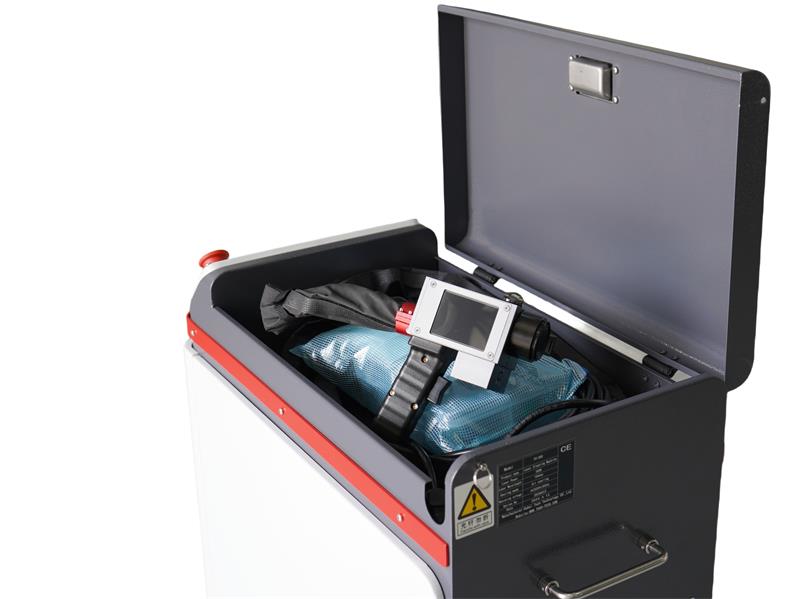
Industrial cleaning is no longer just a maintenance task—it’s becoming a strategic decision that affects cost, efficiency, sustainability, and even product quality. Among the many technologies competing for dominance, two stand out: laser cleaning and dry ice blasting.
At first glance, both promise non-abrasive, chemical-free cleaning. But beneath that similarity lies a deeper divide—one rooted in physics, economics, and the future direction of manufacturing.
This is not just a comparison. It’s a reality check.
Two Technologies, Two Philosophies
Let’s strip away the marketing.
- Laser cleaning uses focused light energy to selectively vaporize contaminants.
- Dry ice blasting uses high-speed CO₂ pellets combined with thermal shock and expansion to break contaminants loose
They achieve similar outcomes—but through fundamentally different mechanisms.
That difference changes everything.
Where Dry Ice Blasting Still Dominates
Dry ice blasting is not obsolete. In fact, in some scenarios, it is still the more practical choice.
1. Speed Over Precision
Dry ice blasting excels in large-area cleaning:
- Factory floors
- Heavy equipment
- Structural components
Because it uses compressed air and pellets, it can cover wide surfaces quickly, often outperforming lasers in bulk cleaning tasks .
2. Complex Geometries & Hidden Spaces
Need to clean:
- Pipes
- Internal cavities
- Wiring systems
Dry ice blasting reaches areas lasers struggle with. The particle flow naturally penetrates irregular structures.
3. Mixed Materials & Sensitive Assemblies
Dry ice is non-abrasive and non-conductive, making it suitable for:
- Electronics
- Food processing equipment
- Machinery with seals or polymers
This flexibility is why it remains widely used in maintenance-heavy industries.
The Hidden Costs of Dry Ice Blasting
However, dry ice blasting carries structural inefficiencies that are often underestimated.
1. Supply Chain Dependency
Dry ice must be:
- Produced separately
- Stored below -78°C
- Used quickly before sublimation
This creates ongoing logistical pressure—not just cost, but operational complexity.
2. Safety and Environmental Constraints
- Extreme cold can cause frostbite risks
- High noise levels require protective equipment
- CO₂ buildup demands proper ventilation
And while pellets disappear, removed contaminants do not—they become airborne debris.
3. Weak Performance on Tough Layers
Dry ice struggles with:
- Heavy rust
- Thick coatings
- Strong chemical films
In those cases, it becomes inefficient—or simply ineffective.
Why Laser Cleaning Is Disrupting the Industry
Laser cleaning doesn’t just improve cleaning—it redefines it.
1. Precision Becomes a Competitive Advantage
Laser systems remove contaminants micron by micron:
- No abrasion
- No structural damage
- No media embedding
This makes them ideal for:
- Aerospace components
- molds and precision tools
- heritage restoration
This level of control is impossible with particle-based methods.
2. Zero Consumables = Long-Term Cost Collapse
No pellets. No chemicals. No secondary materials.
Laser cleaning eliminates:
- Supply chains
- Storage systems
- Continuous material costs
While initial investment is higher, operational costs drop dramatically over time .
3. Environmental Shift: From Waste to Clean Energy
Laser cleaning produces:
- Minimal waste
- No chemical runoff
- Controlled dust extraction
Compared to dry ice blasting, which still disperses contaminants, laser cleaning creates a contained cleaning environment .
This aligns directly with:
- ESG policies
- Carbon reduction goals
- Sustainable manufacturing trends
4. Data-Driven Cleaning (The Real Revolution)
Here’s where most articles stop—but this is where the real shift begins.
Laser cleaning is:
- Programmable
- Repeatable
- Integratable with automation
This means cleaning is no longer manual—it becomes part of the production system.
Dry ice blasting is a tool.
Laser cleaning is a process platform.
The Trade-Off No One Talks About
Laser cleaning is not perfect.
Limitations:
- Higher upfront cost
- Slower on large, low-precision surfaces
- Requires parameter expertise
Dry ice blasting, in contrast:
- Is cheaper to start
- Easier to deploy
- Faster in bulk scenarios
But this comparison misses a deeper truth.
Breaking Conventional Thinking: It’s Not “Either-Or”
The smartest factories are no longer choosing one.
They are combining both.
Hybrid Strategy:
- Dry ice blasting → remove bulk contamination
- Laser cleaning → precision finishing
This approach:
- Maximizes speed
- Ensures surface quality
- Optimizes cost
In other words, the future is not about replacing methods—it’s about layering technologies intelligently.
So, Which Is Better?
The honest answer:
- Choose dry ice blasting if:
- You need speed over precision
- You are cleaning large or complex assemblies
- Budget constraints are critical
- Choose laser cleaning if:
- Precision and surface integrity matter
- You want long-term cost efficiency
- Sustainability and automation are priorities
Final Insight: The Industry Is Already Deciding
The question “Which is better?” is slowly becoming irrelevant.
Because the industry trend is clear:
- Maintenance → Dry ice blasting
- Manufacturing & precision → Laser cleaning
Laser cleaning is not just an alternative—it is the direction of industrial evolution.
And in that context, the real question becomes:
Are you optimizing for today’s convenience—or tomorrow’s system?
Post time: Apr-24-2026
