
1. The End of “Dirty Cleaning”
For decades, surface cleaning has been a necessary evil in manufacturing—essential, yet inefficient, polluting, and often destructive. Chemical baths, sandblasting, and mechanical grinding built the industrial world, but they were never designed for the precision economy we live in today.
Data from modern manufacturing trends shows a clear shift: industries are no longer optimizing just for output, but for precision, sustainability, and lifecycle cost. Traditional cleaning methods fail all three.
- Chemical cleaning generates hazardous waste and long-term environmental liabilities
- Abrasive methods damage substrates and reduce component lifespan
- Manual processes lack consistency and scalability
Laser cleaning doesn’t improve these methods—it replaces them entirely.
2. Cleaning with Light: A Paradigm Shift
Laser cleaning is not just a new tool; it’s a new philosophy.
Instead of using force, friction, or chemistry, it uses controlled energy. A high-energy laser beam interacts with contaminants at the molecular level, causing them to vaporize, detach, or break apart—while leaving the base material untouched.
At its core, three physical mechanisms drive the process:
- Thermal ablation – contaminants absorb energy and evaporate
- Thermal stress – rapid expansion causes separation from the surface
- Plasma shock waves – micro-explosions dislodge particles
This is not cleaning in the traditional sense. It is selective material removal with micron-level precision.
3. Why Traditional Methods Are Becoming Obsolete
The decline of conventional cleaning is not accidental—it is structural.
| Method | Hidden Cost |
|---|---|
| Chemical cleaning | Waste disposal, regulatory pressure, operator health risks |
| Sandblasting | Surface damage, dust pollution, high containment cost |
| Mechanical grinding | Labor intensity, inconsistency, low precision |
| Ultrasonic cleaning | Limited scalability, weak on heavy contamination |
In high-end sectors like aerospace and electronics, even microscopic surface damage can lead to failure. Traditional methods simply cannot meet these tolerances anymore.
Laser cleaning aligns perfectly with the new industrial logic: zero contact, zero waste, maximum control.
4. Core Advantages: Not Incremental, But Exponential
Laser cleaning is often described as “better,” but that undersells its impact. It fundamentally changes cost structures and production models.
1. Extreme Efficiency
Cleaning occurs almost instantly, enabling inline integration with production lines.
2. True Green Manufacturing
No chemicals, no wastewater—only minimal particulate that can be filtered.
3. Precision Engineering Capability
Parameters such as wavelength, pulse duration, and energy density allow tailored cleaning at micro-scale.
4. Non-Destructive Processing
No mechanical stress, no abrasion, minimal thermal impact.
5. Automation-Ready
Easily integrated with robotics and AI vision systems for smart factories.
This is why laser cleaning is increasingly viewed not as a tool—but as infrastructure for intelligent manufacturing.
5. Where Laser Cleaning Is Winning
Laser cleaning has already crossed the tipping point from “emerging” to “mainstream” in several industries:
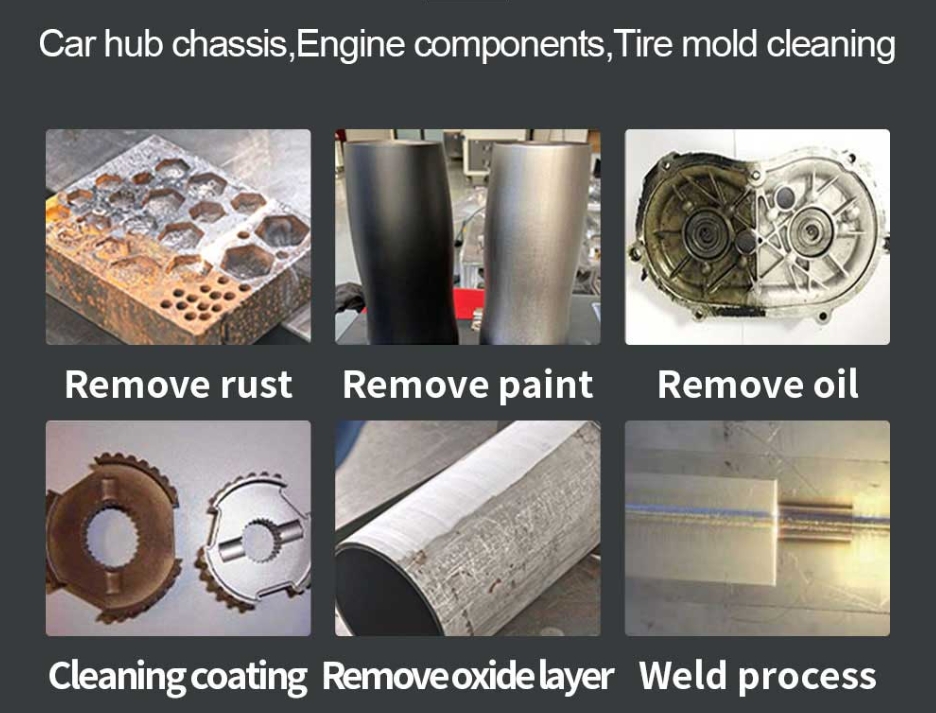
- Automotive: Pre-weld cleaning improves bonding strength and consistency
- Mold maintenance: In-situ cleaning eliminates downtime
- Aerospace: Precision coating removal without structural risk
- Shipbuilding: Rust removal with lower environmental footprint
- Electronics: Micro-level oxide cleaning for reliability
- Cultural heritage: Non-invasive restoration of fragile materials
What connects these sectors is not the application—but the requirement:
cleaning without compromise.
6. The Economics: From Cost Center to Value Driver
Here is the overlooked truth: cleaning has traditionally been treated as a cost center.
Laser cleaning flips that model.
- Reduced labor dependency
- Lower consumable costs (no abrasives, no chemicals)
- Minimal rework due to higher consistency
- Compliance with tightening environmental regulations
Forward-looking manufacturers are not asking, “Is laser cleaning cheaper?”
They are asking, “Can we afford not to switch?”
7. The Future: Intelligent, Portable, Ubiquitous
The next phase of laser cleaning is already forming:
- Portable systems enabling field operations and decentralized maintenance
- AI-driven parameter optimization for adaptive cleaning
- Higher power systems for heavy-duty industrial use
- Cost democratization making the technology accessible to SMEs
As laser sources become cheaper and smarter, laser cleaning will move from specialized equipment to standard industrial infrastructure.
8. A Contrarian View: It’s Not About Cleaning
Most discussions frame laser cleaning as a better way to clean surfaces.
That’s the wrong perspective.
Laser cleaning is actually about control over material at the microscopic level. Cleaning is just the first application.
Once manufacturers realize they can precisely remove, modify, or prepare surfaces without contact, new possibilities emerge:
- Functional surface engineering
- Selective coating removal in electronics
- Hybrid manufacturing processes
In that sense, laser cleaning is not the end of an era—it is the beginning of light-based manufacturing logic.
Conclusion
Laser cleaning is not an incremental upgrade—it is a structural shift in how industries approach surface treatment. By eliminating chemicals, reducing damage, and enabling precision at scale, it aligns perfectly with the future of manufacturing: clean, intelligent, and highly controlled.
The real question is no longer whether laser cleaning works.
It’s whether traditional cleaning still makes sense in a world that demands perfection.
Post time: Apr-10-2026
