
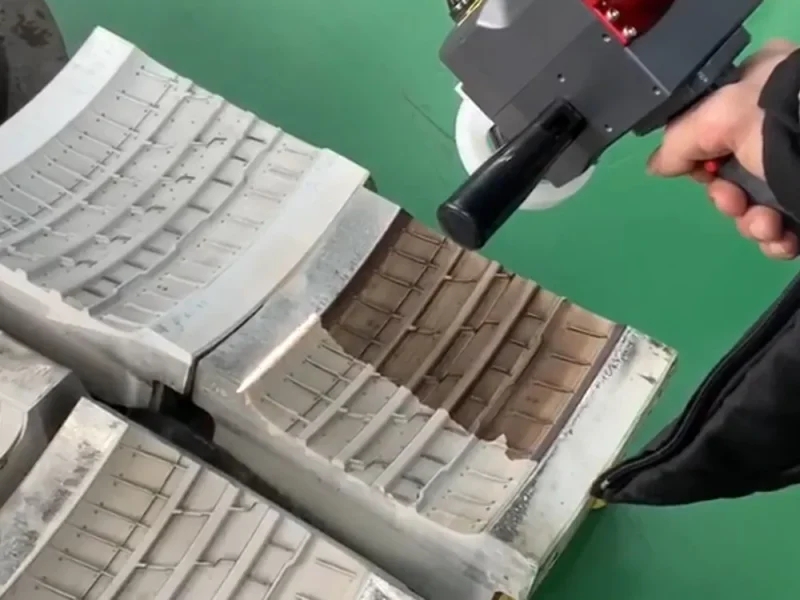
1. Mold Cleaning Is No Longer a Side Process
In modern manufacturing, molds are no longer passive tools—they are precision assets that directly define product quality, cycle time, and profitability.
Across industries such as injection molding, die casting, and rubber processing, molds continuously accumulate contaminants: release agents, carbon deposits, oxides, and polymer residues. These seemingly minor layers create a cascade of problems:
- Surface defects in finished parts
- Increased reject rates
- Frequent production interruptions
- Accelerated mold wear
Traditional cleaning methods—chemical soaking, abrasive blasting, and manual scraping—have long been accepted as “good enough.” But in a data-driven manufacturing environment, “good enough” is becoming economically unacceptable.
Laser cleaning emerges not as an upgrade—but as a redefinition of mold maintenance logic.
2. The Core Breakthrough: Cleaning Without Contact
At the heart of laser cleaning lies a disruptive principle:
remove contamination without touching the mold.
Using controlled laser pulses, contaminants absorb energy and detach or vaporize, while the base material reflects or minimally absorbs that energy. The result is selective removal with almost zero mechanical or thermal damage.
This solves the mold industry’s oldest contradiction:
How do you clean aggressively—without damaging precision surfaces?
Laser cleaning resolves this paradox by eliminating physical interaction entirely.
3. Why Traditional Mold Cleaning Is Structurally Outdated
The limitations of conventional methods are not just technical—they are systemic:
| Method | Structural Limitation |
|---|---|
| Chemical cleaning | Hazardous waste, regulatory pressure, hidden disposal costs |
| Sandblasting | Surface erosion, loss of precision, dust contamination |
| Manual cleaning | Labor-dependent, inconsistent, slow |
| Dry ice blasting | Secondary residues, limited precision |
These methods were built for an era of low precision and cheap labor.
Today’s mold industry demands the opposite: micron-level accuracy and repeatability.
Laser cleaning fits that demand natively.
4. Key Advantages—But Viewed Differently
Most discussions list advantages. That’s superficial.
What matters is how these advantages reshape production.
4.1 Zero Damage = Extended Mold Lifespan
Laser cleaning is non-contact and non-abrasive, meaning no wear, no micro-cracks, and no geometric distortion.
Real implication:
Molds last longer—not incrementally, but significantly—especially high-value precision molds.
4.2 Precision Cleaning = Process Stability
Laser parameters (power, pulse width, scanning path) allow targeted cleaning of micro-areas, such as vent slots or cavity edges.
Real implication:
Instead of cleaning the entire mold, manufacturers clean only what matters—reducing unnecessary intervention and stabilizing production quality.
4.3 No Chemicals = Compliance + Cost Shift
Laser cleaning eliminates solvents, wastewater, and secondary waste.
Real implication:
Environmental compliance is no longer a cost burden—it becomes a built-in feature of the process.
4.4 In-Place Cleaning = Downtime Collapse
Laser systems allow in-situ cleaning directly on the production line, without dismantling molds.
Real implication:
Downtime shifts from hours to minutes.
In high-volume production, this alone justifies the technology.
4.5 No Consumables = Predictable Economics
No abrasives, no chemicals, minimal maintenance.
Real implication:
Costs become predictable and scalable—critical for large manufacturing operations.
4.6 Versatility = One Tool, Multiple Mold Types
Laser cleaning adapts to:
- Injection molds
- Tire molds
- Die-casting tools
- Rubber and composite molds
Real implication:
A single system replaces multiple cleaning processes, simplifying operations.
5. The Hidden Advantage: Production Continuity
The most underestimated benefit is not cleaning quality—it is production continuity.
Laser cleaning enables:
- Cleaning at operating temperature (no cooling required)
- Rapid cycles (minutes instead of hours)
- Frequent maintenance without disruption
This leads to a new operational model:
Clean more often, but stop production less.
That is a fundamental shift.
6. A Necessary Reality Check
Laser cleaning is not a universal solution.
- Deeply bonded metallic residues (e.g., in die casting) may resist removal
- Functional coatings can be sensitive if parameters are misconfigured
- Initial investment remains high
In other words, laser cleaning excels in surface-level contamination scenarios, which fortunately represent the majority of mold maintenance needs.
7. Industry Trend: From Maintenance to Strategy
Data across manufacturing sectors shows a clear trajectory:
- Increasing automation of cleaning processes
- Integration with robotic systems
- Shift toward predictive maintenance
Laser cleaning aligns with all three.
It transforms mold cleaning from a reactive task into a strategic component of smart manufacturing.
8. A Contrarian Perspective: It’s Not About Cleaning Molds
The industry frames laser cleaning as a maintenance tool.
That framing is limiting.
What laser cleaning actually delivers is:
- Control over surface conditions
- Consistency across production cycles
- Decoupling of maintenance from downtime
This is not cleaning—it is process control at the surface level.
Once manufacturers understand this, new possibilities emerge:
- Real-time mold conditioning
- Adaptive cleaning during production
- Integration with AI-driven quality systems
Conclusion
Laser cleaning in the mold industry is not just a better cleaning method—it is a structural upgrade to manufacturing itself.
By eliminating contact, reducing downtime, and enabling precision-level control, it aligns perfectly with the future of production: automated, sustainable, and highly predictable.
The real shift is not technological.
It is conceptual:
Cleaning is no longer maintenance.
It is part of the production system.
Post time: Apr-10-2026
