
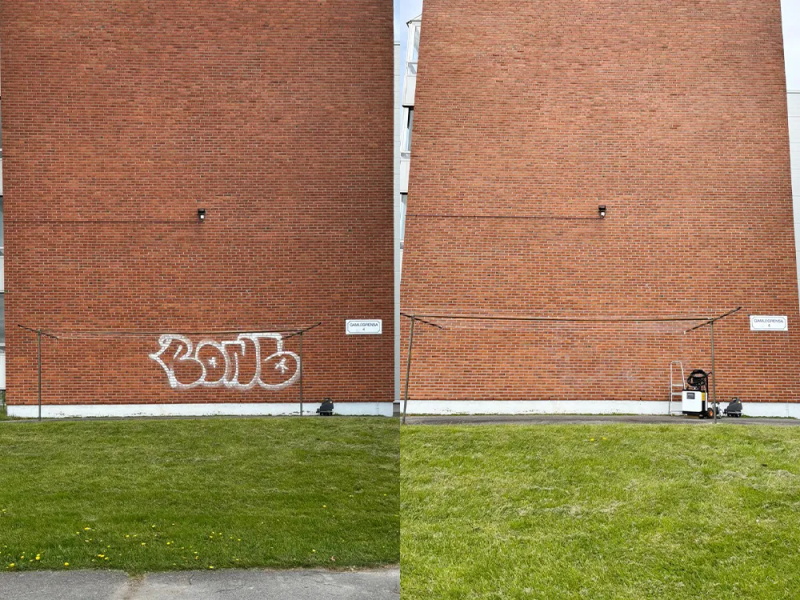
Why Graffiti Removal Is More Complex Than It Looks
Graffiti is often framed as a simple cleaning problem. It is not.
It sits at the intersection of urban management, material science, and cost control. Cities, transport systems, and property owners spend billions annually on graffiti removal, yet the methods used remain largely outdated.
Traditional approaches—chemical solvents, pressure washing, sandblasting—create a recurring cycle:
- Remove graffiti
- Damage the surface
- Increase future cleaning costs
The result is not restoration. It is gradual surface degradation disguised as maintenance.
Laser cleaning introduces a fundamentally different model.
What Makes Laser Cleaning Different
Laser cleaning does not rely on force or chemicals. It uses high-energy, short laser pulses to break the bond between graffiti and the underlying surface.
The process works through selective absorption:
- Paint layers absorb laser energy and vaporize
- Substrates (stone, metal, brick) reflect or dissipate energy
This allows non-contact, highly controlled removal without grinding, scratching, or chemical reactions.
Key shift:
From “removing everything” → to removing only what should not be there
Why Cities and Industries Are Turning to Laser Graffiti Removal
1. Surface Preservation Becomes a Priority
Urban infrastructure is not disposable. Materials such as:
- Historic stone
- Architectural concrete
- Metal panels
- Glass and coated surfaces
require preservation, not repeated abrasion.
Laser cleaning protects:
- Surface texture
- Structural integrity
- Original finish
This is especially critical in heritage districts and high-value properties.
2. Environmental Regulations Are Tightening
Chemical graffiti removers introduce:
- Toxic runoff
- Airborne pollutants
- Hazardous waste disposal requirements
Pressure washing consumes large volumes of water and spreads contaminants.
Laser cleaning eliminates:
- Chemicals
- Secondary waste
- Water dependency
Result: compliance becomes easier, not harder.
3. Long-Term Cost Is Driving Adoption
At first glance, laser systems appear expensive. But cost analysis over time reveals a different picture.
Traditional methods require:
- Consumables (chemicals, abrasives)
- Frequent surface repairs
- Repeated labor-intensive processes
Laser cleaning offers:
- Minimal consumables
- Lower maintenance
- Reduced rework
Over multiple cleaning cycles, the cost per removal decreases significantly.
How Laser Cleaning Removes Graffiti Step by Step
1. Surface Assessment
Operators evaluate:
- Substrate type (brick, stone, metal, painted surface)
- Paint composition (spray paint, marker, industrial coatings)
- Depth of penetration
This determines parameter settings.
2. Parameter Optimization
Key variables include:
- Laser power
- Pulse frequency
- Scanning speed
Incorrect settings can either leave residue or damage the substrate.
This is not plug-and-play. Precision matters.
3. Layer-by-Layer Removal
Laser pulses remove graffiti gradually:
- Top paint layers vaporize first
- Deeper residues are removed in controlled passes
- Cleaning stops once the substrate is exposed
This avoids over-cleaning—a common problem with blasting.
4. Final Surface Integrity Check
After cleaning:
- No chemical residue remains
- No abrasion marks are introduced
- Surface is ready for immediate use or protection
Where Laser Graffiti Removal Excels
1. Historic and Cultural Buildings
Laser cleaning preserves delicate surfaces where traditional methods would cause irreversible damage.
2. Public Infrastructure
Bridges, tunnels, and transit systems benefit from:
- Fast cleaning
- Minimal disruption
- Consistent results
3. Commercial Properties
Retail and office buildings require clean surfaces without downtime or visible damage.
4. Transportation Equipment
Trains, buses, and containers can be cleaned without repainting entire surfaces.
Power Selection: Why Bigger Isn’t Always Better
A common misconception is that higher power ensures better results.
In graffiti removal:
- Low to mid power (100W–300W):
Ideal for controlled paint removal and delicate surfaces - Higher power systems:
Faster, but risk damaging coatings or substrates
Reality:
Graffiti removal is a precision task, not a brute-force operation.
Limitations You Should Not Ignore
Laser cleaning is not a universal solution.
Challenges include:
- Deeply absorbed paint in porous materials
- Need for skilled parameter adjustment
- Higher initial investment
- Slower performance on large, heavily covered areas
Ignoring these factors leads to unrealistic expectations.
A Contrarian View: The Problem Is Not Graffiti—It’s the System
Most cities treat graffiti as a recurring cleaning issue.
This is inefficient.
Laser cleaning enables a different approach:
- Rapid, localized removal
- Minimal surface damage
- Integration with preventive coatings
New strategy:
Reduce long-term damage, not just remove short-term marks.
Future Trends: Intelligent Urban Cleaning
The next evolution of graffiti removal will include:
- Robotic laser cleaning systems
- AI-based surface detection
- Integration with smart city infrastructure
Cleaning will become:
- Automated
- Predictive
- Data-driven
Conclusion: From Damage Control to Precision Restoration
Laser cleaning transforms graffiti removal from a destructive process into a controlled, repeatable operation.
It delivers:
- Surface preservation
- Environmental compliance
- Long-term cost efficiency
Final Insight:
The goal is no longer just to remove graffiti.
It is to do so without leaving a trace that cleaning ever happened.
Post time: Apr-21-2026
