
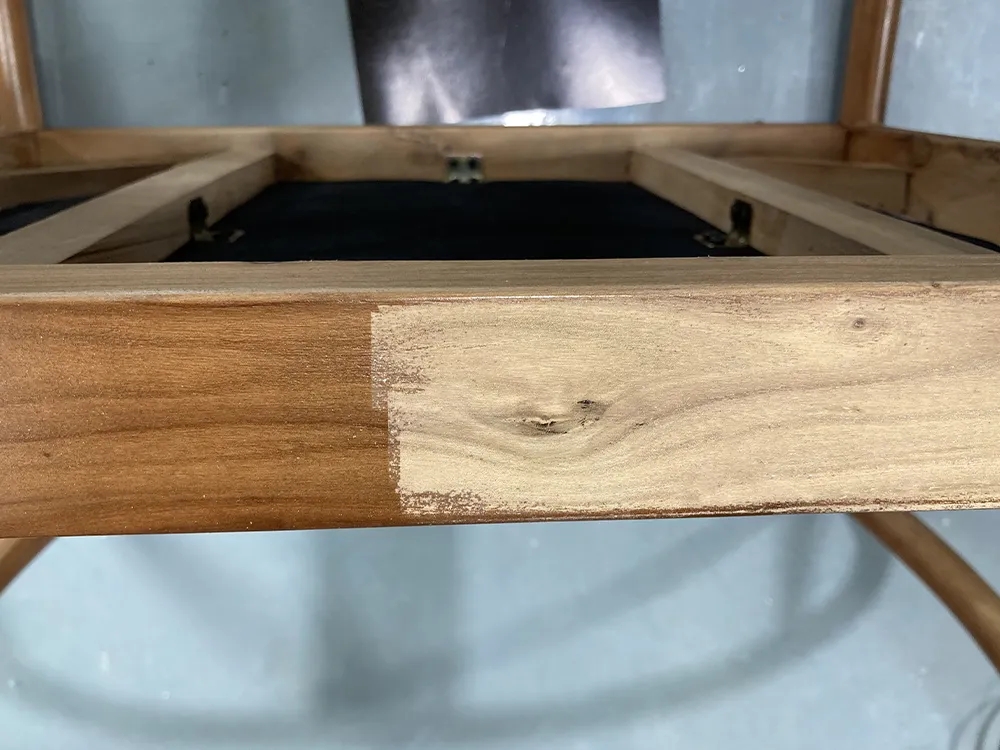
In the global furniture industry—valued at over $600 billion and increasingly driven by sustainability, restoration demand, and customization—surface treatment technologies are undergoing a quiet but profound shift. Among them, laser cleaning for wood furniture is emerging not as a niche experiment, but as a disruptive force redefining how we restore, preserve, and even reinterpret wooden surfaces.
The Problem with Traditional Wood Cleaning
For decades, wood furniture restoration has relied on mechanical sanding, chemical stripping, or abrasive blasting. These methods, while effective in certain contexts, carry inherent limitations:
- Loss of material integrity: Sanding removes not just contaminants but also valuable wood layers.
- Chemical dependency: Solvents introduce environmental hazards and worker safety concerns.
- Inconsistent results: Manual processes vary by operator skill, leading to uneven finishes.
In a market where antique preservation, high-end craftsmanship, and eco-conscious production are increasingly prioritized, these drawbacks are no longer acceptable.
Enter Laser Cleaning: Controlled Energy, Zero Contact
Laser cleaning operates on a fundamentally different principle: selective ablation. A high-energy laser beam targets contaminants—paint, varnish, oil, mold—without damaging the underlying wood substrate.
Key advantages include:
- Non-contact process: No physical stress on delicate wood structures
- Micron-level precision: Ideal for intricate carvings and heritage furniture
- No consumables: Eliminates chemicals and reduces operational waste
- Repeatability: Digitally controlled parameters ensure consistent outcomes
Unlike sanding, which is subtractive and blind, laser cleaning is intelligent and discriminative—it removes only what should be removed.
Data-Driven Industry Shift
Recent manufacturing and restoration trends indicate a strong pivot toward laser-based processes:
- In Europe, over 35% of high-end furniture restoration workshops have adopted or tested laser cleaning systems.
- The global laser cleaning market is projected to grow at over 10% CAGR, driven by automotive, aerospace, and increasingly, woodworking sectors.
- Environmental regulations (especially in the EU and North America) are accelerating the phase-out of solvent-based cleaning methods.
What this signals is clear: laser cleaning is not replacing traditional methods—it is rendering them obsolete in high-value scenarios.
Applications in Wood Furniture
Laser cleaning is not limited to one niche—it spans across multiple segments:
1. Antique Restoration
Delicate heritage pieces benefit the most. Laser systems can remove centuries-old varnish layers without touching the original wood grain.
2. Paint and Coating Removal
From modern lacquer finishes to stubborn industrial coatings, lasers can strip surfaces cleanly without gouging or uneven abrasion.
3. Mold and Contaminant Removal
In humid regions, mold infiltration is a major issue. Laser cleaning eliminates biological contaminants without introducing moisture—an overlooked advantage.
4. Surface Preparation for Refinishing
Before repainting or re-coating, laser cleaning creates an ideal bonding surface, improving finish durability.
Breaking the Conventional Mindset
Here is the uncomfortable truth: most resistance to laser cleaning is not technical—it is psychological.
Woodworkers and restorers often equate craftsmanship with manual effort. Sanding, scraping, and polishing are seen as “authentic” processes. But this mindset ignores a critical evolution:
Precision is the new craftsmanship.
Using a laser does not diminish skill—it elevates it. It allows the operator to work at a level of control that human hands alone cannot achieve.
In fact, the real artistry lies not in how hard you work the material, but in how precisely you preserve it.
Cost vs Value: A Strategic Perspective
Critics often point to the initial investment cost of laser systems. However, a deeper analysis reveals a different picture:
- Reduced labor time (up to 70% in some restoration tasks)
- Zero consumable costs
- Lower rework rates
- Premium service pricing for high-precision restoration
When viewed through a long-term ROI lens, laser cleaning is not expensive—it is underpriced for the value it delivers.
The Future: Intelligent Surface Processing
Looking ahead, laser cleaning is likely to integrate with:
- AI-driven surface recognition
- Automated scanning systems for irregular furniture shapes
- Hybrid workflows combining laser cleaning with laser engraving or marking
This convergence will transform furniture processing from a manual craft into a data-driven precision industry.
Final Thought
Laser cleaning for wood furniture is not just a technological upgrade—it is a philosophical shift. It challenges the assumption that restoration must involve destruction, that cleaning must involve contact, and that tradition must resist innovation.
The question is no longer whether laser cleaning will become mainstream.
The question is: how long can traditional methods survive in a world that demands precision, sustainability, and perfection—simultaneously?
Post time: Apr-08-2026
