
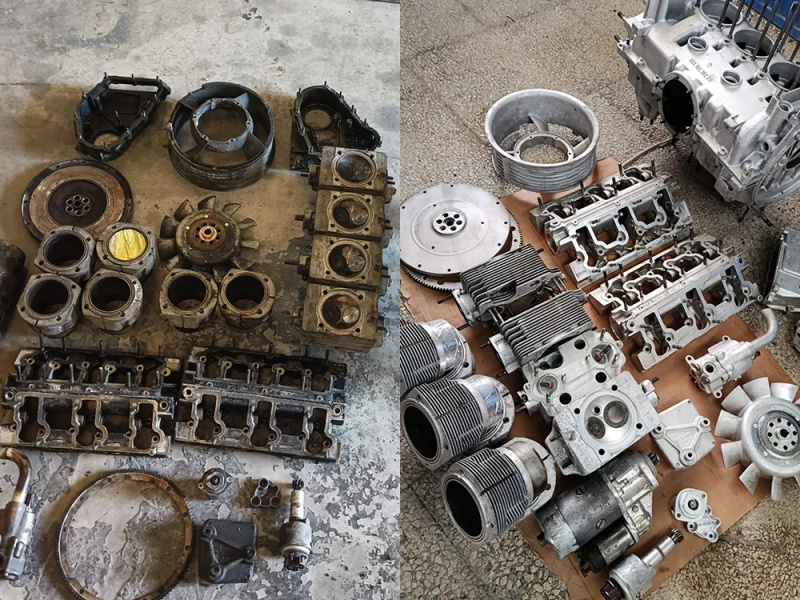
The Hidden Bottleneck in Automotive Production
Automotive manufacturing has mastered automation, robotics, and digital quality control—yet one process has remained stubbornly outdated: cleaning.
Before welding, coating, bonding, or assembly, every component must be free of:
- Oil and grease
- Oxides and rust
- Residual coatings
- Particulate contamination
For decades, this has relied on chemicals, abrasives, or manual labor. These methods work—but they introduce variability, waste, and long-term cost.
Laser cleaning changes the equation entirely.
From Surface Cleaning to Surface Engineering
Laser cleaning is not simply a replacement for traditional methods. It represents a shift from removal by force to removal by controlled energy.
Using pulsed laser beams, contaminants are:
- Rapidly heated
- Vaporized or detached
- Removed without physical contact
The base material remains largely unaffected when parameters are properly set.
Key difference:
Traditional cleaning removes material indiscriminately.
Laser cleaning removes selectively.
Why the Automotive Industry Is Moving Toward Laser Cleaning
1. Precision Is No Longer Optional
Modern vehicles rely heavily on:
- Lightweight alloys
- High-strength steels
- Composite materials
These materials are sensitive to abrasion and contamination. Even microscopic residues can lead to:
- Weak welds
- Poor coating adhesion
- Structural inconsistencies
Laser cleaning enables micron-level control, ensuring surfaces meet strict quality standards.
2. Automation Demands Consistency
Automotive production lines operate at high speed and low tolerance for variation.
Laser systems integrate directly with:
- Robotic arms
- Conveyor systems
- Vision inspection modules
This allows:
- Real-time adjustment
- Repeatable cleaning quality
- Reduced dependency on manual labor
Insight:
Automation without consistent cleaning is incomplete automation.
3. Environmental Pressure Is Reshaping Decisions
Regulations are tightening globally:
- Chemical usage restrictions
- Waste disposal costs
- Worker safety requirements
Laser cleaning eliminates:
- Chemical solvents
- Abrasive media
- Secondary waste streams
This is not just environmentally beneficial—it reduces compliance costs and operational complexity.
Core Applications in Automotive Parts Cleaning
1. Pre-Welding Surface Preparation
Before welding, contaminants must be removed to prevent:
- Porosity
- Weak joints
- Inconsistent weld quality
Laser cleaning ensures:
- Clean metal surfaces
- Stable weld penetration
- Reduced defect rates
2. Rust and Oxide Removal
Automotive parts often face oxidation during storage or transport.
Laser cleaning removes:
- Light to moderate rust
- Oxide layers
Without:
- Grinding
- Material loss
- Surface damage
3. Paint and Coating Removal
In rework or refurbishment processes, coatings must be stripped selectively.
Laser systems allow:
- Controlled paint removal
- Preservation of underlying material
- Minimal surface alteration
4. Mold and Tool Maintenance
Production molds accumulate:
- Residues
- Carbon deposits
- Release agents
Laser cleaning enables:
- Non-contact cleaning
- No downtime for cooling
- Extended tool lifespan
Power Range: Matching Technology to Application
Not all automotive cleaning tasks require the same power level.
- Low power (100W–300W):
Precision cleaning, small components, delicate surfaces - Mid power (500W–1000W):
General automotive parts cleaning, balanced efficiency - High power (1000W+):
Heavy rust removal, large-scale industrial applications
Critical point:
More power increases speed—but also risk.
Optimal results come from matching power to task, not maximizing it.
The Economics: Beyond Initial Cost
Laser cleaning systems have higher upfront costs compared to traditional tools. However, long-term economics tell a different story.
Savings come from:
- Eliminating consumables (chemicals, abrasives)
- Reducing labor requirements
- Lower maintenance needs
- Decreased rework and defect rates
Over time, the cost per cleaned part decreases significantly.
Challenges and Misconceptions
“Laser cleaning is plug-and-play” — False
Effective use requires:
- Parameter optimization
- Process understanding
- Skilled operation
“It replaces all cleaning methods” — Incorrect
Laser cleaning is ideal for:
- Precision tasks
- Controlled environments
But may not be the best choice for:
- Extremely heavy contamination
- Low-cost, non-critical applications
A Contrarian View: The Real Value Is Not Cleaning
The industry often frames laser cleaning as a better cleaning method.
This is too narrow.
The real value lies in:
- Process integration
- Data-driven manufacturing
- Quality standardization
Laser cleaning transforms cleaning from a standalone step into a controlled, programmable part of production.
Future Outlook: Intelligent Cleaning Systems
The next phase of development will include:
- AI-driven parameter optimization
- Real-time surface analysis
- Fully automated cleaning cells
In this future, cleaning will not be reactive—it will be predictive and adaptive.
Conclusion: From Necessary Step to Strategic Advantage
Laser cleaning automotive parts is not just an upgrade—it is a shift in manufacturing philosophy.
It enables:
- Higher precision
- Greater consistency
- Lower environmental impact
- Improved long-term efficiency
Final Insight:
In modern automotive production, the quality of what you build depends on how well you prepare the surface.
Laser cleaning ensures that preparation is no longer the weakest link—but a competitive advantage.
Post time: Apr-21-2026
