
Why This Technology Is Quietly Replacing Traditional Industrial Cleaning
For more than a century, industrial cleaning has relied on brute force.
Sandblasting tears away contamination with abrasive particles. Chemical cleaning dissolves surfaces using acids and solvents. Grinding physically scrapes materials clean while generating noise, dust, waste, and surface damage.
These methods worked — but they also created enormous hidden costs.
Today, laser cleaning technology is changing the logic of industrial surface treatment itself. What began as a niche process in aerospace and military applications has evolved into one of the fastest-growing technologies in modern manufacturing.
The reason is simple:
Laser cleaning is no longer just about cleaning.
It is about precision, automation, sustainability, and intelligent manufacturing.
Recent industry research shows that laser cleaning systems are now rapidly expanding across automotive manufacturing, aerospace, battery production, heavy industry, shipbuilding, precision electronics, and cultural restoration sectors.
What Is Laser Cleaning?
Laser cleaning uses high-energy laser beams to remove:
- Rust
- Paint
- Oxide layers
- Oil contamination
- Carbon deposits
- Surface coatings
- Organic residues
The laser energy interacts with contaminants differently than with the underlying substrate. The unwanted layer absorbs the energy, vaporizes, fractures, or detaches, while the base material remains largely unaffected.
Unlike traditional methods, laser cleaning is:
- Non-contact
- Non-abrasive
- Highly controllable
- Easy to automate
This distinction is what makes the technology disruptive.
Why Industries Are Abandoning Traditional Cleaning Methods
Traditional cleaning methods suffer from increasingly serious industrial limitations.
Sandblasting
Sandblasting remains effective for heavy corrosion, but it creates:
- Massive dust pollution
- Abrasive waste
- Surface wear
- High consumable costs
Even industrial Reddit discussions admit sandblasting still dominates some large-scale applications because of speed, but laser cleaning increasingly wins where precision, automation, and lower long-term operating costs matter more.
Chemical Cleaning
Chemical cleaning creates:
- Hazardous waste
- Toxic fumes
- Worker safety risks
- Environmental compliance problems
As environmental regulations tighten globally, chemical cleaning is becoming economically and politically difficult to justify.
Mechanical Grinding
Grinding physically damages surfaces.
This becomes unacceptable in industries involving:
- Aerospace parts
- Precision molds
- Electronics
- Battery components
- High-value tooling
Modern manufacturing increasingly requires surface treatment without substrate destruction.
Laser cleaning solves exactly that problem.
The Biggest Advantages of Laser Cleaning Technology
Non-Contact Cleaning
This is perhaps the most important advantage.
Laser cleaning uses photons instead of physical force. The laser beam never physically touches the substrate.
That means:
- No abrasion
- No scratching
- No mechanical wear
- No surface fatigue
For delicate or expensive parts, this changes everything.
Aircraft components, precision molds, and semiconductor parts cannot tolerate aggressive abrasive cleaning anymore.
Precision and Selective Cleaning
Laser cleaning can selectively remove contaminants layer by layer.
Operators can target:
- Rust only
- Paint only
- Oxides only
- Specific weld zones
- Microscopic contamination areas
This level of precision is impossible with traditional blasting or chemical soaking.
Modern laser systems now support micron-level surface control in industries such as electronics and semiconductor manufacturing.
Environmental Protection
Laser cleaning is often called a “green cleaning technology” because it:
- Requires no chemicals
- Produces minimal secondary waste
- Reduces consumables
- Generates lower pollution
The waste produced is usually dry particulate matter that can be filtered and collected easily.
This is one reason governments and manufacturers increasingly support laser cleaning adoption.
Environmental compliance itself has become an economic advantage.
Automation Compatibility
This is where the real industrial transformation begins.
Laser cleaning integrates naturally with:
- Robotic arms
- AI inspection systems
- Automated production lines
- Smart manufacturing platforms
- Vision positioning systems
According to industry trend analysis, laser cleaning has evolved from handheld tools into intelligent automated systems integrated with robotics and AI-driven process control.
Traditional cleaning methods struggle to integrate into modern smart factories.
Laser cleaning fits perfectly.
Major Applications of Laser Cleaning
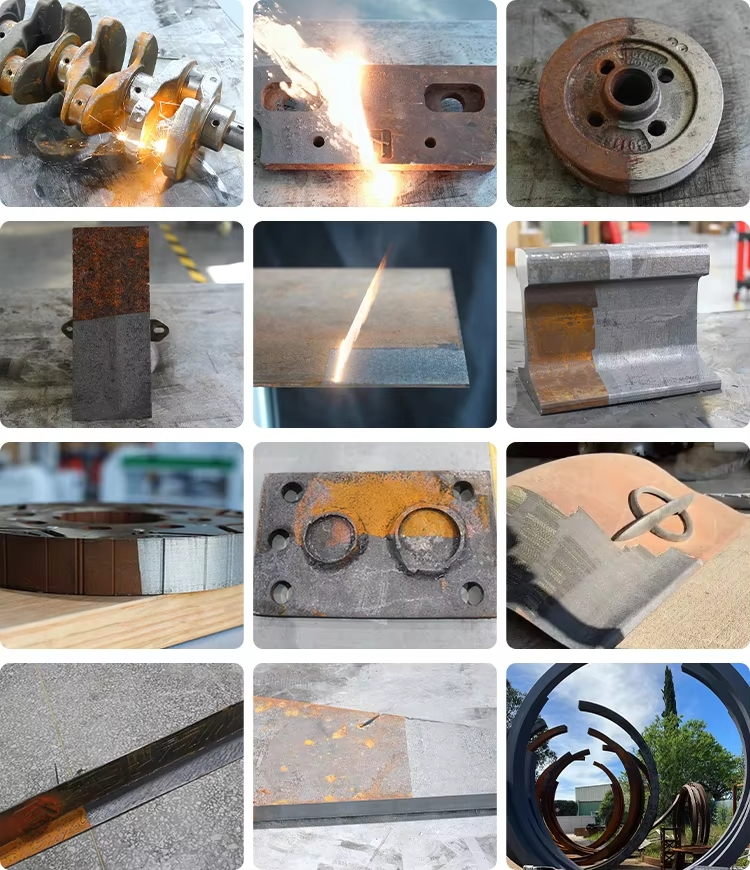
Rust Removal
Rust removal remains the largest laser cleaning application globally.
Industries using laser rust removal include:
- Shipbuilding
- Steel manufacturing
- Railway maintenance
- Construction machinery
- Oil and gas infrastructure
Laser cleaning removes corrosion without excessive substrate damage, making it especially valuable for expensive industrial components.
Paint and Coating Removal
Paint stripping is one of the fastest-growing sectors in laser cleaning.
Laser systems can remove:
- Industrial coatings
- Powder coatings
- Epoxy layers
- Surface films
- Anti-corrosion coatings
This is widely used in:
- Aerospace maintenance
- Automotive manufacturing
- Rail transportation
- Ship repair
Unlike chemical stripping, laser cleaning can selectively remove upper layers while preserving underlying surfaces.
Mold Cleaning
Mold maintenance has become one of the most economically valuable laser cleaning applications.
Laser cleaning removes:
- Carbon deposits
- Release agents
- Oil residue
- Rubber buildup
without damaging mold geometry or texture.
Injection molding factories increasingly adopt laser cleaning because molds can often be cleaned without disassembly, reducing downtime dramatically.
Welding Preparation and Weld Cleaning
Laser cleaning improves welding quality significantly.
Before welding, it removes:
- Oxides
- Grease
- Oil contamination
After welding, it removes:
- Heat tint
- Oxidation
- Weld residue
This improves weld penetration, appearance, and structural consistency.
Electronics and Semiconductor Manufacturing
The electronics industry demands microscopic precision.
Laser cleaning is increasingly used for:
- Oxide removal
- Wafer cleaning
- Connector preparation
- Battery tab treatment
- Semiconductor surface processing
Traditional abrasive cleaning simply cannot achieve the required precision level safely.
Aerospace Applications
Aircraft manufacturing and maintenance require surface treatment without material damage.
Laser cleaning is used for:
- Aircraft paint removal
- Turbine blade cleaning
- Composite preparation
- Oxide treatment
Because laser cleaning minimizes substrate damage, aerospace companies increasingly view it as a critical maintenance technology.
The Hidden Truth: Laser Cleaning Is Not Replacing Everything
Many marketing articles exaggerate laser cleaning as the universal replacement for all traditional methods.
Reality is more complicated.
Heavy sandblasting still dominates certain applications involving:
- Thick corrosion
- Massive steel structures
- Large ship hulls
- Heavy industrial scale removal
Even experienced laser cleaning professionals openly acknowledge this.
But the trend is obvious:
As laser power increases and automation improves, laser cleaning continues moving into areas once considered impossible.
The technology is evolving extremely fast.
Continuous vs Pulsed Laser Cleaning
Continuous Laser Cleaning
Best for:
- Large-area cleaning
- Thick rust removal
- Heavy industrial applications
Advantages:
- Faster cleaning speed
- Higher productivity
- Better for large surfaces
Pulsed Laser Cleaning
Best for:
- Precision cleaning
- Delicate materials
- Electronics industry
- Mold maintenance
Advantages:
- Lower heat impact
- Better substrate protection
- Higher cleaning precision
The future increasingly points toward hybrid systems that combine both approaches.
Laser Cleaning Is Becoming an Industrial Infrastructure Technology
This is the deeper shift happening globally.
Laser cleaning is transitioning from:
“specialized equipment”
to
“core manufacturing infrastructure.”
Industry reports increasingly describe laser cleaning as a foundational process in smart manufacturing and green industrial transformation.
Factories no longer want:
- Dirty processes
- Consumable-heavy systems
- Manual inconsistency
- Chemical dependency
They want:
- Precision
- Automation
- Data-driven control
- Sustainability
- Repeatable quality
Laser cleaning aligns perfectly with that future.
And that is why its growth is accelerating across nearly every major industrial sector.
Post time: May-11-2026
