
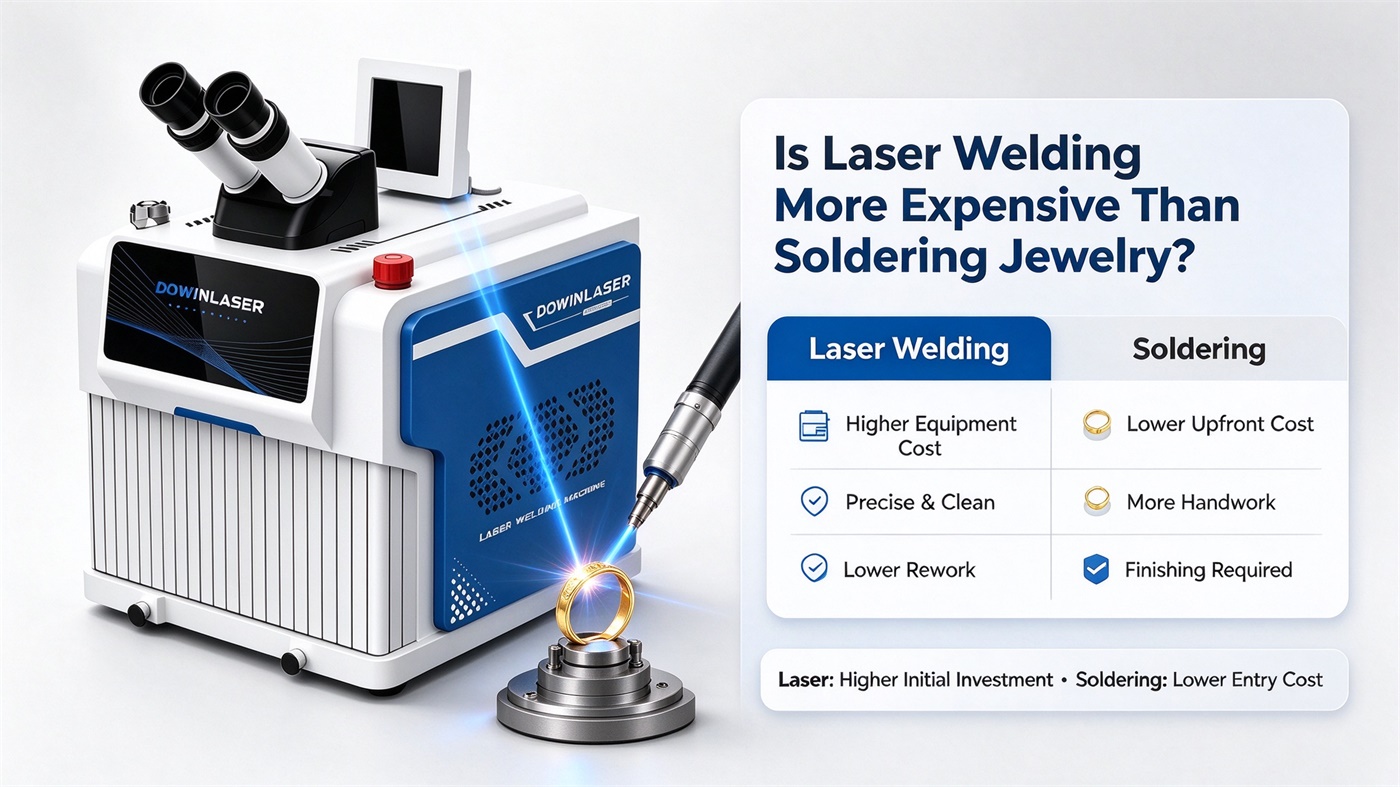
Laser welding is generally more expensive to start with than traditional soldering because jewelry laser welding machines requires a higher initial investment. However, the actual cost depends on the type of jewelry being repaired, the number of pieces processed, labor time, and the quality requirements of the finished product.
For professional jewelers, jewelry manufacturers, and repair workshops, the better question is not simply which method costs less, but which method offers the best balance of equipment cost, production efficiency, and repair quality.
1. Initial Equipment Cost: Laser Welding vs. Soldering
Traditional jewelry soldering requires relatively inexpensive equipment, including a torch, solder, flux, tweezers, and other basic tools. This makes it accessible to small jewelry workshops and independent jewelers.
A jewelry laser welding machine requires a larger upfront investment. The price varies depending on laser power, pulse energy, positioning systems, cooling methods, and additional features such as a microscope or CCD camera.
However, the equipment cost should be evaluated alongside its expected service life and the number of repairs performed. A workshop repairing only a few pieces each week may find traditional soldering more economical, while a business handling delicate jewelry repairs every day may benefit from investing in laser welding.
2. Operating Costs: Which Method Is Cheaper?
Soldering involves ongoing expenses for solder, flux, fuel, and other consumables. It may also require additional cleaning or finishing after the repair, depending on the jewelry material and the work involved.
Laser welding typically requires less consumable material during the welding process. Depending on the application, filler wire may still be necessary, but the process does not require soldering flux or torch fuel. Electricity and routine equipment maintenance remain part of the operating cost.
The difference becomes more significant when a workshop processes a high volume of jewelry. If laser welding reduces finishing time and rework for suitable applications, its higher initial cost may be offset by lower labor and operating costs over time.
3. Labor Costs: Where Laser Welding Can Save Money
Labor is one of the most important factors when comparing the two methods.
Traditional soldering requires the jeweler to control the flame and heat distribution carefully. Some repairs also require removing gemstones or other heat-sensitive components before soldering, followed by cleaning and refinishing.
Laser welding concentrates energy in a small area, allowing the operator to work on localized joints with less heat spread to the surrounding material. This can be particularly useful for fine chains, intricate settings, small cracks, and repairs close to gemstones.
The time saved depends on the specific repair. Laser welding does not automatically eliminate polishing, inspection, or other finishing work, but it can reduce the amount of additional work required for certain delicate jobs.
4. Repair Quality: Is Laser Welding Worth the Extra Cost?
Cost is only one part of the decision. Repair quality, precision, and the risk of damaging surrounding components also matter.
Traditional soldering remains an effective and economical choice for many jewelry repairs, especially straightforward joints where broader heating is acceptable.
Jewelry laser welding offers several advantages for applications requiring localized heat input:
-
Precise heat control: Energy can be concentrated on a small repair area.
-
Reduced heat spread: Nearby components are exposed to less heat than with many conventional torch-soldering operations.
-
Fine repair capability: Suitable for delicate chains, small cracks, and intricate jewelry details.
-
Less disturbance to surrounding surfaces: Properly controlled welding may reduce the need for extensive refinishing.
-
Versatile repair applications: Depending on the machine settings and material, laser welding can be used on gold, silver, platinum, and various jewelry alloys.
The final result depends on the operator’s skill, material compatibility, laser parameters, joint design, and the condition of the jewelry. Laser welding is not automatically superior for every repair.
5. When Should Jewelers Choose Laser Welding?
A jewelry laser welding machine is worth considering when a workshop regularly handles high-value jewelry, delicate components, fine chains, or repairs that are difficult to perform with a torch.
For example, repairing a broken gold chain close to a gemstone may require careful control of heat exposure. Laser welding can help target the damaged link while limiting the affected area. Similarly, intricate jewelry with small cracks or localized defects may benefit from the precision of a pulsed laser system.
Traditional soldering remains practical for general repairs, simple joints, and businesses with limited repair volumes. Jewelers should compare the cost of equipment with their actual repair workload rather than assuming that one method is always more economical.
6. How to Calculate the Break-Even Point of a Jewelry Laser Welding Machine
The simplest way to evaluate a laser welding investment is to calculate how much the machine could save per repair.
Use the following formula:
Break-even repairs = Machine investment ÷ Net savings per repair
Net savings per repair should include measurable reductions in labor, consumables, and rework, minus any additional operating or maintenance costs.
For example, suppose a workshop invests $6,000 in a jewelry laser welding machine and estimates that it saves $3 per suitable repair after accounting for operating costs.
Break-even point = $6,000 ÷ $3 = 2,000 repairs.
In this hypothetical example, the workshop would need approximately 2,000 qualifying repairs to recover the initial investment through those savings. The actual result may be very different depending on the machine price, labor costs, repair volume, and the percentage of jobs suitable for laser welding.
This calculation does not include financing costs, taxes, depreciation, or any additional revenue generated by offering new repair services.
7. Choosing the Right Jewelry Laser Welding Machine
Before purchasing a machine, consider the jewelry materials you work with, the typical size of the repair area, your daily workload, and the level of precision required.
A compact jewelry laser welding machine may be sufficient for a small repair studio. Workshops handling a wider variety of jewelry or more demanding repair tasks may prefer a machine with adjustable pulse energy, stable positioning, and a suitable microscope for accurate operation.
Dowin offers jewelry laser welding equipment for professional jewelry repair and manufacturing applications. Buyers can compare machine configurations based on their repair requirements, working methods, and production volume.
Explore the Dowin 60W Portable Jewelry Welding Machine for a compact jewelry repair solution, or review the 200W YAG Pulsed Jewelry Laser Welder for a different power and pulse-energy configuration.
The most suitable machine is the one that matches your actual repair workload and provides consistent results on the materials you handle.
Conclusion
Laser welding usually costs more initially than traditional jewelry soldering, but it can offer advantages in precision, localized heating, and labor efficiency for suitable repair applications.
Soldering remains a cost-effective choice for simple repairs and low-volume workshops. Laser welding becomes more attractive when a business regularly performs delicate repairs, handles valuable jewelry, or needs to reduce heat exposure to surrounding components.
The best purchasing decision comes from comparing the total cost of ownership with the expected repair volume and the value of improved repair capabilities.
FAQs
Is laser welding more expensive than soldering jewelry?
Yes, in terms of initial equipment investment, laser welding is generally more expensive. However, lower consumable use and potential labor savings may offset some of the difference over time.
Is laser welding cheaper than soldering in the long run?
It can be, particularly for workshops that perform many suitable repairs. The result depends on equipment cost, repair volume, labor savings, maintenance, and rework rates.
Can laser welding replace traditional jewelry soldering?
No. Laser welding is an additional repair method rather than a universal replacement. Traditional soldering remains suitable for many joints and general jewelry work.
Is laser welding safer for gemstones?
Laser welding can reduce heat exposure to nearby gemstones because the energy is concentrated in a small area. However, protection depends on the gemstone, its setting, the laser parameters, and the operator’s technique. Some stones remain vulnerable to heat or laser exposure.
What should I consider before buying a jewelry laser welding machine?
Evaluate the machine’s pulse energy, power, positioning system, microscope, cooling method, compatibility with your jewelry materials, after-sales support, and expected daily workload. Ask the supplier to demonstrate representative repairs before making a purchase.
Post time: Oct-09-2026
