
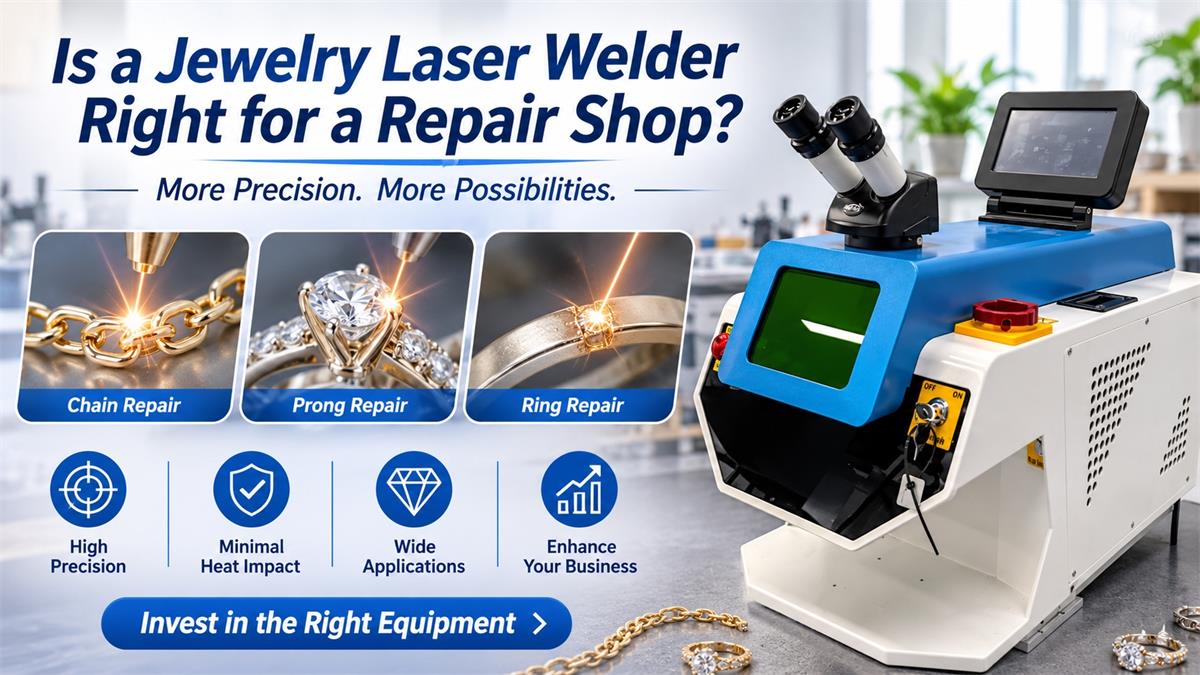
For a jewelry repair shop, investing in new equipment should solve real problems and create additional business opportunities. Traditional soldering works well for many repairs, but it can become challenging when dealing with delicate gold chains, small cracks, thin ring bands, or jewelry with mounted gemstones. A jewelry laser welder offers a more localized and controlled way to join metal, making it an attractive option for professional repair businesses. But is it actually worth the investment? In this guide, we examine the applications, advantages, limitations, and purchasing considerations to help you decide. You can also explore the Dowin Jewelry Laser Welding Machine to see what a dedicated jewelry welding system offers.
1. What Problems Can a Jewelry Laser Welder Solve?
Most jewelry repair shops handle a wide range of small and delicate repair jobs. Some are relatively straightforward, while others require precise heat control and careful positioning.
A jewelry laser welder is particularly useful when a repair requires melting a small area of metal without unnecessarily heating the entire component.
Common applications include:
- Broken gold chains: Reconnect small chain links and damaged connections.
- Cracked ring bands: Repair localized cracks in gold, silver, and other suitable jewelry metals.
- Broken prongs: Rebuild or repair small sections of gemstone settings when appropriate.
- Ring resizing: Join ring sections after cutting and adjusting the band.
- Earring post repair: Reconnect broken posts and small jewelry components.
- Filling casting pores: Add compatible filler material to repair tiny imperfections in cast jewelry.
- Decorative components: Join small metal parts used in custom jewelry fabrication.
These jobs are common in professional jewelry workshops. Having a laser welder can expand the types of repairs a shop is equipped to handle.
2. Jewelry Laser Welding vs Traditional Soldering
Traditional soldering is still an important jewelry repair technique. However, laser welding offers a different approach to heat application.
With soldering, the jeweler heats the surrounding metal until the solder flows into the joint. With laser welding, concentrated laser energy melts the metal at a selected location to form a joint.
| Comparison | Laser Welding | Traditional Soldering |
|---|---|---|
| Heat application | Concentrated on a small area | Heats a larger surrounding area |
| Repair precision | High with microscope positioning | Depends on torch control |
| Small cracks | Very suitable | Suitable in appropriate cases |
| Delicate components | Offers localized heat control | Requires careful heat management |
| Gemstone protection | Can reduce surrounding heat exposure | Greater risk of heating nearby stones |
| Filler material | Compatible welding wire can be used | Solder alloy is used |
| Equipment investment | Generally higher | Generally lower |
| Workshop applications | Precision welding and repair | Joining, fabrication, and conventional repairs |
The biggest advantage of laser welding is localized energy delivery. It can reduce unnecessary heating, but it does not eliminate heat-related risks. Some gemstones still need to be removed before repair, depending on their type, treatment, condition, and location.
3. Is a Jewelry Laser Welder Suitable for Small Repair Shops?
Not every jewelry repair business needs a laser welder. The investment makes more sense when the shop regularly handles precision repairs or wants to expand its services.
Small Independent Jewelry Repair Shops
Independent repair shops often work with gold rings, necklaces, bracelets, earrings, and other small jewelry items. A desktop jewelry laser welder can fit into a relatively compact workshop and support a variety of repair tasks.
For a business that frequently repairs broken chains, cracked rings, and small metal components, the additional capability can be valuable.
Jewelry Stores Offering In-House Repairs
Jewelry retailers often receive customer requests for minor repairs. Instead of sending every damaged item to an external workshop, a store with trained staff and suitable equipment may complete certain repairs in-house.
This can shorten repair turnaround times and provide an additional service for customers.
Professional Jewelry Repair Centers
For established repair centers, a laser welder can complement existing soldering equipment. Shops handling different jewelry metals, intricate settings, and delicate components may benefit from having both technologies available.
New Jewelry Businesses
A new business should evaluate its expected repair volume before purchasing. If most of its work involves basic repairs that can be completed efficiently with existing tools, a laser welder may not be an immediate necessity.
However, if precision welding is part of the planned service offering, investing in suitable equipment from the beginning may help establish a broader range of repair capabilities.
4. What Types of Jewelry Repairs Can a 150W Laser Welder Handle?
Machine power is an important purchasing factor, but it should not be the only consideration. Pulse energy, pulse duration, frequency, spot size, material thickness, and operator experience all influence the final result.
A 150W YAG jewelry laser welder is designed for fine jewelry welding applications. Depending on the material and repair requirements, it can be used for tasks such as:
- Repairing small breaks in gold and silver chains.
- Welding thin ring bands and localized cracks.
- Rebuilding small metal sections around suitable settings.
- Repairing earring posts and other delicate components.
- Filling small pores in gold and silver castings.
- Joining small jewelry components during fabrication.
For very thin materials, excessive laser energy can cause burn-through or deformation. A proper sample test is important before selecting parameters for actual customer repairs.
For example, Dowin’s 150W desktop YAG jewelry laser welder features:
- 150W YAG laser source.
- Microscope observation for precise positioning.
- LED shadowless lighting for a clearer working area.
- Adjustable welding parameters.
- Desktop configuration weighing approximately 23 kg.
- 220V power supply.
- Air-cooled design.
These features make it suitable for workshops looking for dedicated equipment for fine jewelry welding.
Product details: Dowin 150W Jewelry Laser Welding Machine.
5. Does a Jewelry Laser Welder Help Reduce Repair Costs?
Buying a laser welder is an equipment investment, so repair shops should consider its financial return rather than focusing only on the machine price.
There are several potential ways a laser welder can contribute to workshop profitability.
More Repair Services
A shop that previously avoided delicate welding jobs may be able to accept additional types of repairs after purchasing suitable laser welding equipment and training its operators.
For example, small chain repairs, localized ring cracks, and certain casting defects can become additional service opportunities.
Less Time Spent on Some Repairs
Laser welding may simplify certain small repair procedures by concentrating energy on the joint and reducing the amount of surrounding metal that needs heating and finishing.
However, actual time savings depend on the repair itself, operator experience, preparation, and post-weld finishing requirements.
Reduced Risk of Unnecessary Heat Damage
When repairing delicate jewelry, excessive heat can create additional work or damage the item. More localized energy delivery can help reduce this risk in suitable applications.
It is important to remember that a laser welder does not eliminate the possibility of gemstone or material damage. Proper inspection and protection remain necessary.
Improved Service Range
Offering more specialized repair services can help differentiate a workshop from competitors that only provide conventional soldering and basic jewelry maintenance.
6. When Is a Jewelry Laser Welder Not Necessary?
Although laser welding offers several advantages, it is not the best solution for every jewelry repair business.
There are situations where purchasing a machine may not be economically justified.
- Very low repair volume: If your workshop only performs a few simple repairs each month, the investment may take a long time to recover.
- Mostly conventional soldering work: Large joints and repairs well suited to traditional soldering may not require laser equipment.
- Limited operator training: Staff need appropriate training to control the laser and understand material compatibility.
- Insufficient workspace or safety arrangements: A laser system requires suitable installation, protective measures, and a controlled working environment.
- Highly specialized repair needs: Some jobs require different equipment or procedures beyond the capabilities of a small jewelry laser welder.
The right purchase decision depends on the actual jobs your workshop receives, not simply on whether laser welding is a newer technology.
7. What Should You Check Before Buying a Jewelry Laser Welder?
If you have decided that laser welding is suitable for your business, compare machines based on practical workshop requirements.
1. Laser Output and Pulse Adjustment
Look beyond the advertised wattage. Check whether pulse energy, pulse duration, and frequency can be adjusted to match different metals and component thicknesses.
2. Welding Spot Size
Fine jewelry repairs require accurate positioning and a suitable spot size. Ask the manufacturer about the available spot-size range and the consistency of the laser output.
3. Microscope Quality
A microscope is important for observing small repair areas. Clear magnification and comfortable positioning help the operator work more accurately.
4. Cooling System
Check whether the machine uses air cooling or water cooling, and understand the maintenance requirements. Cooling configuration should match the machine design and expected workload.
5. Sample Welding Tests
Before purchasing, ask the manufacturer to test materials similar to those used in your workshop. Gold chains, silver bands, thin components, and casting samples can provide useful information about actual welding performance.
6. Technical Support and Training
Machine setup is only the beginning. Ask about operating instructions, parameter recommendations, training, spare parts, and after-sales support.
8. How to Calculate Whether the Investment Is Worth It
A simple break-even calculation can help you evaluate a jewelry laser welder.
Use the following formula:
Monthly additional contribution = Additional repair jobs per month × Average contribution per repair
Estimated payback period = Total equipment investment ÷ Monthly additional contribution
For example, suppose a repair shop invests $6,000 in a laser welding system and generates an additional $500 in monthly contribution from new repair services.
The estimated payback period would be:
$6,000 ÷ $500 = 12 months.
This is only an illustrative calculation. The actual result should account for training, maintenance, consumables, labor, financing, taxes, and the possibility that some new jobs replace existing work rather than generate additional revenue.
Before making a purchase, estimate realistic repair demand using your existing customer base and local market conditions.
9. Why Consider a Dowin Jewelry Laser Welder?
For repair shops looking for a dedicated desktop welding system, Dowin offers a 150W YAG jewelry laser welder designed for fine metal welding and repair.
Its main features include:
- 150W YAG laser: Designed for precision jewelry welding applications.
- Microscope: Helps operators position the laser accurately on small repair areas.
- LED shadowless lighting: Provides a clearer view of the jewelry during operation.
- Air cooling: A practical cooling configuration for its desktop design.
- Compact machine design: Approximately 23 kg, making it suitable for many jewelry workshop environments.
The machine is intended for businesses that need more than basic chain-joining equipment and want to handle a wider range of jewelry repair applications.
View the product here: Dowin 150W YAG Jewelry Laser Welder.
10. Frequently Asked Questions
Is a jewelry laser welder worth buying for a small repair shop?
It can be worthwhile if the shop regularly handles delicate metal repairs, broken chains, cracked rings, and small jewelry components. Shops with very low repair volumes should calculate the expected return before investing.
Can a jewelry laser welder replace traditional soldering?
No. Laser welding and soldering are complementary techniques. Laser welding is particularly useful for localized precision repairs, while traditional soldering remains valuable for many conventional joining and fabrication tasks.
Can a jewelry laser welder repair gold chains?
Yes. Jewelry laser welders are commonly used for repairing suitable gold chain connections. The appropriate parameters depend on chain thickness, alloy composition, and joint geometry.
Can I repair jewelry without removing the gemstones?
Some repairs can be performed with gemstones remaining mounted, particularly when the welding location is sufficiently separated from the stone. However, heat-sensitive gemstones, treated stones, and stones positioned close to the weld may need to be removed before repair.
Is 150W enough for a professional jewelry repair shop?
A 150W YAG jewelry laser welder can handle many fine jewelry repair applications. Whether it is sufficient for a particular workshop depends on the materials, thicknesses, joint designs, and expected repair workload. Test representative samples before purchasing.
How much space does a desktop jewelry laser welder need?
A desktop unit generally requires less floor space than larger industrial welding systems. However, the workshop must also provide sufficient working clearance, suitable electrical power, and appropriate laser safety arrangements.
Does a jewelry laser welder require special training?
Yes. Operators should understand laser safety, material compatibility, pulse settings, focusing, and welding techniques. Training and sample testing are important before repairing customer jewelry.
Conclusion
A jewelry laser welder can be a valuable investment for a repair shop, especially when the business regularly handles delicate gold and silver jewelry, chain repairs, ring cracks, and precision welding jobs.
It is not necessary for every workshop, and it does not replace traditional soldering. Its value comes from providing additional control over localized heat input and expanding the range of repairs a trained jeweler can perform.
Before making a decision, evaluate your repair volume, test your common jewelry materials, and compare the machine’s actual capabilities with your workshop requirements.
Explore the Dowin 150W Jewelry Laser Welding Machine for more information about its specifications and precision jewelry repair applications.
“`
Post time: Nov-23-2026
