
Compare industrial laser coding machines and inkjet coders by marking quality, material compatibility, production speed, maintenance, and total operating cost.
Industrial manufacturers need reliable ways to mark expiration dates, batch numbers, serial numbers, barcodes, QR codes, and product identification information. Two widely used technologies are industrial laser coding machines and inkjet coding systems. Both can integrate into automated production lines, but their operating principles, consumable requirements, and suitability for different materials are not the same.
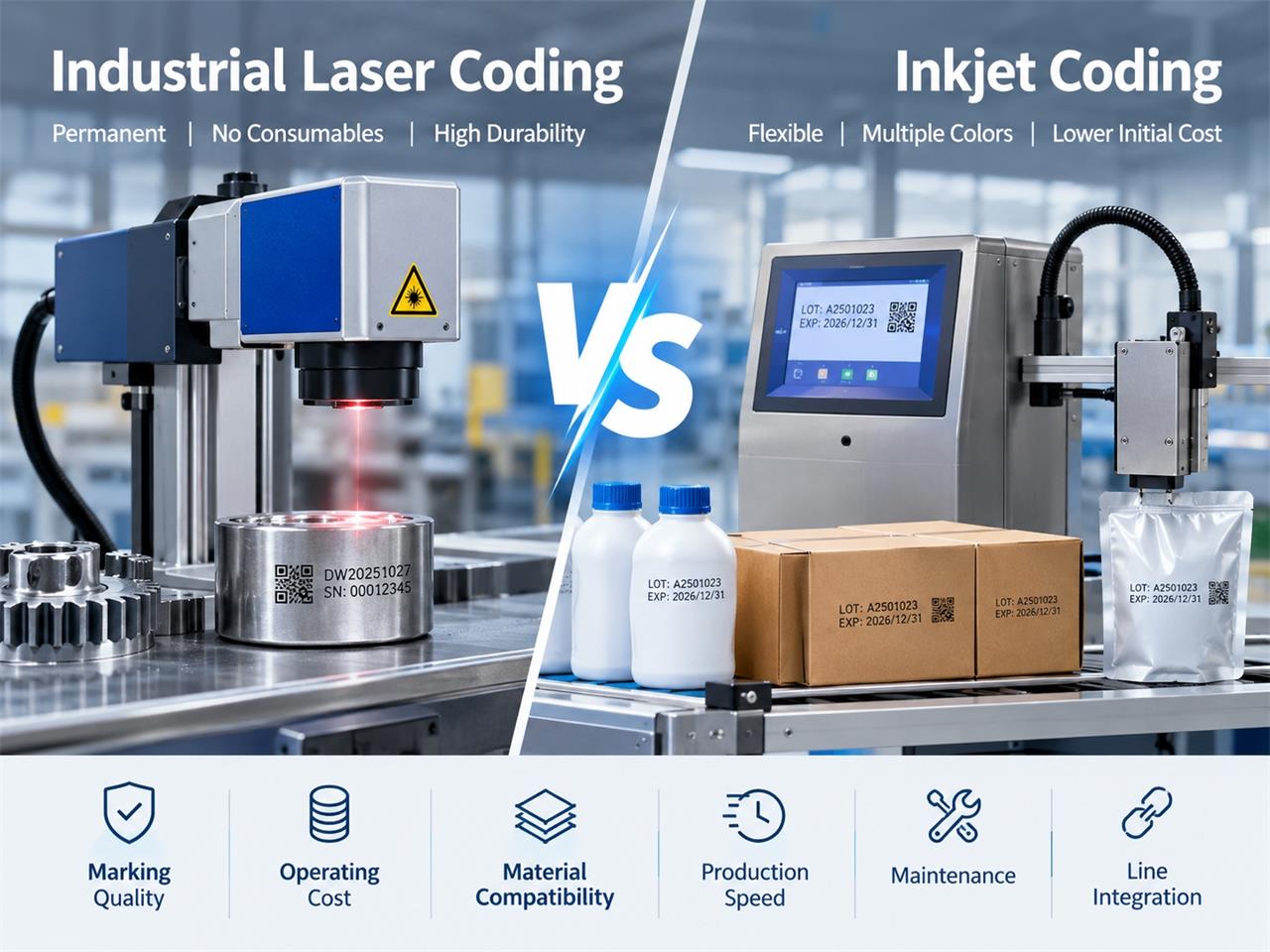
An industrial laser coding machine uses a focused laser beam to create marks by changing, removing, or engraving the surface of a material. An inkjet coding machine deposits ink onto the product or packaging. The better choice depends on your substrate, production speed, marking durability requirements, and long-term operating costs.
Manufacturers considering automated marking can explore Dowin Laser marking machines to compare fiber, CO2, and UV laser solutions for different industrial applications.
1. How Do Industrial Laser Coding and Inkjet Coding Work?
Understanding the working principles of both technologies helps explain why they perform differently on production lines.
How an Industrial Laser Coding Machine Works
A laser coding system directs a concentrated laser beam onto a selected area of the product. Depending on the material and laser parameters, the beam can remove a surface layer, produce a color change, create a contrasting mark, or engrave characters and patterns.
The process does not require ink, solvent, or a printing ribbon. Once the material and marking parameters are correctly selected, the machine can repeatedly produce product codes with consistent positioning and legibility.
Common applications include:
-
Serial numbers and identification codes on metal components.
-
Batch numbers and traceability codes on industrial products.
-
Date codes on compatible plastic packaging.
-
Logos, QR codes, and Data Matrix codes.
-
Permanent identification marks on tools, automotive components, and electronic parts.
Laser coding can be configured for stationary products or moving production lines. In a flying laser marking system, an encoder or other suitable tracking arrangement synchronizes the marking process with product movement.
How an Inkjet Coding Machine Works
Inkjet coding systems use controlled ink droplets to form characters, numbers, symbols, and other information on a product surface.
Continuous inkjet (CIJ) systems generate a continuous stream of droplets and are widely used for coding moving products. Thermal inkjet (TIJ) systems eject droplets from a printhead using thermal energy and are commonly used for high-resolution coding on packaging.
Inkjet coding offers flexibility in ink selection, color, and application. Depending on the printer and ink formulation, it can mark porous and nonporous materials, including cartons, plastic bottles, glass, metal cans, and flexible packaging.
However, the correct ink must be selected for the substrate, production environment, and required resistance to moisture, abrasion, chemicals, and handling.
2. Industrial Laser Coding Machine vs. Inkjet Coding: Key Differences
| Comparison factor | Industrial laser coding | Inkjet coding |
|---|---|---|
| Initial equipment cost | Generally higher | Generally lower |
| Consumables | No printing ink or solvent required | Ink, cartridges, or solvent depending on the system |
| Marking durability | Often highly durable and permanent | Depends on ink adhesion and curing |
| Material compatibility | Depends on laser wavelength and surface response | Broad, depending on ink formulation |
| Color options | Usually limited to material-dependent mark colors | Multiple ink colors may be available |
| Maintenance | Generally less routine consumable-related maintenance | Regular fluid management and printhead care may be required |
| Production speed | Can be very fast on compatible applications | Can be very fast, especially with CIJ |
| Curved surfaces | Possible with appropriate optics and positioning | Often convenient for curved and moving products |
| Long-term operating costs | Often favorable for high-volume applications | Ongoing consumable costs can be significant |
| Environmental considerations | May require fume extraction and laser safety controls | Requires appropriate ink and solvent handling |
Neither technology is automatically superior in every production environment. The correct comparison must consider the actual product, required code, production conditions, and total cost of ownership.
3. Which Technology Produces More Durable Codes?
Marking durability is one of the most important differences between laser coding and inkjet printing.
Laser Coding for Permanent Product Identification
Laser coding changes the material surface rather than simply depositing ink on it. On suitable substrates, this creates marks that resist rubbing, smudging, and normal handling.
This makes laser coding particularly useful for products that require long-term traceability or identification throughout their service life.
Examples include:
-
Metal tools and machine components.
-
Automotive parts and industrial equipment.
-
Electronic housings and compatible plastic components.
-
Product serial numbers and identification codes.
-
Components exposed to repeated handling or cleaning.
However, permanent does not necessarily mean indestructible. The durability of a laser mark depends on the material, marking method, processing depth, and subsequent operating environment.
Inkjet Coding for Flexible Packaging Applications
Inkjet coding can also produce durable, readable codes when the appropriate ink is used. Certain industrial inks offer strong adhesion and resistance to moisture, chemicals, or abrasion.
Nevertheless, the result depends on surface energy, cleanliness, drying time, curing requirements, and ink compatibility. An unsuitable ink may smear, fade, or detach from the substrate.
Practical recommendation: If the code must remain readable throughout the product’s service life, laser marking deserves serious consideration. If packaging changes frequently or requires different ink colors, inkjet may offer greater flexibility.
4. Which Machine Has Lower Operating Costs?
Purchase price alone is not enough to determine which coding technology is more economical.
An inkjet system may cost less initially, but it typically requires recurring purchases of ink or cartridges and may consume solvents or cleaning fluids. Maintenance, replacement parts, and production interruptions can also affect the cost per code.
Laser coding generally eliminates printing ink and solvent costs. Its ongoing expenses can include electricity, periodic servicing, optical component maintenance, and fume extraction filters where required.
Calculate the Total Cost of Ownership
A practical comparison should include:
Total operating cost = Equipment purchase + Installation + Consumables + Maintenance + Downtime + Other operating expenses
For a fair comparison, evaluate both systems over the same operating period and production volume.
Consider a factory marking 500,000 products annually. If ink, solvent, and other recurring expenses are substantial, switching to laser coding could produce meaningful savings over several years.
However, the savings are not guaranteed. A laser system with a much higher initial cost may take longer to pay back when production volumes are low or the inkjet system already operates efficiently.
To estimate the payback period, use:
Payback period = Additional laser investment ÷ Annual net operating savings
Annual net operating savings should account for consumables, maintenance, energy, extraction, and any differences in downtime.
This calculation is more useful than comparing equipment quotations alone.
5. Laser Coding vs. Inkjet: Which Is Better for Different Materials?
Material compatibility is often the deciding factor. A laser that performs well on stainless steel may not produce an acceptable mark on a flexible plastic film. Likewise, an ink that adheres well to cardboard may fail on a glossy plastic surface.
Metal Products
For stainless steel, aluminum, brass, and other suitable metals, fiber laser marking is often an effective solution.
It can create identification codes, serial numbers, logos, and traceability marks without ink. The required contrast and marking depth depend on the metal and processing parameters.
Inkjet may still be appropriate when the product requires temporary identification, colored codes, or printing on a compatible coating or label.
Plastic Products
Plastic coding requires more careful evaluation because different polymers respond differently to laser energy.
Fiber lasers work well on certain plastics and specially formulated materials. UV lasers are often considered for sensitive plastics and applications requiring fine details with reduced thermal effects. CO2 lasers can suit certain nonmetallic materials, depending on the substrate.
Inkjet offers broad flexibility across plastics when the correct ink formulation is selected.
For transparent, glossy, dark-colored, or heat-sensitive plastics, test both methods before making a purchasing decision.
Glass and Ceramic Products
Laser coding can mark selected glass and ceramic surfaces, but the result depends on the material composition, surface treatment, and required appearance.
Inkjet can provide an alternative when compatible inks and suitable curing processes are available.
If the product must withstand washing, sterilization, or high-temperature processing, evaluate the completed mark under actual operating conditions rather than relying on an initial visual inspection.
Paper, Cartons, and Flexible Packaging
CO2 laser coding can be suitable for paperboard, cartons, and certain packaging films. UV lasers may be appropriate for selected flexible packaging materials, especially where fine marking and reduced thermal effects are important.
Inkjet remains a strong option for cartons, labels, pouches, and many other packaging applications.
For flexible films, verify that the laser does not damage the packaging structure, weaken seals, or affect barrier performance. Inkjet users should verify drying time, adhesion, and resistance to smearing.
6. Which Is Better for High-Speed Production Lines?
Both laser coding and inkjet systems can operate on automated production lines. The best choice depends on actual line speed, code content, product spacing, and the available marking window.
When Laser Coding Is a Good Fit
An industrial laser coding machine is worth considering when:
-
Products use a consistent, laser-compatible material.
-
Codes must be permanent and resistant to handling.
-
The production line runs continuously or for extended shifts.
-
Reducing ink and solvent consumption is a priority.
-
The manufacturer needs repeatable positioning and low routine maintenance.
For moving products, an inline or flying laser marking system can synchronize marking with conveyor movement. Sensors, encoders, and suitable control systems help maintain code placement and readability.
When Inkjet Coding Is a Good Fit
Inkjet coding may be preferable when:
-
The initial equipment budget is limited.
-
The production line handles many different substrates.
-
Colored printing is required.
-
Products have curved or irregular surfaces.
-
Existing inkjet equipment already meets speed and quality requirements.
-
Product or packaging changes frequently.
CIJ systems are particularly well established in high-speed coding applications, including beverage containers, cables, and packaged goods.
Do not assume that laser coding is always faster or that inkjet is always easier to integrate. Compare the actual code size, number of characters, line speed, product spacing, and available marking time. A sample test under production conditions is the most reliable way to confirm performance.
7. Choosing the Right Industrial Laser Coding Machine
If laser coding appears suitable for your application, the next decision is which laser technology to use.
Different wavelengths interact with different materials, so choosing by laser power alone can lead to poor results.
Fiber Laser Coding Machines
Fiber lasers are commonly used for metal marking and for certain compatible plastics.
Typical applications include metal components, tools, hardware, electronic housings, and industrial identification plates.
They are particularly worth considering when manufacturers need precise codes, serial numbers, logos, or other permanent marks on metal surfaces.
CO2 Laser Coding Machines
CO2 lasers are commonly used for nonmetallic materials, including paper, cardboard, wood, and selected packaging materials.
They are relevant to packaging manufacturers that need to code cartons, labels, or other compatible substrates without printing ink.
UV Laser Coding Machines
UV lasers are often selected for fine marking on certain plastics, electronic components, and heat-sensitive materials.
Their shorter wavelength can enable marking with reduced thermal damage compared with some other laser types. Actual performance still depends on the substrate and laser parameters.
For more details about the differences between these technologies, see the Dowin Laser marking machine range.
8. What Should You Test Before Buying?
Before replacing an inkjet coder or installing a new laser coding machine, prepare representative production samples and verify the following points.
-
Code readability: Confirm that dates, batch numbers, barcodes, and QR codes can be read consistently.
-
Marking speed: Test the required code content at the actual conveyor speed.
-
Material compatibility: Check marking contrast, surface damage, and consistency across production batches.
-
Durability: Perform appropriate rubbing, moisture, chemical, or environmental tests.
-
Integration: Confirm compatibility with sensors, conveyors, encoders, PLCs, and inspection equipment where needed.
-
Safety: Evaluate laser guarding, interlocks, and fume extraction requirements.
-
Operating cost: Compare consumables, servicing, downtime, and other expenses over the expected equipment life.
For regulated products or packaging applications, also verify that the chosen marking process meets applicable product, packaging, and traceability requirements.
A successful sample mark is only the first step. The system must maintain acceptable quality throughout normal production.
9. Frequently Asked Questions
Is a laser coding machine better than an inkjet printer?
Laser coding is often better for permanent marks and reducing consumable costs on compatible materials. Inkjet is often better when flexibility, color options, lower initial investment, or compatibility with diverse packaging materials is more important.
Does laser coding require ink or solvent?
No. Laser coding creates marks by interacting with the material surface, so it does not require printing ink or solvent. Some applications still require fume extraction, periodic servicing, and other operating expenses.
Can an industrial laser coding machine print expiration dates and batch numbers?
Yes. Suitable systems can mark expiration dates, production dates, batch numbers, serial numbers, and other variable information. For moving products, the system must be configured to handle the required line speed and code content.
Is laser coding suitable for plastic bottles?
It can be, depending on the plastic type, bottle color, surface treatment, and required code quality. Fiber, CO2, or UV lasers may be suitable for different applications. Testing the actual bottle material is essential.
Can laser coding replace inkjet coding completely?
Not in every factory. Laser coding may replace inkjet successfully for specific products, but applications requiring multiple ink colors, certain curved surfaces, or substrates that do not respond well to lasers may still need inkjet technology.
Which laser is best for industrial coding?
Fiber lasers are commonly used for metals, CO2 lasers for many nonmetallic materials, and UV lasers for selected plastics and heat-sensitive applications. The correct choice depends on the substrate and required marking result rather than power alone.
Conclusion: Choose Based on the Application, Not Just the Machine Price
An industrial laser coding machine can be the better investment when permanent marking, lower consumable use, and consistent operation on compatible materials are priorities. Inkjet coding remains a practical choice for manufacturers that need flexible printing, multiple colors, and a lower initial investment.
The most effective selection process starts with the product material and required code, followed by production speed, marking durability, integration requirements, and total operating cost.
If your factory is considering a transition from inkjet to laser coding, compare sample results and calculate the expected payback before committing to a system. Explore Dowin Laser marking machines to identify a suitable fiber, CO2, or UV laser solution for your application.
Post time: Oct-28-2026
