
Choosing the right industrial fabric cutting machine is an important decision for textile manufacturers, garment factories, upholstery producers, and technical textile processors. The right machine can improve cutting efficiency, maintain consistent dimensions, reduce material waste, and support large-scale production. However, not every cutting technology is suitable for every fabric or manufacturing process.
Before investing in an industrial fabric cutting machine, buyers should evaluate fabric type, production volume, cutting accuracy, automation requirements, maintenance costs, and the size of the materials being processed. This guide explains the main factors to consider and helps manufacturers select a machine that fits their actual production needs.
1. Identify the Fabric Materials You Need to Cut
The first step is to identify the types of fabric your factory processes. Different materials have different thicknesses, densities, fiber structures, and heat sensitivities, which directly affect cutting performance.
For example, cotton, polyester, nylon, and blended fabrics are commonly processed in garment and textile factories. Felt, technical textiles, automotive interior materials, and upholstery fabrics may require different cutting configurations depending on their thickness and structure.
A CO2 laser cutting machine is particularly suitable for many non-metallic materials, including polyester fabrics and certain synthetic textiles. Laser cutting uses a focused beam to separate the material without direct mechanical contact. For suitable synthetic fabrics, the heat can also seal the cut edges, helping reduce fraying.
Mechanical knife cutting may be preferable for some natural fabrics, thick multilayer materials, or applications where heat-related discoloration or edge melting is unacceptable. The correct choice depends on the specific fabric and the required edge quality.
Before selecting a machine, test representative samples of your production materials. Check edge quality, dimensional accuracy, cutting speed, discoloration, and any melting or burning. These tests provide more reliable purchasing information than machine specifications alone.
2. Compare the Main Types of Industrial Fabric Cutting Machines
Industrial fabric cutting machines use different technologies to meet different production requirements. Understanding their strengths and limitations will help you narrow down the available models.
CO2 Laser Fabric Cutting Machines
CO2 laser cutting machines are widely used for non-metallic materials. They are suitable for applications such as garment components, synthetic textiles, decorative fabrics, labels, upholstery materials, and certain technical textiles.
Their main advantages include non-contact cutting, flexible digital pattern processing, and the ability to cut intricate shapes without manufacturing a dedicated physical die. With an automatic feeding system, the machine can process continuous fabric rolls, reducing the need for repeated manual positioning.
However, laser cutting generates heat. Some fabrics may melt, discolor, shrink, or produce smoke and fumes. Effective extraction, appropriate laser parameters, and material testing are essential.
For manufacturers that process fabric rolls and need to improve production efficiency, an automatic fabric laser cutting machine is worth considering. Automatic feeding can help maintain a more continuous workflow than manually loading individual pieces.
CNC Knife Cutting Machines
CNC knife cutting machines use a moving blade to cut materials according to digital patterns. Because they do not rely on a laser beam, they avoid laser-related thermal effects on the cut edge.
They can be a good option for natural fabrics, foam, leather, composites, and other materials that are sensitive to heat, depending on the blade configuration and machine design.
However, blade wear, tool changes, material movement, and the complexity of certain cutting paths can affect operating efficiency. Buyers should also check whether the machine can handle their required fabric thickness and whether it supports automatic feeding or multilayer cutting.
Die Cutting Machines
Die cutting machines use physical cutting dies to produce repeated shapes. They can be efficient for high-volume production involving standardized patterns.
Their main limitation is the need to manufacture or replace dies when designs change. For manufacturers handling many customized patterns, frequent design revisions, or small production batches, this can increase setup time and tooling costs.
A digital laser or CNC knife system may provide greater flexibility when product designs change frequently.
3. Choose Between Manual Feeding and Automatic Feeding
Feeding configuration is one of the most important factors when choosing an industrial fabric cutting machine.
A manual-feeding machine may be suitable for small workshops, sample development, customized orders, and production involving relatively short pieces of fabric. It generally requires less automation and may have a lower initial investment.
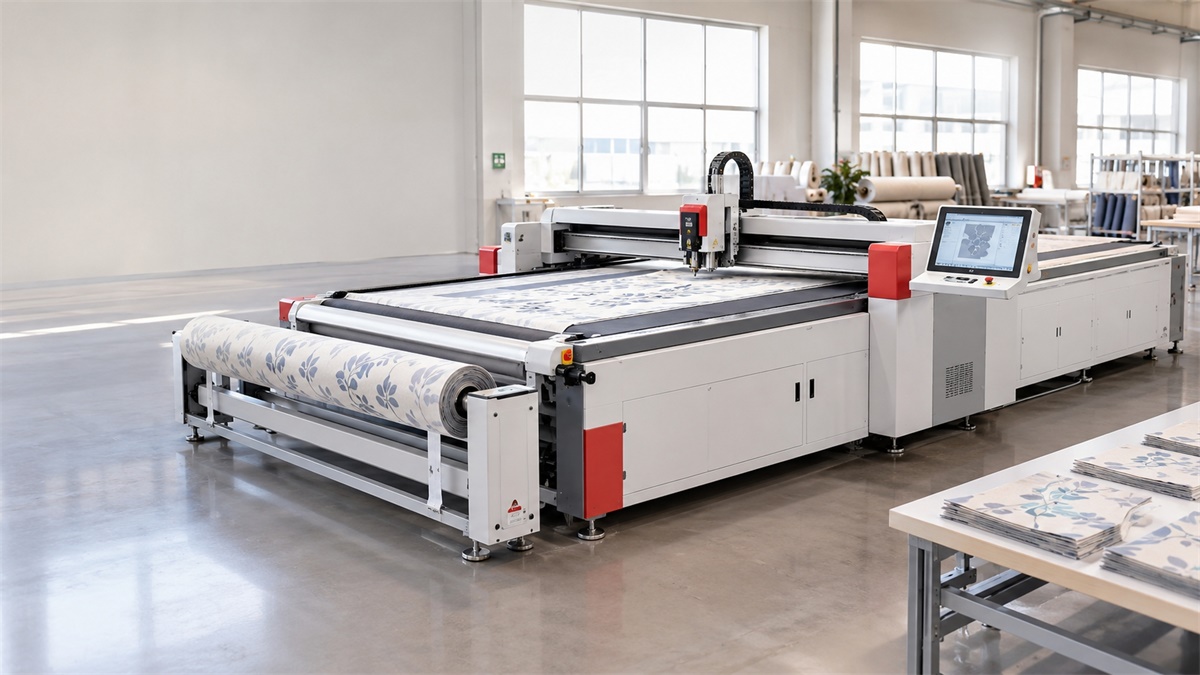
An automatic-feeding machine is designed to improve material handling and support continuous processing. Depending on its configuration, the system can feed fabric from a roll onto the cutting area, reducing repeated manual loading and helping operators maintain a more consistent workflow.
Automatic feeding is particularly useful when a factory processes long fabric rolls, produces repeated patterns, or needs to increase throughput without proportionally increasing manual handling.
However, automatic feeding does not guarantee that every material will run smoothly. Stretchy, slippery, curled, or loosely woven fabrics may require careful tension control and suitable material-handling arrangements.
Before purchasing, ask the supplier to demonstrate the complete process using your actual fabric roll. Evaluate feeding stability, alignment, cutting accuracy, and the time required to change materials or patterns.
4. Match the Working Area to Your Production Needs
The machine’s working area determines the maximum usable cutting dimensions for a given setup. A machine that is too small may require frequent repositioning, while an unnecessarily large model may consume more factory space and increase the initial investment.
When comparing machines, consider the maximum fabric width, the length of each cutting job, the size of your patterns, and whether the system uses a conveyor or automatic feeding mechanism.
For roll-to-roll production, the effective cutting width is often more important than the overall machine dimensions. Check the usable cutting width rather than relying only on the model name or external dimensions.
You should also consider loading space, fabric storage, operator access, ventilation equipment, and maintenance clearance. These factors affect how easily the machine can be integrated into an existing production line.
5. Evaluate Cutting Speed and Real Production Capacity
Manufacturers often compare machines based on maximum cutting speed. However, the maximum speed stated in a specification sheet does not necessarily reflect actual production output.
Real cutting performance depends on several factors:
-
Fabric type, thickness, density, and surface condition.
-
Pattern complexity and the number of small details.
-
Required cutting accuracy and edge quality.
-
Laser power or knife configuration.
-
Acceleration, deceleration, and the frequency of direction changes.
-
Material feeding, unloading, and repositioning time.
For example, a machine may travel quickly along straight lines but operate more slowly when cutting intricate patterns with many corners and small openings.
The most useful comparison is a production test using your typical files and materials. Ask the supplier to measure the time required to complete a representative job, including material handling and routine setup. This provides a more realistic basis for estimating daily output and return on investment.
6. Check Laser Power, Motion Components, and Software
If you choose a CO2 laser fabric cutting machine, evaluate the entire system rather than selecting a model based on laser power alone.
Laser power influences the machine’s ability to process particular materials at a given speed, but the appropriate configuration depends on the fabric and the desired cutting quality. Excessive power or unsuitable parameters can cause burning, melting, or unnecessary thermal damage.
The motion system also matters. Stable mechanical construction, appropriate transmission components, accurate motion control, and suitable cutting software contribute to consistent results.
For automatic fabric cutting applications, review the following specifications:
-
Laser source type and rated power.
-
Effective working width and automatic feeding configuration.
-
Motion system and achievable positioning accuracy.
-
Cutting software and supported file formats.
-
Exhaust ventilation and filtration requirements.
-
Safety enclosure, interlocks, and emergency-stop functions.
-
Spare parts availability and technical support.
If you intend to cut multiple fabric types, ask whether the software supports different parameter settings for individual materials and whether operators can save and reuse tested cutting recipes.
7. Calculate the Total Cost of Ownership
The purchase price is only one part of the cost of an industrial fabric cutting machine. A more accurate evaluation includes installation, training, energy consumption, maintenance, consumables, labor, and production downtime.
Automatic feeding may increase the initial investment but reduce repetitive manual work. A laser system may eliminate the need for physical cutting dies, while a knife system may require blade replacement and tool maintenance. Each technology has a different cost structure.
Consider the following factors when calculating total ownership costs:
Initial investment: Machine price, optional equipment, delivery, installation, and training.
Operating expenses: Electricity, compressed air where applicable, extraction or filtration, replacement parts, and routine servicing.
Labor requirements: Number of operators, manual loading time, material handling, and supervision.
Material utilization: Cutting layout efficiency, scrap generation, damaged pieces, and rework.
Downtime risk: Spare parts lead times, service response, maintenance access, and the supplier’s technical capabilities.
A lower-priced machine is not necessarily the most economical choice. For a factory with high production volume, even a modest improvement in usable output or material utilization may have a meaningful long-term effect on operating costs.
8. Common Mistakes When Buying an Industrial Fabric Cutting Machine
Several purchasing mistakes can lead to poor cutting results or unexpected operating expenses.
Choosing a machine based only on price. A low initial cost may be offset by insufficient capacity, frequent downtime, or high labor requirements.
Ignoring fabric compatibility. A machine that performs well on polyester may not produce acceptable results on every natural, coated, or heat-sensitive fabric.
Confusing maximum speed with production output. Cutting performance must be evaluated alongside pattern complexity, material handling, and setup time.
Buying unnecessary capacity. Oversized equipment may increase costs without providing a meaningful production benefit.
Overlooking ventilation and safety. Laser processing can generate smoke and potentially hazardous fumes. Appropriate extraction, material-specific risk assessment, and protective systems are essential.
Failing to test real production files. A successful demonstration on a simple sample does not guarantee the same performance on complex patterns or long fabric rolls.
The most reliable approach is to provide the supplier with actual materials, sample patterns, target output, and acceptable edge-quality requirements before making a final decision.
9. Which Industrial Fabric Cutting Machine Is Right for Your Factory?
The best machine depends on your materials, production volume, product designs, and automation goals.
For small workshops and customized production, a manually loaded system may offer sufficient flexibility. For manufacturers that repeatedly cut natural or heat-sensitive fabrics, a CNC knife system may be more appropriate. For high-volume production using standardized patterns, die cutting can be a practical option.
For manufacturers processing suitable synthetic textiles, detailed patterns, or continuous fabric rolls, a CO2 laser cutting machine with automatic feeding can offer a useful combination of digital flexibility and reduced manual handling.
If your factory needs to process fabric rolls with fewer interruptions, explore Dowin’s automatic fabric laser cutting machine. Compare the available configuration with your material width, required cutting quality, and expected production volume before selecting a model.
The final decision should be based on demonstrated cutting performance, realistic production capacity, operating costs, and the supplier’s ability to provide long-term technical support.
Frequently Asked Questions
1. What is the best industrial fabric cutting machine?
There is no single best machine for every factory. CO2 laser machines are suitable for many synthetic textiles and intricate patterns, CNC knife machines are useful for materials requiring non-thermal cutting, and die cutting machines can be effective for high-volume production of standardized shapes.
2. Is a laser cutting machine suitable for all fabrics?
No. Some fabrics can melt, discolor, shrink, or release hazardous fumes during laser processing. Always test the specific material and verify that the machine’s ventilation and safety systems are suitable for the application.
3. Is automatic feeding worth the extra cost?
Automatic feeding can be worthwhile when processing long fabric rolls or repeated cutting jobs. It can reduce manual handling and support a more continuous workflow. Its value depends on production volume, material stability, labor costs, and the machine’s actual operating efficiency.
4. What laser power is suitable for industrial fabric cutting?
The appropriate power depends on fabric composition, thickness, cutting speed, and the required edge quality. Buyers should test their actual materials and compare complete machine configurations instead of selecting a laser solely by its rated power.
5. How can I reduce fabric waste during cutting?
Use optimized nesting software, accurate material alignment, stable feeding, and tested cutting parameters. Regularly review scrap rates and compare the usable output from different cutting layouts.
6. What should I ask a supplier before purchasing?
Ask for a cutting demonstration using your own fabric and pattern files. Confirm the effective working width, achievable cutting quality, actual processing time, ventilation requirements, maintenance schedule, spare parts availability, warranty terms, and technical support arrangements.
Post time: Oct-14-2026
