
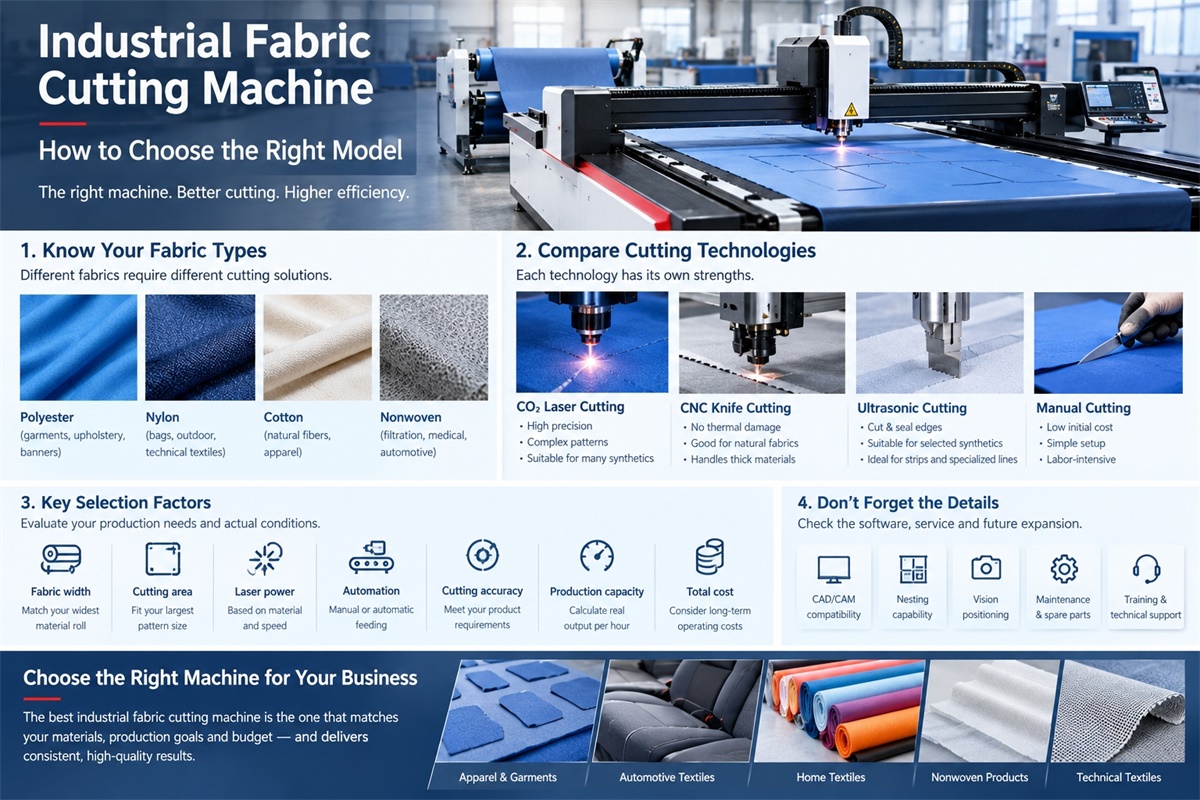
Choosing the right industrial fabric cutting machine is an important decision for textile manufacturers, garment factories, automotive upholstery suppliers, and technical textile producers. The wrong machine can increase material waste, slow down production, and create inconsistent cutting edges. The right equipment can improve cutting accuracy, reduce labor requirements, and support long-term production growth.
However, industrial fabric cutting machines are available in several configurations, including CO2 laser cutting machines, CNC knife cutters, ultrasonic cutters, and automatic fabric cutting systems. Each technology has different strengths depending on fabric type, cutting complexity, production volume, and automation requirements.
For manufacturers processing fabric rolls or producing large quantities of textile components, an automatic feeding laser cutting machine can be a practical option. Before choosing a model, it is important to evaluate the materials you process, the required cutting area, production capacity, and total operating costs.
1. Identify Your Fabric Types Before Choosing a Machine
The first step is to determine which materials the machine must process. Different fabrics respond differently to laser energy, mechanical blades, and ultrasonic vibration.
Polyester fabric
Polyester is widely used in garments, sportswear, upholstery, banners, and industrial textiles. A CO2 laser cutting machine can cut many polyester fabrics while thermally sealing their edges, helping reduce fraying.
For manufacturers producing complex patterns or customized textile components, laser cutting offers flexibility without requiring physical cutting dies.
Nylon fabric
Nylon is commonly used in bags, outdoor products, protective textiles, and technical fabrics. Laser cutting can process many nylon materials, but excessive heat may cause melting, discoloration, or edge deformation.
The correct combination of laser power, cutting speed, and focus position should be established through material testing.
Cotton and natural fabrics
Cotton, linen, and other natural fibers do not melt and seal in the same way as thermoplastic synthetic fabrics. Laser cutting may cause browning, scorching, or charring, particularly when processing light-colored or delicate materials.
Mechanical knife cutting may be more suitable when the application requires avoiding heat-related edge discoloration.
Nonwoven fabric
Nonwoven materials are used in filtration, packaging, automotive interiors, medical-related products, and disposable textile applications. CO2 laser cutting can process many nonwoven materials, especially synthetic varieties.
The suitable machine depends on fiber composition, material density, thickness, and the required edge finish.
Before purchasing an industrial fabric cutting machine, prepare a list of all materials you intend to process. Include the fiber composition, thickness, fabric width, number of layers, and any surface coatings.
2. Choose the Right Fabric Cutting Technology
Different cutting technologies serve different manufacturing requirements. Comparing them helps narrow the machine selection before evaluating individual models.
| Technology | Main advantages | Suitable applications | Main limitations |
|---|---|---|---|
| CO2 laser cutting | Non-contact processing, intricate contours, flexible digital patterns | Polyester, synthetic textiles, nonwovens, upholstery components | Heat-sensitive materials may discolor or melt |
| CNC knife cutting | No thermal cutting zone, suitable for many natural fabrics | Cotton, leather, foam, selected technical textiles | Blade wear and mechanical pressure can affect results |
| Ultrasonic cutting | Can cut and seal compatible thermoplastic materials | Selected synthetic fabrics, strips, specialized production lines | Material compatibility and tool configuration matter |
| Manual cutting | Low initial equipment cost and simple setup | Small workshops and occasional cutting | Labor-intensive and difficult to standardize at scale |
For manufacturers that process multiple textile designs and need repeatable cutting paths, CO2 laser cutting is worth evaluating. A CNC laser system can follow digital designs without requiring a new physical die for each pattern.
If your factory mainly cuts cotton garments or thick multilayer fabrics, a knife-based system may be a better fit for certain applications. The final decision should be based on actual sample results rather than the technology name alone.
3. Determine the Required Cutting Area and Fabric Width
The working area is one of the most important specifications when choosing an industrial fabric cutting machine.
A machine that is too small may require repeated repositioning, manual cutting, or additional production steps. An unnecessarily large machine, however, can increase the initial investment and consume valuable factory space.
Consider the following factors:
-
Maximum fabric width: Measure the widest material roll used in regular production.
-
Cutting length: Determine whether you process individual sheets, short sections, or long continuous rolls.
-
Pattern dimensions: Ensure the working area accommodates your largest cutting layout.
-
Loading space: Allow sufficient room for roll holders, conveyors, and material alignment.
-
Future production requirements: Consider whether wider fabrics or larger products may be introduced later.
For roll-fed fabric processing, an automatic feeding system can reduce manual handling and help maintain consistent material positioning.
Explore the Dowin fabric auto-feeding laser cutting machine range when evaluating equipment for continuous textile feeding and automated cutting.
When comparing models, check the usable cutting width rather than relying solely on the machine’s external dimensions.
4. How Much Laser Power Do You Need for Industrial Fabric Cutting?
Laser power affects cutting capability, but higher power does not automatically mean higher production efficiency.
For fabric cutting, the required laser power depends on the material composition, thickness, weave, cutting speed, and edge-quality requirements. Thin synthetic fabric may need relatively little energy, while dense or multilayer materials may require a different configuration.
When evaluating a CO2 laser cutting machine, consider these factors:
Material thickness: Thicker and denser fabrics may require more processing energy or slower cutting speeds.
Cutting speed: Higher production targets may require sufficient laser power to maintain acceptable edge quality at the desired speed.
Thermal sensitivity: Delicate materials may require lower power and faster motion to reduce heat damage.
Layer count: Cutting several layers together changes the heat distribution and may increase the risk of incomplete cuts or uneven edges.
Pattern complexity: Intricate contours and small details may require careful acceleration and power control, rather than simply increasing laser output.
Ask the supplier to test your actual material at realistic production speeds. The most useful result is a complete sample showing the cut quality, achievable throughput, and consistency across the cutting area.
5. Automatic Feeding vs. Manual Fabric Cutting Machines
For manufacturers processing fabric rolls, the feeding system can have a major impact on labor requirements and production consistency.
Manual fabric cutting machines
Manual loading and positioning may be sufficient for small production volumes, occasional orders, or materials that are difficult to feed automatically.
However, manual handling can increase labor costs and create inconsistencies when operators need to align fabric repeatedly. Long production runs may also require more time for material preparation and repositioning.
Automatic feeding laser cutting machines
An automatic feeding system transports fabric into the cutting area, reducing the need for repeated manual placement. Depending on the machine configuration, the system may include a conveyor table, roll holder, tension control, and automatic material feeding.
Key advantages can include:
-
Reduced manual fabric handling
-
More consistent material positioning
-
Better suitability for long cutting jobs
-
Improved integration with digital cutting patterns
-
More efficient production workflows for repetitive orders
Automatic feeding does not eliminate every production problem. Stretch fabrics, loosely woven textiles, and slippery materials may still require careful tension control and alignment.
Before purchasing, confirm how the machine handles fabric rolls, whether the conveyor supports your material weight, and how the system responds when the fabric stretches or shifts during feeding.
6. Evaluate Cutting Accuracy and Edge Quality
Cutting accuracy affects product assembly, material utilization, and the consistency of finished textile components.
For example, garment manufacturers may need accurate outlines for sleeves, collars, and decorative components. Automotive upholstery suppliers may require repeatable shapes for seat covers and interior panels.
When testing an industrial fabric cutting machine, inspect:
-
Dimensional accuracy across repeated parts
-
Consistency between the beginning and end of a long cutting job
-
Edge smoothness and fraying
-
Melting, scorching, or discoloration
-
Accuracy of small holes, corners, and narrow features
-
Alignment between printed patterns and cutting paths, if applicable
For laser cutting, inspect whether the edge is clean and whether the heat-affected area is acceptable for the final product.
For mechanical cutting, check for fabric movement, blade marks, and distortion caused by pressure.
Do not judge cutting quality from a single small sample. Ask the supplier to process a realistic pattern with multiple parts, curves, corners, and longer cutting paths.
7. Calculate Production Capacity Before Buying
Industrial fabric cutting equipment should be selected according to actual production demand, not just advertised maximum speed.
A machine may move quickly along a straight line but process complex patterns more slowly because of frequent direction changes, positioning movements, and acceleration limits.
To estimate production requirements, calculate how many acceptable finished parts your factory needs per shift.
For example, if your factory needs 2,400 parts per day across two eight-hour shifts, the average target is 150 acceptable parts per operating hour. The selected machine must achieve that output after accounting for loading, unloading, setup, inspection, and downtime.
Important capacity factors include:
-
Cutting length per part
-
Number of parts arranged in each layout
-
Nesting efficiency and fabric utilization
-
Machine movement speed and acceleration
-
Loading and unloading time
-
Operator availability
-
Maintenance and unplanned downtime
For automatic cutting, a well-designed layout can be just as important as the machine’s maximum speed. Efficient nesting may reduce fabric waste while allowing more parts to be produced from each roll.
8. Consider Software, Automation, and Future Expansion
Modern industrial fabric cutting machines often depend on software as much as on the mechanical structure.
For laser cutting, the control system must convert digital patterns into accurate cutting paths and coordinate laser output with machine movement.
Before purchasing, check whether the machine supports your existing design workflow and file formats. Confirm how patterns are imported, edited, arranged, and transferred to the cutting system.
Other features worth evaluating include:
-
CAD/CAM compatibility
-
Automatic nesting capabilities
-
Camera or vision-based positioning, where required
-
Conveyor synchronization
-
Material alignment and tension control
-
Cutting job storage and repeatability
-
Remote diagnostics and technical support
Do not pay for advanced features simply because they are available. Choose the functions that solve current production problems or support a realistic expansion plan.
For example, vision positioning can be useful for cutting printed fabrics or irregularly positioned designs, but may not be necessary for every roll-fed textile application.
9. Compare Total Cost of Ownership, Not Just Purchase Price
A low purchase price does not always result in the lowest long-term production cost.
The total cost of an industrial fabric cutting machine includes the initial investment, installation, labor, energy, maintenance, consumables, material waste, and production downtime.
Laser cutting machines generally avoid cutting-blade wear, but they require maintenance of optical components and appropriate smoke extraction. Knife-based systems may have lower equipment costs in some configurations, but blade replacement and mechanical maintenance must be considered.
Automatic feeding systems may require a higher initial investment but can reduce manual handling and improve production consistency.
Use this basic calculation:
Cost per acceptable part = Total production cost ÷ Number of acceptable finished parts
When comparing suppliers, request the following information:
-
Machine price and included accessories
-
Installation and training costs
-
Expected maintenance requirements
-
Availability and price of replacement parts
-
Energy consumption under representative operating conditions
-
Labor requirements per shift
-
Material waste and rejection rates
-
Warranty coverage and technical support arrangements
Where possible, compare the machines using the same material, cutting pattern, production target, and finished-part specifications.
10. Common Mistakes When Choosing an Industrial Fabric Cutting Machine
Several purchasing mistakes can lead to higher costs and disappointing results.
Choosing power without testing the fabric
A higher-power laser may be unnecessary for thin materials and may increase the risk of heat damage if the parameters are poorly configured. Select power based on verified cutting performance.
Ignoring fabric width
A machine that cannot accommodate the actual roll width may create additional handling steps and reduce production efficiency.
Focusing only on maximum speed
Maximum movement speed is not the same as finished-part output. Evaluate the complete cutting cycle, including positioning and material handling.
Overlooking edge quality
A machine may cut quickly but still produce unacceptable melting, fraying, or discoloration. Always inspect samples against the final product requirements.
Ignoring after-sales support
Industrial equipment requires installation, training, maintenance, and troubleshooting. Check the supplier’s ability to provide technical assistance and replacement parts.
Buying unnecessary automation
Automation should solve a measurable production problem. If your orders are small and highly irregular, a simpler machine may offer a better return on investment.
11. A Practical Checklist for Selecting the Right Model
Before requesting quotations, prepare the following information:
-
Main fabric types and fiber composition
-
Minimum and maximum material thickness
-
Maximum fabric roll width
-
Typical cutting patterns and part dimensions
-
Daily or monthly production targets
-
Required cutting accuracy
-
Acceptable edge finish
-
Whether single-layer or multilayer cutting is required
-
Whether automatic feeding or vision positioning is needed
-
Available factory space and electrical requirements
-
Budget and expected return on investment
Provide this information to each supplier so that quotations can be compared on the same basis.
For a more reliable decision, send representative fabric samples and request a cutting test. Ask the supplier to demonstrate the finished parts, explain the recommended processing parameters, and provide realistic production estimates.
Conclusion
Choosing the right industrial fabric cutting machine requires balancing material compatibility, cutting accuracy, production capacity, automation, and operating costs.
A CO2 laser cutting machine is worth considering when your factory needs intricate cutting paths, flexible digital patterns, reduced fraying on suitable synthetic fabrics, and integration with automatic feeding. CNC knife cutting may be more appropriate for certain natural fabrics or applications where thermal damage must be avoided, while ultrasonic cutting can be effective for specialized cutting and edge-sealing operations.
For textile manufacturers processing continuous fabric rolls, an automatic feeding system can help reduce manual handling and support a more consistent production workflow.
Review the Dowin fabric auto-feeding laser cutting machine range and compare the available configurations with your material width, cutting requirements, and production targets. The best model is the one that consistently produces acceptable parts at a competitive total cost.
Frequently Asked Questions
1. What is the best industrial fabric cutting machine?
The best machine depends on the fabric, production volume, required edge quality, and cutting complexity. CO2 laser systems are suitable for many synthetic textiles and complex patterns, while knife cutters and ultrasonic systems serve different material and production requirements.
2. Is a CO2 laser cutting machine suitable for textile factories?
Yes. CO2 laser cutting machines are widely used for processing many synthetic fabrics, nonwovens, upholstery materials, and other textiles. Material testing is important to verify cutting quality and avoid excessive melting or discoloration.
3. What is the advantage of an automatic fabric cutting machine?
Automatic systems can reduce manual handling, improve material positioning, and support longer production runs. Their actual productivity depends on feeding stability, fabric properties, cutting patterns, and the overall production workflow.
4. How do I choose the right laser power for fabric cutting?
Consider fabric composition, thickness, density, desired cutting speed, and edge-quality requirements. Request sample tests at realistic production speeds instead of selecting a laser based on power alone.
5. Can an industrial fabric cutting machine reduce material waste?
Yes. Accurate cutting paths, efficient pattern nesting, consistent feeding, and reduced cutting errors can improve material utilization. The amount of waste reduction depends on the fabric, pattern layout, and production process.
6. Is automatic feeding necessary for fabric laser cutting?
Not always. Automatic feeding is most beneficial when processing fabric rolls, repetitive patterns, or high production volumes. Manual loading may be sufficient for small batches or specialized materials that are difficult to feed consistently.
7. What should I ask a supplier before purchasing?
Ask about material compatibility, usable cutting width, tested cutting speed, accuracy, software, maintenance, spare parts, training, warranty, and technical support. Most importantly, request a sample test using your own fabric and cutting patterns.
Post time: Oct-20-2026
