
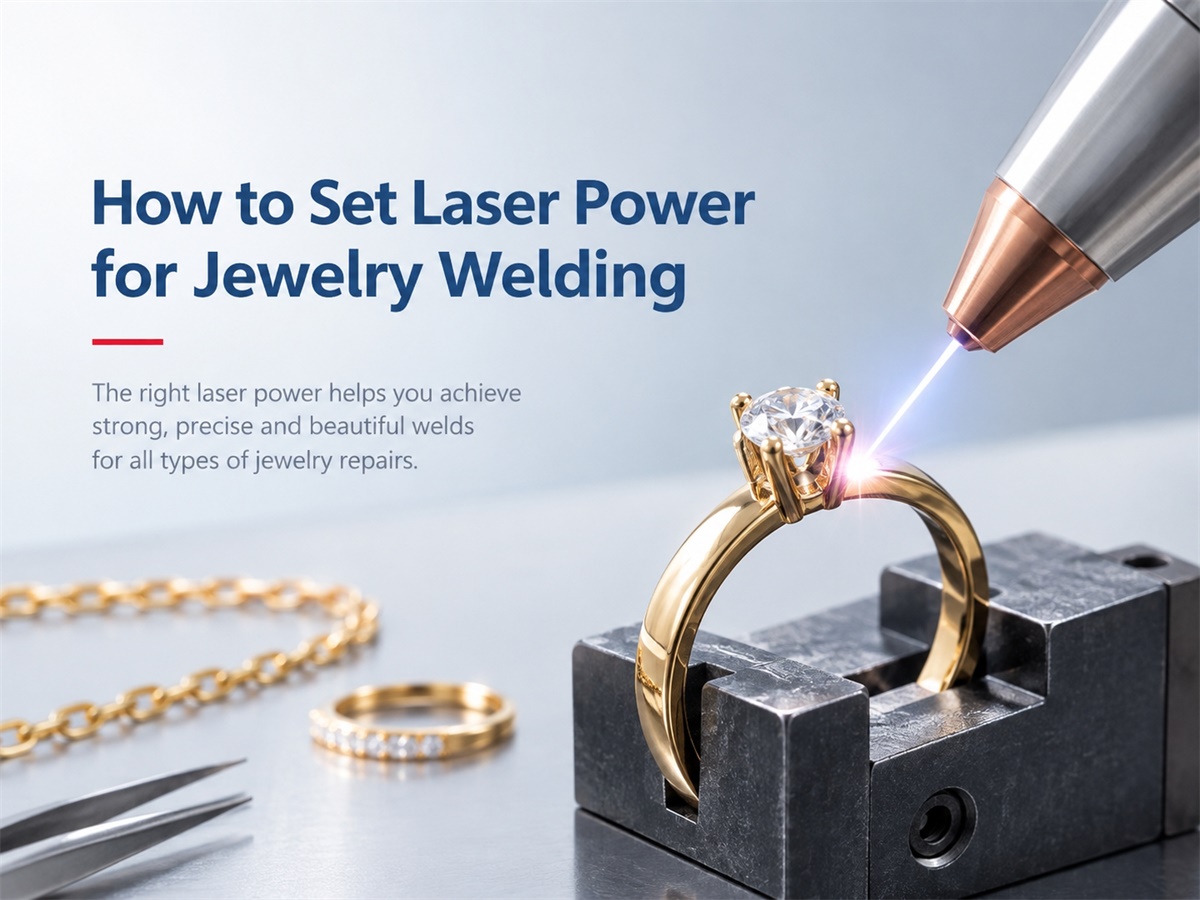
Laser power is one of the most important parameters in jewelry laser welding. The correct setting helps jewelers repair broken gold chains, close ring cracks, rebuild worn prongs, and weld delicate silver or platinum components with greater precision.
However, there is no single laser power setting suitable for every jewelry repair. The ideal power depends on the metal type, workpiece thickness, spot size, pulse duration, and welding position. Understanding how these factors interact allows jewelers to achieve reliable welds while minimizing unwanted heat damage.
1. Understand Laser Power, Pulse Energy, and Pulse Duration
Before adjusting a jewelry laser welding machine, it is important to understand the difference between its main parameters.
Laser power indicates the laser’s output capability. Depending on the machine, the interface may display power in watts or as a percentage.
Pulse energy (J) refers to the energy delivered in a single laser pulse. It directly affects how much energy is available to melt the metal.
Pulse duration (ms) determines how long each laser pulse lasts. A longer pulse can increase total energy input and heat diffusion.
Spot size (mm) determines how the laser energy is distributed across the target area. A smaller spot concentrates energy into a more localized area.
Pulse frequency (Hz) controls how many pulses are delivered per second. Higher frequency can increase cumulative heat during continuous welding.
On a pulsed YAG jewelry laser welder, these parameters work together. Increasing the power percentage alone does not provide a complete picture of the actual energy delivered to the workpiece. The relationship between voltage, pulse duration, beam diameter, and energy also depends on the machine’s design.
2. How to Choose Laser Power for Different Jewelry Metals
Different precious metals respond differently to laser energy. Thermal conductivity, reflectivity, alloy composition, and workpiece thickness all affect the welding result.
Gold jewelry, including 14K and 18K alloys, generally requires controlled energy to achieve sufficient fusion without excessive melting or porosity.
White gold may require additional attention to alloy composition and cracking risk. Short test pulses and gradual parameter adjustments can help establish suitable settings.
Rose gold requires careful energy control to maintain the desired weld appearance and minimize excessive melting.
Sterling silver has high thermal conductivity and reflectivity, which can make it more challenging to weld. Its laser parameters may differ considerably from those used for gold.
Platinum has a high melting temperature, and its welding requirements depend on the specific alloy, joint geometry, and required penetration depth.
There is no universal power percentage for each precious metal. Always use the machine manufacturer’s recommended parameters as a starting point, then test and adjust according to the actual material and repair conditions.
3. How to Adjust Laser Power Based on Jewelry Thickness
Material thickness is one of the most practical factors when setting laser power. Thin chains, delicate prongs, and fine jewelry components can be damaged by excessive energy, while thicker ring sections may require deeper penetration or multiple weld passes.
Thin Jewelry (Below 0.5 mm)
Begin with low pulse energy and a small, controlled weld area. Use test pulses to avoid burning through delicate chain links, thin edges, or fine settings.
Medium-Thickness Jewelry (0.5–1.5 mm)
Increase energy gradually until the weld achieves sufficient fusion. Adjust pulse duration and spot size to balance penetration with surface appearance.
Thicker Jewelry (Above 1.5 mm)
Higher pulse energy or longer pulse duration may be needed. For larger gaps or worn areas, consider controlled filler-wire buildup or multiple passes instead of attempting to complete the weld with one high-energy pulse.
These thickness categories are practical guides, not fixed parameter boundaries. Joint geometry, alloy composition, and the required weld depth can change the settings significantly.
4. Step-by-Step: How to Set Laser Power on a Jewelry Laser Welder
Step 1: Identify the Metal and Repair Type
Confirm the metal, alloy, thickness, and repair location. Check whether the piece contains heat-sensitive gemstones or other materials that need protection.
Step 2: Select a Conservative Starting Setting
Use the machine’s material-specific reference settings if available. Start at the lower end of a suitable energy range rather than immediately selecting maximum power.
Step 3: Test on Matching Scrap Metal
Use scrap of the same alloy and similar thickness. Observe the weld pool, penetration, and surface condition before working on valuable jewelry.
Step 4: Adjust One Parameter at a Time
If the weld is too shallow, increase pulse energy slightly or adjust pulse duration. If the metal burns through or splatters, reduce energy and reassess the spot size.
Avoid changing several parameters simultaneously, as this makes it difficult to identify which adjustment improves the welding result.
Step 5: Save the Verified Parameters
Record the material, thickness, energy, pulse duration, frequency, spot size, and filler wire. Save successful settings as workshop presets for repeat repairs.
A controlled test-and-adjust process is more dependable than copying a power percentage from another machine. Jewelry laser welders can differ in output characteristics even when their rated wattage is similar.
5. Common Laser Power Problems and How to Fix Them
Weak or Shallow Welds
Insufficient pulse energy, poor joint fit, or incorrect focus may result in weak penetration. Increase energy gradually and check the alignment of the workpiece.
Burn-Through
Excessive energy for the material thickness can cause holes or damage. Reduce pulse energy or shorten pulse duration, then test again on matching scrap.
Excessive Spatter
High energy, unsuitable focus, or poor material conditions can cause spatter. Reduce energy and check the spot size and focal position.
Porosity
Porosity is not necessarily caused by incorrect laser power. Contamination, poor joint fit, unsuitable filler material, or inadequate shielding may contribute. Clean the joint and review the welding conditions.
Large Heat-Affected Areas
Excessive total heat input can increase the heat-affected area. Consider reducing pulse energy or duration and avoiding unnecessary repeated pulses in the same location.
Inconsistent Welds
Inconsistent positioning, focus, material fit, or machine settings can produce uneven results. Check the workpiece alignment and maintain consistent welding conditions.
6. Why Maximum Laser Power Is Not Always the Best Choice
A common mistake in jewelry laser welding is assuming that higher power always produces a stronger weld. In reality, excessive energy can enlarge the molten pool, increase spatter, and damage delicate jewelry structures.
For fine jewelry repair, controlled energy delivery is more important than maximum output. A properly adjusted 60W, 100W, or 200W YAG jewelry laser welder can serve different repair requirements when its pulse energy and other parameters are appropriately configured.
When comparing jewelry laser welding machines, buyers should consider the adjustable pulse energy range, pulse duration, spot-size control, output stability, and ease of parameter adjustment—not just the rated wattage.
7. Frequently Asked Questions
What laser power should I use for gold jewelry welding?
The appropriate setting depends on gold karat, alloy composition, thickness, and joint design. Start with a conservative setting, test on matching scrap, and gradually adjust pulse energy until sufficient fusion is achieved.
Is higher laser power better for jewelry welding?
Not necessarily. Excessive energy can cause burn-through, spatter, deformation, and larger heat-affected areas. The goal is sufficient penetration with controlled heat input.
Why does silver jewelry need different laser settings from gold?
Silver has high thermal conductivity and reflectivity, which affect how laser energy is absorbed and distributed. Its welding parameters may therefore differ considerably from those used for gold.
Can I use the same laser power settings for every jewelry repair?
No. Even jewelry made from the same metal may require different settings depending on thickness, joint geometry, and repair requirements. Use verified presets as starting points, not universal settings.
How can I reduce heat damage during jewelry laser welding?
Use appropriate pulse energy, carefully control pulse duration and frequency, select a suitable spot size, and avoid unnecessary repeated pulses in the same area. Protect heat-sensitive components and test the settings before repairing valuable jewelry.
Conclusion
Setting the correct laser power for jewelry welding requires an understanding of material properties, thickness, pulse energy, and heat input. Rather than relying on maximum power or copied settings, jewelers should use a systematic testing process to find the right combination of parameters for each repair.
For jewelry workshops handling gold, silver, platinum, and delicate precious-metal components, a jewelry laser welding machine with precise, adjustable pulse parameters can support consistent repairs, controlled heat input, and high-quality finishing.
The key is simple: use enough energy to achieve reliable fusion, but no more than the application requires.
Looking for a jewelry laser welder for precision repair or manufacturing? Explore Dowin’s jewelry laser welding solutions to compare machine configurations and find an option suited to your materials and welding requirements.
Post time: Sep-23-2026
