
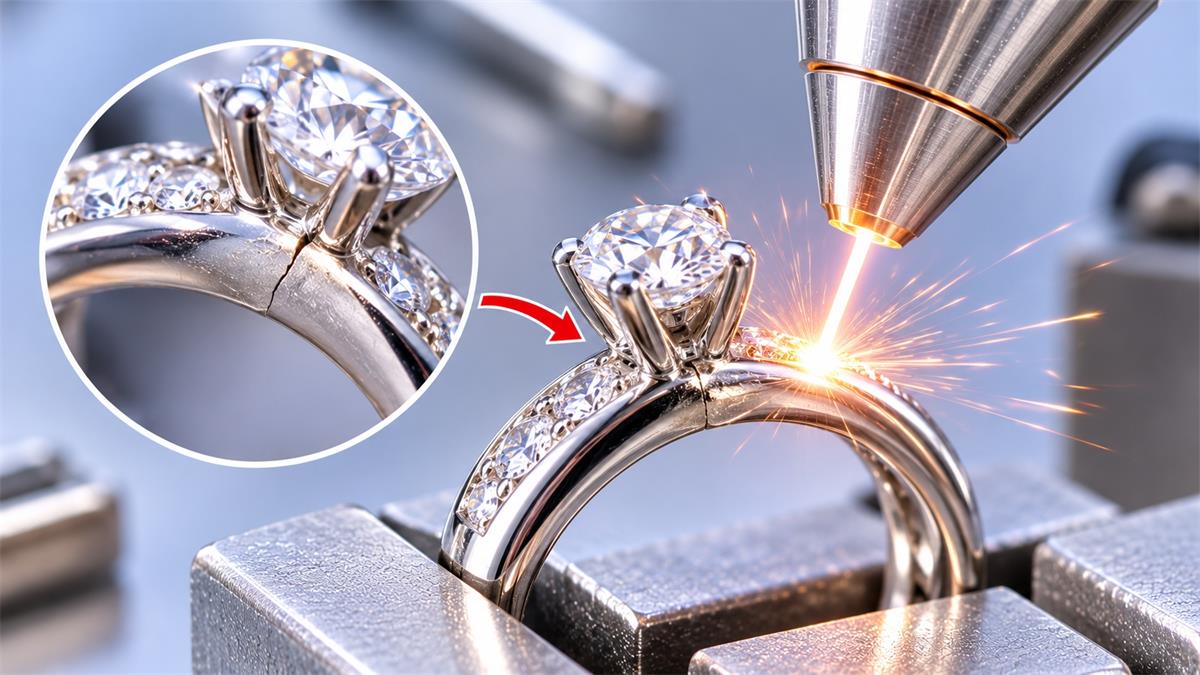
Repairing a cracked ring near a stone setting is one of the more delicate jobs in jewelry repair. Unlike a simple crack on the bottom of a gold band, damage near a diamond or gemstone requires careful attention to heat control, metal thickness, and stone protection. Excessive heat can damage sensitive gemstones, weaken nearby prongs, or affect the appearance of the finished ring.
For professional jewelry repair workshops, a pulsed YAG jewelry laser welding machine offers a practical solution for certain localized ring repairs. Its concentrated energy allows technicians to work on small metal areas while reducing unnecessary heat exposure to surrounding components. However, the correct repair method depends on the crack location, gemstone type, and ring construction.
1. Why Is a Cracked Ring Near a Stone Setting Difficult to Repair?
A crack close to a gemstone setting creates several challenges that do not usually occur when repairing a plain gold band.
The main concerns include:
- Gemstone heat sensitivity: Some gemstones cannot tolerate the temperature changes associated with welding. Emeralds, opals, pearls, and certain treated stones require particular caution.
- Damage to prongs: Excessive heat can weaken or deform the small metal prongs holding a gemstone.
- Limited working space: The closer the crack is to the stone, the more difficult it becomes to position the laser accurately.
- Thin metal sections: The metal around gemstone settings may be relatively thin, increasing the risk of burn-through.
- Visible repair marks: Poorly controlled welding can leave pits, discoloration, or uneven surfaces around the setting.
The biggest challenge is repairing the damaged metal without compromising the security of the gemstone.
2. Can You Laser Weld a Cracked Ring Without Removing the Stone?
Yes, some cracked rings can be laser welded without removing the gemstone, but this depends on the stone type, crack position, setting design, and available access to the damaged metal.
Laser welding delivers energy to a relatively small area, which can reduce heat transfer to surrounding parts compared with conventional torch soldering. Nevertheless, it does not eliminate the possibility of thermal damage.
Before deciding whether to leave the gemstone in place, a jewelry technician should consider the following factors:
Gemstone Type
Different gemstones have different thermal properties. Diamonds are generally more resistant to heat than many colored gemstones, but they can still be damaged by thermal shock, existing fractures, or certain treatments.
Emeralds, opals, pearls, turquoise, and heat-sensitive treated gemstones require additional caution. In many cases, removing the gemstone before welding is the safer approach.
Distance Between the Crack and the Stone
A crack located several millimeters away from a gemstone may offer more flexibility than a crack directly beneath a prong or setting. However, distance alone does not determine safety. The metal structure and heat conduction path must also be evaluated.
Setting Construction
Prong settings, bezel settings, and channel settings provide different levels of access to the damaged area. A technician must identify whether the crack can be reached without directing laser energy toward the gemstone or weakening its supporting structure.
3. What Types of Ring Damage Can Be Repaired with Laser Welding?
Not every crack near a gemstone requires the same repair procedure. Identifying the type of damage helps determine whether laser welding is appropriate.
Cracked Gold Band Near a Diamond Setting
A small crack on the upper section of a gold band, close to a diamond setting, may be repaired using localized laser welding if sufficient metal remains around the damaged area.
The technician must ensure that the crack is fully addressed and that the nearby setting remains secure.
Cracked Metal Near a Prong
Prongs are essential for keeping gemstones in position. If a crack develops near the base of a prong, the repair becomes more complicated because the damaged area is directly related to stone security.
Depending on the extent of the damage, the technician may need to remove the gemstone, rebuild the damaged metal, or replace the prong rather than simply welding the crack.
Cracked Bezel Setting
A bezel setting surrounds the gemstone with a metal rim. A crack in the bezel can weaken the structure that holds the stone.
Laser welding may be suitable for certain localized repairs, but the technician must avoid damaging the gemstone or changing the shape of the bezel.
Cracked Sidewall of a Ring
Some rings have decorative sidewalls or supporting metal structures around the gemstone setting. Small cracks in these areas may be suitable for laser welding when the surrounding structure is sound.
Cracked Ring Shank Near the Shoulder
The shoulder is the section connecting the main band to the central setting. Cracks in this area can affect the structural stability of the entire ring.
Laser welding can be considered for localized repairs, but the technician should inspect the surrounding metal for additional weakness before completing the job.
4. Step-by-Step: How to Repair a Cracked Ring Near a Stone Setting
For suitable gold ring repairs, a pulsed YAG laser welding machine can be used as part of the following professional workflow.
Step 1: Inspect the Ring Under a Microscope
First, examine the crack carefully using a microscope. Identify its length, depth, and exact position relative to the gemstone and setting.
Check whether the crack is limited to the surface or extends through the metal. Also inspect nearby prongs, bezels, and other supporting structures.
Step 2: Identify the Metal and Gemstone
Determine whether the ring is made from 14K gold, 18K gold, white gold, platinum, or another alloy.
Identify the gemstone and check whether it has undergone heat treatment, filling, coating, or other enhancements. If its composition or treatment is uncertain, do not assume it can tolerate welding heat.
Step 3: Decide Whether the Stone Needs to Be Removed
If the crack is close to a sensitive gemstone or directly involves its supporting setting, removing the stone may be necessary.
For suitable repairs where the gemstone can safely remain in place, use an appropriate protection procedure and ensure that the welding position is accessible.
Step 4: Clean and Prepare the Damaged Area
Remove dirt, oil, polishing compounds, and other contamination from the repair area. Make sure the ring is completely dry before welding.
If the crack has opened, the technician should evaluate whether the edges can be aligned or whether compatible filler material is required.
Step 5: Position the Ring Under the Microscope
Secure the ring on a stable work surface. Position the damaged area so the technician can clearly see the crack and control the laser spot.
A microscope is particularly important when working close to small prongs, bezels, and gemstone settings.
Step 6: Perform Controlled Laser Welding
Start with parameters established through testing on comparable material. Apply controlled pulses to the damaged metal, avoiding unnecessary exposure to surrounding areas.
For a small crack, the objective is to achieve sufficient fusion along the damaged section without creating excessive melting or distortion.
Depending on the crack width and metal composition, compatible filler wire may be needed to restore the missing material.
Step 7: Inspect the Weld and Gemstone Setting
After welding, inspect the repaired area under magnification. Look for incomplete fusion, cracks, holes, excessive melting, and discoloration.
Also check whether the gemstone has moved and whether the prongs or bezel remain secure. A mechanically sound weld does not automatically mean the gemstone setting is safe.
Step 8: Finish and Polish the Ring
Once the repair has been inspected, perform suitable surface finishing and polishing. Avoid removing too much material from the repaired section, especially when working with delicate ring designs.
5. What Laser Parameters Are Important for Ring Repairs Near Gemstones?
When repairing a cracked ring close to a gemstone, precise control of laser energy is essential. The goal is to melt the damaged metal sufficiently while minimizing unnecessary heat exposure to surrounding components.
For pulsed YAG jewelry laser welding, several parameters need attention:
| Parameter | Function |
|---|---|
| Pulse energy | Controls the energy delivered to each welding point. |
| Pulse duration | Influences heat delivery and the size of the molten area. |
| Pulse frequency | Determines the number of pulses delivered per second. |
| Spot diameter | Controls the size and concentration of the welding area. |
| Shielding gas | Helps protect the molten metal from atmospheric contamination. |
There is no universal parameter setting for every ring repair. A thin 14K white gold ring requires a different approach from a thick 18K yellow gold ring.
Technicians should test the welding conditions on matching scrap material before working on valuable jewelry. They should also remember that low laser energy does not automatically guarantee gemstone safety. The distance, heat conduction path, and gemstone characteristics remain important.
6. Common Mistakes When Repairing a Cracked Ring Near a Stone
Mistake 1: Welding Too Close to the Gemstone
Applying laser energy too close to a gemstone without evaluating its thermal sensitivity can result in damage, even if the laser beam does not directly hit the stone.
Better approach: Evaluate the gemstone type, crack location, and heat conduction path. Remove the stone when necessary.
Mistake 2: Using Excessive Laser Energy
Too much energy can burn through thin gold sections, deform the setting, or weaken nearby prongs.
Better approach: Optimize pulse energy and duration using comparable material samples before beginning the repair.
Mistake 3: Ignoring Existing Metal Weakness
Sometimes a visible crack is only one part of a larger problem. Worn or weakened metal around the setting may cause the ring to crack again after repair.
Better approach: Inspect the entire surrounding structure and determine whether additional metal restoration is necessary.
Mistake 4: Applying Excessive Polishing
Over-polishing can reduce the thickness of the repaired metal and weaken the area around the setting.
Better approach: Use controlled finishing techniques and preserve as much original material as possible.
7. Is a 150W Jewelry Laser Welder Suitable for Ring Repairs?
A 150W desktop pulsed YAG jewelry laser welder can be a practical option for many precision gold jewelry repair applications, including suitable cracked-ring repairs near gemstone settings.
For jewelry workshops, the following features are particularly useful:
- Adjustable pulse parameters for different gold alloys.
- Localized welding for small cracks and damaged metal sections.
- Microscope-assisted positioning for accurate operation.
- Controlled energy delivery for delicate jewelry components.
- Flexibility for repairing rings, necklaces, bracelets, and other fine jewelry.
However, machine wattage alone does not determine whether a ring can be safely repaired. Minimum controllable pulse energy, pulse duration, spot diameter, and the actual gemstone protection procedure are all important.
For workshops handling a wider range of jewelry repair applications, a 200W configuration may also be worth considering. The appropriate choice should be based on actual material samples and the required welding performance.
Explore the Dowin 200W 180 Joules YAG Pulsed Jewelry Laser Welder for more information about this machine configuration.
8. Laser Welding vs Traditional Soldering for Rings with Gemstones
Traditional soldering is still widely used in jewelry repair. However, heating a larger section of a ring can create additional challenges when gemstones are already mounted.
| Comparison | Laser Welding | Traditional Soldering |
|---|---|---|
| Heat application | Localized | Generally heats a larger area |
| Repair precision | Suitable for small, accessible repair areas | Depends on torch control and operator skill |
| Nearby components | Reduced unnecessary heat exposure with proper settings | May require more extensive heat protection |
| Small cracks | Suitable for localized metal joining | May require more surrounding preparation |
| Post-processing | May require less finishing | May require solder cleanup and polishing |
Laser welding is particularly useful when localized heat control is important. Nevertheless, neither method guarantees that a mounted gemstone can remain in place. The repair technician must evaluate the individual ring before selecting the process.
9. How to Choose a Jewelry Laser Welder for Gemstone Ring Repair
If your jewelry workshop regularly repairs cracked rings, diamond settings, and other gemstone jewelry, choosing a machine with suitable precision and adjustment capabilities is important.
Consider the following factors before purchasing:
- Pulse energy adjustment: The machine should provide suitable control for delicate and thicker metal components.
- Microscope quality: Clear magnification helps technicians identify small cracks and accurately position the welding spot.
- Material compatibility: Consider the gold alloys and other metals your workshop regularly repairs.
- Welding stability: Consistent pulse delivery is important for repeatable repair results.
- Sample testing: Ask the supplier to demonstrate welding performance on materials similar to your actual repair jobs.
Before purchasing, it is worth sending the supplier a sample ring or representative metal samples. This helps determine whether the proposed machine configuration is suitable for your specific repair applications.
10. FAQ: Repairing Cracked Rings Near Stone Settings
Can you laser weld a cracked ring next to a diamond?
Yes, certain repairs are possible. However, the technician must evaluate the distance between the crack and the diamond, the diamond’s condition, and the ring structure. Removing the diamond may be necessary in some cases.
Can a cracked gold ring be repaired without removing the stone?
Sometimes. If the damaged metal is accessible and the gemstone can be adequately protected, laser welding may be possible without removing the stone. This decision depends on the gemstone type and repair location.
Can laser welding damage diamond settings?
Yes. Excessive heat can weaken or deform prongs and other supporting structures. The technician should inspect the setting before and after welding and avoid unnecessary heating of the surrounding metal.
Can you repair a cracked ring near an emerald?
It may be possible, but emeralds require particular caution because they commonly contain inclusions and may have oil or resin treatments. Removing the emerald before welding is often the safer approach.
Is 150W enough for jewelry ring repair?
A 150W pulsed YAG jewelry laser welder can handle many small gold ring repair applications. Actual performance depends on pulse energy adjustment, metal thickness, alloy composition, and the specific repair requirements.
Can laser welding repair a broken ring prong?
Laser welding can be used for certain prong repairs or metal reconstruction. However, the gemstone may need to be removed, and the repaired prong must be checked carefully to ensure it securely holds the stone.
Can you laser weld white gold near a diamond?
Yes, suitable white gold repairs can be performed using pulsed laser welding. However, alloy composition, surface finishing, and gemstone protection must be considered. Rhodium-plated surfaces may also require refinishing after repair.
Does laser welding leave visible marks on a repaired ring?
It can leave a small weld area that may require polishing. The final appearance depends on the welding parameters, filler material, original surface finish, and technician’s skill.
Conclusion
Repairing a cracked ring near a stone setting requires more than simply joining two pieces of metal. The technician must consider gemstone sensitivity, metal thickness, setting construction, and the structural strength of the repaired area.
A pulsed YAG jewelry laser welding machine provides localized heat application and precise control, making it a useful solution for many suitable gold ring repair applications. With proper inspection, gemstone protection, and parameter adjustment, jewelry workshops can handle delicate repairs while reducing unnecessary heat exposure.
If your workshop regularly repairs cracked gold rings, diamond settings, and other fine jewelry, explore Dowin Jewelry Laser Welding Machines. Contact Dowin with your material samples and repair requirements to discuss a suitable machine configuration and request a welding test.
“`
Post time: Nov-17-2026
