
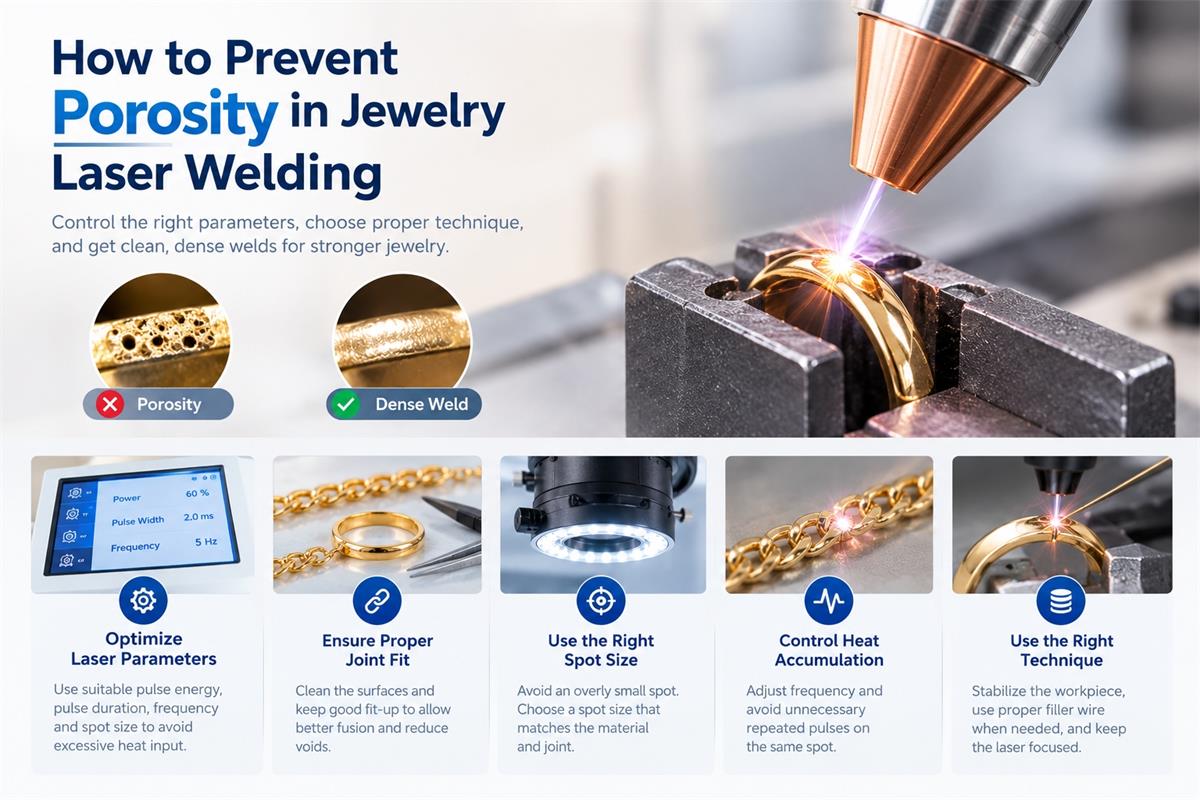
Porosity is a common welding defect that can affect the appearance, strength, and reliability of jewelry laser welds. Small pores or voids can form inside the weld when gases become trapped during melting and solidification.
In jewelry repair, porosity can be particularly problematic because welds are often small and highly visible. Gold chains, rings, prongs, bracelets, and other precious-metal components require clean and controlled welding to achieve a smooth finished surface.
Preventing porosity is not simply a matter of increasing or reducing laser power. Surface cleanliness, joint fit, laser parameters, shielding gas, filler wire, and welding technique can all affect the final result.
1. What Causes Porosity in Jewelry Laser Welding?
Porosity occurs when gas becomes trapped in the molten metal instead of escaping before the weld solidifies.
Several factors can contribute to this problem.
Contamination on the jewelry surface can introduce gases or impurities into the molten pool. Oils, polishing compounds, oxidation, dirt, and other residues should be removed before welding.
Poor joint fit can create gaps where gas or contaminants become trapped. The closer and more consistent the joint surfaces are, the easier it is to achieve stable fusion.
Incorrect laser parameters can also contribute to porosity. Excessive energy may create an unstable molten pool, while insufficient energy may produce incomplete fusion.
Improper shielding gas can allow atmospheric contamination during welding. Gas flow, nozzle position, and shielding conditions should therefore be checked when porosity repeatedly occurs.
Filler wire can also influence weld quality. Contaminated, incompatible, or improperly positioned filler material may introduce additional impurities into the weld.
2. Clean the Jewelry Before Welding
Proper cleaning is one of the simplest steps for reducing porosity.
Jewelry may contain polishing compounds, oils, fingerprints, dust, plating residues, or other contaminants from previous manufacturing and repair processes.
Before laser welding:
-
Remove grease and oil from the repair area.
-
Clean polishing compounds from the joint.
-
Remove visible dirt and oxidation.
-
Ensure the filler wire is clean.
-
Allow the workpiece to dry completely before welding.
Pay particular attention to narrow cracks and small gaps because contaminants can remain inside areas that are difficult to see.
A clean welding surface allows the laser to interact more consistently with the base metal and reduces the possibility of contaminants becoming trapped in the molten pool.
3. Ensure Proper Joint Fit
Joint preparation has a major influence on weld quality.
If two jewelry components do not fit together properly, excessive gaps can require more filler material and additional laser energy. These conditions can make it more difficult to produce a dense and consistent weld.
Before welding, position the components securely and make sure the joint is properly aligned.
For a cracked ring, for example, the two sides of the crack should be positioned as closely as practical before welding. For chain repair, the individual links should be correctly aligned before applying the laser.
A well-fitted joint allows the laser to focus on the intended welding area rather than unnecessarily filling large gaps.
4. Optimize Laser Parameters
Laser parameters should be adjusted according to the jewelry material, thickness, and repair type.
Important parameters include:
-
Pulse energy
-
Pulse duration
-
Pulse frequency
-
Spot size
-
Welding speed
-
Pulse overlap
If pulse energy is too high, the molten pool may become unstable and excessive heat can increase the risk of defects.
If energy is too low, the weld may not achieve adequate fusion.
Pulse duration also affects how energy is delivered to the material. A suitable combination of energy and pulse duration helps create a stable molten pool.
Spot size affects energy density. An extremely small spot can concentrate energy strongly in one location, while a larger spot distributes energy over a wider area.
The correct combination is more important than any single parameter.
5. Use the Correct Shielding Gas
Shielding gas helps protect the molten metal from the surrounding atmosphere during welding.
If shielding is inadequate, oxygen and other atmospheric gases can interact with the molten metal and contribute to oxidation or weld defects.
Check the following when porosity occurs repeatedly:
-
Shielding gas type
-
Gas flow rate
-
Nozzle position
-
Distance between nozzle and workpiece
-
Gas supply stability
-
Cleanliness of the gas system
The appropriate shielding conditions depend on the laser welding machine, material, and application. Follow the equipment manufacturer’s recommendations rather than assuming that one gas flow setting is suitable for every jewelry repair.
6. Choose Suitable Filler Wire
Filler wire is commonly used when repairing missing material, filling cracks, rebuilding worn areas, or adding material to jewelry components.
The filler wire should be compatible with the base metal and appropriate for the application.
Before welding, check that the wire is clean and free from oil, oxidation, and other contaminants.
Introduce the filler wire into the molten pool in a controlled manner. Excessive filler material can make it more difficult to maintain a stable weld pool and may increase the amount of laser energy required.
For high-value jewelry, the filler material should be selected according to the alloy and the desired final appearance.
7. Control Heat Accumulation
Repeated laser pulses in the same area can cause heat to accumulate.
Excessive heat can make the molten pool larger and less stable, increasing the possibility of defects.
This is especially important when welding thin jewelry components or working on small areas where heat cannot dissipate easily.
To control heat accumulation:
-
Avoid unnecessary repeated pulses.
-
Adjust pulse frequency when appropriate.
-
Use suitable pulse energy.
-
Control pulse overlap.
-
Move progressively along longer weld seams.
-
Allow cooling when the application permits.
A stable welding process is generally preferable to repeatedly applying high energy to the same point.
8. Maintain Proper Laser Focus
Incorrect focus can change the distribution of laser energy and affect the stability of the weld pool.
Before welding, make sure the jewelry is positioned correctly and the laser is focused on the intended repair area.
A microscope or optical positioning system can make it easier to maintain accurate positioning, particularly when working on very small jewelry components.
If weld quality changes unexpectedly across the same component, check the focus and workpiece positioning before making major changes to the laser parameters.
9. Avoid Excessive Welding Speed
Welding speed affects pulse overlap and heat distribution.
If the operator moves too quickly, individual pulses may not overlap sufficiently, resulting in incomplete fusion or an inconsistent weld.
If the operator moves too slowly, excessive pulses may accumulate in the same area and increase heat input.
The appropriate speed depends on pulse frequency, spot size, pulse energy, and the geometry of the repair.
For longer jewelry seams, maintain a consistent movement speed and observe the weld pool rather than relying only on a fixed machine setting.
10. Common Porosity Problems and Solutions
Porosity after welding can have multiple causes. The following troubleshooting guide can help identify where to begin.
Small Pores Appear Throughout the Weld
Possible causes include contaminated surfaces, contaminated filler wire, or inadequate shielding.
Clean the jewelry and filler material, then check the shielding gas conditions.
Large Voids Appear in the Weld
Possible causes include excessive gaps, poor joint fit, or insufficient fusion.
Improve the joint alignment and adjust the welding parameters according to the material thickness.
Porosity Appears Only When Using Filler Wire
Check the cleanliness, alloy compatibility, and feeding technique of the filler wire.
Porosity Appears After Repeated Pulses
Excessive heat accumulation may be contributing to an unstable molten pool.
Review pulse energy, frequency, and pulse overlap.
Weld Surface Looks Uneven and Porous
Check the complete welding process rather than changing only laser power. Surface contamination, focus, shielding, filler wire, and joint preparation should all be considered.
11. Frequently Asked Questions
What causes porosity in jewelry laser welding?
Porosity can be caused by surface contamination, poor joint fit, trapped gas, inadequate shielding, unsuitable laser parameters, contaminated filler wire, or excessive heat accumulation.
How can I prevent porosity when laser welding gold?
Start with clean surfaces, accurate joint alignment, suitable shielding, compatible filler wire, and properly adjusted laser parameters. Test the settings on matching scrap gold before repairing valuable jewelry.
Does higher laser power cause porosity?
Excessive laser energy can contribute to an unstable molten pool and welding defects, but porosity is not caused by power alone. Cleaning, shielding, joint fit, filler wire, and other parameters should also be evaluated.
Can shielding gas prevent all porosity?
No. Proper shielding can reduce atmospheric contamination, but it cannot correct problems caused by contaminated materials, poor joint fit, incorrect laser parameters, or unsuitable filler wire.
Does filler wire affect jewelry weld porosity?
Yes. Contaminated or incompatible filler wire can introduce impurities into the weld. The wire should be clean and appropriate for the base metal and repair application.
Can a pulsed YAG jewelry laser welder reduce porosity?
A pulsed YAG jewelry laser welder provides precise control over pulse energy, duration, frequency, and spot size, which can help operators establish stable welding conditions. However, porosity prevention still depends on the complete welding process.
Conclusion
Preventing porosity in jewelry laser welding requires control of the entire welding process rather than relying on a single parameter.
Clean the jewelry and filler wire, ensure proper joint fit, use suitable shielding gas, maintain accurate focus, and adjust pulse energy, duration, frequency, and spot size according to the material and repair.
For jewelry workshops working with gold, silver, platinum, and other precious metals, a pulsed YAG jewelry laser welding machine with precise parameter control can provide the flexibility needed to establish stable and repeatable welding conditions.
The goal is to create a stable molten pool that achieves sufficient fusion while minimizing contamination, excessive heat, and trapped gas.
Post time: Sep-29-2026
