
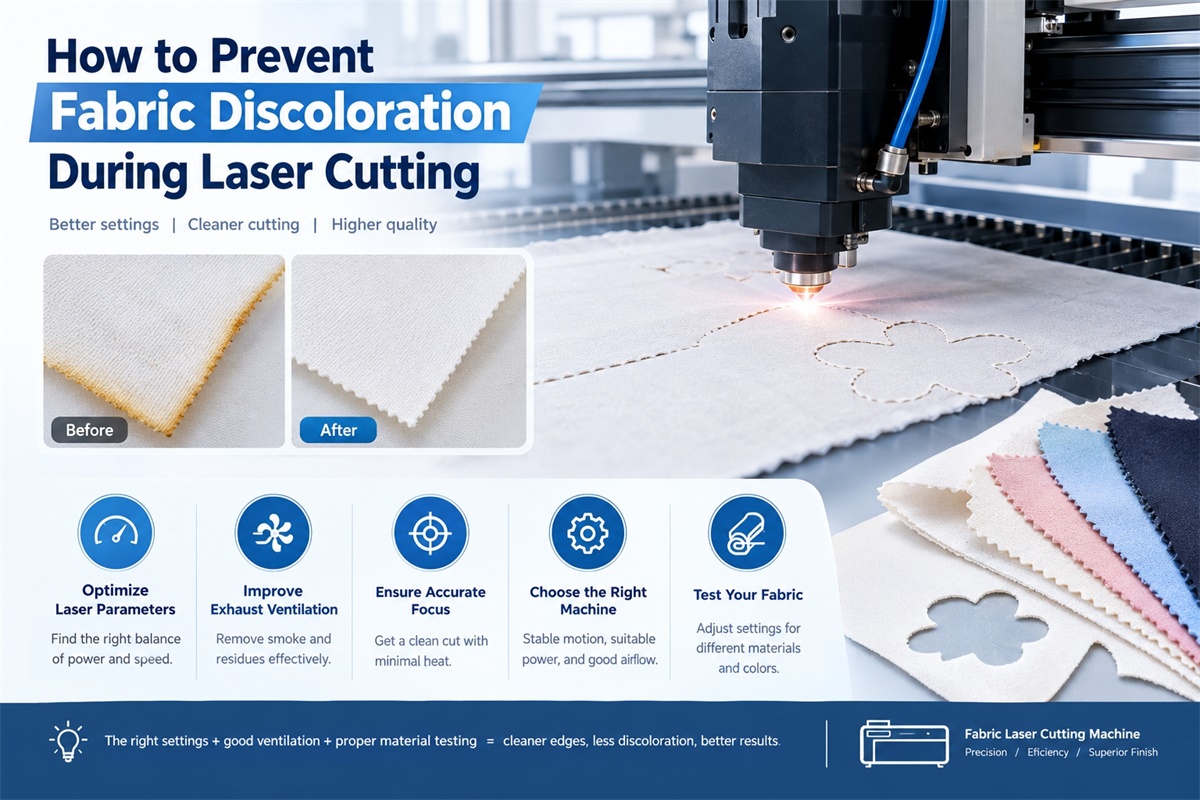
Fabric discoloration is a common challenge when using a CO2 laser cutting machine for textile processing. Yellow edges, brown marks, darkened surfaces, and heat-related color changes can reduce product quality, especially when cutting white fabrics, light-colored textiles, synthetic materials, and delicate fashion fabrics.
The good news is that most discoloration problems can be reduced by adjusting laser parameters, improving exhaust ventilation, selecting suitable fabrics, and optimizing the cutting process. For manufacturers handling large volumes of textiles, choosing the right fabric laser cutting machine is also essential for achieving consistent cutting quality.
In this guide, we will explain why fabric changes color during laser cutting and how to prevent these problems in practical production environments.
1. Why Does Fabric Discolor During Laser Cutting?
Laser cutting uses concentrated heat to cut through textile materials. When the laser energy is too high or the heat cannot dissipate efficiently, the fabric may develop discoloration around the cutting edge or on the surrounding surface.
The most common causes include the following.
Excessive Laser Power
When the laser power is higher than necessary, the fabric receives more thermal energy than required for cutting. This can cause yellowing, browning, carbonization, or darkened edges.
This problem is particularly noticeable when processing white cotton, pale-colored textiles, and lightweight fabrics.
Cutting Speed Is Too Low
A slow cutting speed increases the amount of heat applied to a specific area. Even if the laser power is not extremely high, prolonged exposure can cause visible discoloration.
Incorrect Focus Position
An incorrect focal position can produce an unnecessarily wide kerf or an inconsistent cutting effect. Depending on the material and cutting setup, this may increase heat exposure and create uneven edges.
Insufficient Exhaust Ventilation
Laser cutting produces smoke, vapor, and airborne residues. If the exhaust system cannot remove these by-products effectively, smoke and decomposed material may settle on the fabric surface, leaving stains or dark marks.
Fabric Composition and Color
Different textiles respond differently to laser energy.
-
Cotton: May scorch or turn yellow or brown when exposed to excessive heat.
-
Polyester: Often cuts cleanly with suitable settings, but excessive heat can cause melting, discoloration, or hardened edges.
-
Nylon: Can melt, shrink, or develop heat-related edge changes.
-
Felt: May darken or produce residue depending on its fiber composition and density.
-
White and light-colored fabrics: Usually make even minor discoloration more visible.
Understanding these factors is the first step toward improving cutting quality.
2. Optimize Laser Power and Cutting Speed
One of the most effective ways to prevent fabric discoloration is to find the correct balance between laser power and cutting speed.
Using excessive power at a low speed increases heat exposure. Conversely, reducing power too much may leave fibers incompletely cut, forcing operators to repeat the cutting process and expose the material to additional heat.
The goal is to use the lowest practical energy input that produces a complete, consistent cut.
How to Adjust Laser Parameters
Start with a small test sample made from the actual production fabric. Adjust the power and speed in controlled steps, changing one parameter at a time whenever possible.
| Observed problem | Possible adjustment |
|---|---|
| Yellow or brown edges | Reduce power or increase speed if complete cutting is maintained |
| Incomplete cutting | Increase power gradually or reduce speed |
| Excessive melting on synthetic fabric | Reduce thermal input and test a faster cutting speed |
| Uneven cutting quality | Check focus, material flatness, and machine motion |
| Heavy smoke residue | Improve extraction and inspect airflow around the cutting zone |
These adjustments are starting points rather than universal settings. The correct values depend on fabric thickness, fiber composition, laser power, optical condition, and machine configuration.
For production orders, record the settings that work for each fabric type. This makes repeat orders more consistent and reduces unnecessary material waste.
3. Improve Smoke Extraction and Airflow
Effective smoke extraction is essential for clean textile laser cutting.
When fabric is heated by a CO2 laser, the resulting fumes and residues can accumulate around the cutting area. Poor extraction may cause contamination, particularly when cutting large sheets or operating continuously.
To reduce smoke-related discoloration:
-
Use an extraction system with sufficient airflow for the machine and material.
-
Keep exhaust ducts and filters clean according to the manufacturer’s maintenance instructions.
-
Check for leaks, blocked ducts, and inadequate extraction around the cutting table.
-
Ensure that smoke is removed efficiently without creating unstable airflow that interferes with cutting.
-
Inspect the fabric surface after test cuts to identify residue-related problems.
For factories processing long rolls of fabric, a suitable extraction arrangement is especially important because cutting may continue for extended periods.
An automatic feeding CO2 laser cutting machine can help manufacturers process continuous textile rolls, but the extraction system must also be designed for the actual production workload.
4. Choose the Right Laser Cutting Machine for Fabric
Machine configuration can significantly affect cutting consistency, especially when a manufacturer processes different fabrics every day.
When evaluating a fabric laser cutting machine, consider more than laser power alone.
Stable Motion and Accurate Positioning
A stable motion system helps maintain consistent cutting speed and path accuracy. This is important when cutting complex patterns, narrow outlines, and detailed textile components.
Suitable Laser Power
Higher laser power does not automatically mean better fabric cutting. The appropriate power depends on the fabric’s thickness, density, composition, and required production speed.
For lightweight textiles, excessive power may increase discoloration risks without improving the finished result.
Automatic Feeding for Roll Materials
Automatic feeding systems allow fabric to move continuously through the cutting area. They are useful for manufacturers producing garment panels, sportswear components, textile accessories, and other repeated patterns.
A well-configured system can reduce manual handling and improve production consistency across long fabric rolls.
Effective Exhaust and Cutting Table Design
The cutting table should support the material properly while allowing smoke to be extracted efficiently. Fabric movement, wrinkles, and contact with contaminated surfaces can also affect the finished appearance.
For industrial textile processing, these features should be evaluated together rather than independently.
Manufacturers looking for a production-oriented solution can explore Dowin’s fabric auto-feeding laser cutting machines to compare configurations for continuous fabric cutting applications.
5. Use the Correct Focus and Cutting Distance
The focal position affects the concentration of laser energy and the shape of the cutting kerf.
If the focus is incorrect, the machine may require more energy or slower cutting to achieve complete separation. This can increase thermal exposure and lead to inconsistent results.
To improve cutting quality:
-
Verify the focus position according to the machine manufacturer’s instructions.
-
Check that the fabric remains flat and at a consistent height.
-
Inspect the laser lens and protective optical components for contamination.
-
Confirm that the beam is properly aligned and that the cutting head operates consistently.
-
Repeat a test cut after changing the material thickness or machine setup.
For flexible fabrics, maintaining a consistent material surface is particularly important. Wrinkles and uneven layers can change the effective distance between the laser head and the fabric.
6. Test Different Fabrics Before Mass Production
There is no single laser parameter setting that works equally well for every textile.
Even fabrics with the same color can behave differently because of variations in fiber composition, weave structure, coating, dye, and finishing treatments.
Before starting a production order, test a representative sample under the intended operating conditions.
A practical testing procedure includes:
-
Identifying the fabric’s fiber composition and thickness.
-
Cutting a small sample using a conservative starting setting.
-
Inspecting the cut edge for yellowing, browning, melting, and residue.
-
Adjusting power, speed, and focus as necessary.
-
Checking both the upper surface and the underside of the fabric.
-
Repeating the test under realistic production conditions.
For light-colored materials, examine the fabric under consistent lighting. A cutting edge that appears clean under one type of lighting may show discoloration more clearly under another.
For coated or chemically treated fabrics, consult the material supplier before laser processing. Some materials may release hazardous fumes when heated and may be unsuitable for laser cutting.
7. How to Prevent Yellow Edges on White Fabric
White fabric is one of the most demanding materials for laser cutting because small changes in color are easy to see.
Yellow edges can result from thermal degradation, smoke deposits, fabric finishes, or residues from previous processing.
To minimize yellowing:
First, reduce unnecessary heat exposure. Test a higher cutting speed or lower laser power while confirming that the fabric is still completely cut.
Second, improve smoke removal. Check extraction performance and make sure fumes are not accumulating near the cutting surface.
Third, inspect the fabric finish. Some bleaching agents, dyes, coatings, and finishing chemicals may react differently to laser heat. Test the actual production batch rather than relying on results from a similar fabric.
Fourth, check the cutting table and material contact surfaces. Contaminated surfaces can transfer residues to white textiles.
Finally, inspect the underside. Heat and smoke may affect the bottom surface differently from the top, especially when the fabric contacts the cutting table or backing material.
If discoloration remains after these adjustments, the material itself may not be suitable for the required laser-cutting quality. In such cases, compare the results with a mechanical cutting process before committing to full production.
8. Can Air Assist Prevent Fabric Discoloration?
Air assist can help remove debris from the cutting zone and influence the local cutting conditions. However, its effect depends on the fabric, nozzle configuration, airflow, and cutting setup.
It should not be treated as a universal solution for discoloration.
Excessive or poorly directed airflow may disturb lightweight fabrics, move loose fibers, or affect cutting stability. In other situations, inadequate airflow may allow smoke and residues to accumulate.
For best results:
-
Follow the machine manufacturer’s recommendations for air assist.
-
Test airflow settings on representative fabric samples.
-
Check whether the airflow improves edge cleanliness without moving the material.
-
Evaluate air assist together with laser power, speed, focus, and extraction.
Remember that air assist and exhaust ventilation perform different functions. Air assist influences the cutting zone, while the exhaust system removes smoke and airborne by-products from the machine.
9. Laser Cutting vs. Other Fabric Cutting Methods
Laser cutting is suitable for many textile applications, but it is not necessarily the best choice for every material or quality requirement.
| Cutting method | Main advantages | Potential limitations |
|---|---|---|
| CO2 laser cutting | Precise patterns, flexible digital processing, and sealed edges on many thermoplastic fabrics | Heat-sensitive materials may discolor or melt |
| CNC knife cutting | No laser-related thermal discoloration | Edge sealing is generally not provided |
| Ultrasonic cutting | Can cut and seal suitable synthetic textiles through localized heat and vibration | Material compatibility and equipment requirements vary |
| Die cutting | Efficient for repetitive shapes in high-volume production | Tooling costs and shape changes can reduce flexibility |
For polyester and other suitable thermoplastic fabrics, laser cutting can produce clean, sealed edges that help reduce fraying. However, the same heat-based process may create discoloration or hardened edges when parameters are not optimized.
For white cotton or textiles that are highly sensitive to heat, mechanical cutting may be preferable if laser testing cannot achieve the required appearance.
The best choice depends on fabric composition, order volume, pattern complexity, edge requirements, and acceptable finishing quality.
10. A Practical Checklist for Cleaner Fabric Laser Cutting
Before starting production, use this checklist to reduce discoloration and improve repeatability.
-
Confirm the fabric composition and thickness.
-
Test laser power and cutting speed on a sample.
-
Verify focus and cutting-head alignment.
-
Inspect the fabric for wrinkles and uneven surfaces.
-
Check the exhaust system, filters, and ducts.
-
Inspect the cutting table for contamination.
-
Check both the top and bottom surfaces after cutting.
-
Record the successful settings for future orders.
-
Re-test whenever the fabric batch, finish, or thickness changes.
-
Confirm that the material is safe to laser process.
A consistent testing procedure is more reliable than applying the same machine settings to every textile.
Conclusion
Preventing fabric discoloration during laser cutting requires a combination of correct laser parameters, effective smoke extraction, accurate focusing, suitable machine configuration, and careful material testing.
For manufacturers processing garments, sportswear, nonwoven materials, and other textiles, the most effective approach is to minimize unnecessary heat exposure while maintaining complete and consistent cutting.
A properly configured CO2 fabric laser cutting machine can deliver clean, precise results on many textile materials. However, the final cutting quality always depends on the interaction between the laser, the fabric, and the production environment.
If you are selecting equipment for continuous textile production, review the available automatic fabric laser cutting machine configurations from Dowin and test the intended materials before confirming your production setup.
Frequently Asked Questions
1. Why does fabric turn yellow during laser cutting?
Yellowing can result from excessive heat, thermal degradation, smoke deposits, or reactions involving dyes and fabric finishes. Reducing thermal exposure and improving extraction may help, but some materials remain heat-sensitive.
2. How do I prevent brown edges when laser cutting fabric?
Start by testing a faster cutting speed or lower laser power while ensuring complete cutting. Also check the focus, exhaust performance, and fabric composition.
3. Can a CO2 laser cut white fabric without discoloration?
Yes, some white fabrics can be cut with little visible discoloration when the material and parameters are suitable. However, results depend on fiber composition, finishing treatments, laser settings, and smoke extraction.
4. Does higher laser power cause more fabric discoloration?
Not necessarily. Excessive power can increase thermal damage, but insufficient power may require slower cutting or repeated passes. The best setting balances power and speed to achieve a complete cut with minimal heat exposure.
5. Which fabrics are most likely to discolor during laser cutting?
White and light-colored cotton, heat-sensitive textiles, certain coated fabrics, and materials with reactive finishing treatments may show visible changes. Synthetic fabrics can also melt or develop hardened edges if the settings are unsuitable.
6. Is laser cutting better than knife cutting for fabric?
Laser cutting offers flexible digital processing and can seal the edges of many thermoplastic fabrics. Knife cutting avoids laser-related thermal discoloration and may be preferable for certain heat-sensitive materials. The best method depends on the fabric and finished-product requirements.
7. Can automatic fabric laser cutting machines reduce discoloration?
Automatic feeding can improve material handling and production consistency, but it does not automatically eliminate discoloration. Correct laser parameters, effective exhaust ventilation, stable material feeding, and appropriate machine setup remain essential.
Post time: Oct-20-2026
