
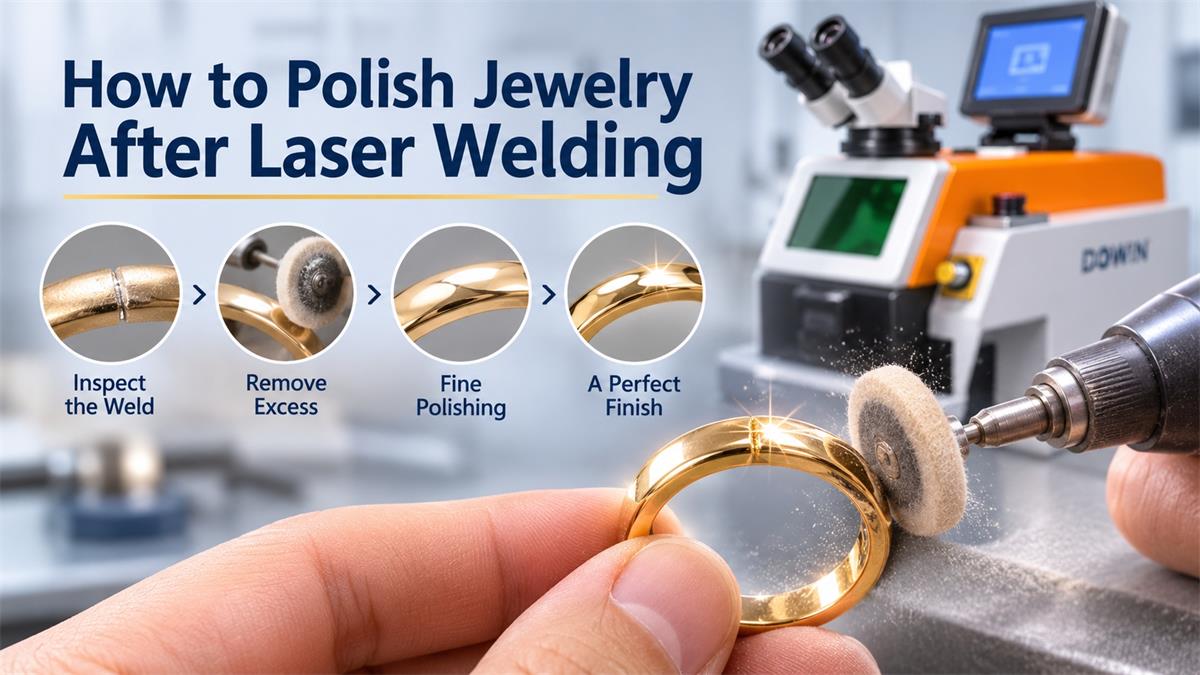
Polishing is an essential step after laser welding jewelry. Even when a weld is strong and precise, the repaired area may still have small bumps, uneven surfaces, or visible marks that affect the final appearance. For jewelry workshops, combining accurate welding with proper finishing techniques is the key to restoring a professional look. A Dowin YAG Jewelry Laser Welding Machine, featuring microscope observation and LED shadowless lighting, helps technicians control the welding area and minimize excessive material buildup, making subsequent polishing easier.
1. Why Does Jewelry Need Polishing After Laser Welding?
Laser welding creates a localized molten area where two metal components are joined. Depending on the welding parameters and joint condition, the finished area may not be perfectly smooth.
Common imperfections include:
- Small raised weld beads or excess filler material.
- Uneven metal surfaces around the joint.
- Fine scratches caused by previous repair operations.
- Color or surface-finish differences between the weld and surrounding metal.
- Visible transitions between the repaired and original areas.
Polishing helps restore the original shape, smoothness, and surface appearance of the jewelry. However, excessive polishing can remove too much metal and weaken delicate components.
2. Step-by-Step: How to Polish Jewelry After Laser Welding
Step 1: Inspect the Welded Area
Before polishing, inspect the weld under magnification. Check for cracks, pores, incomplete fusion, and excessive material buildup.
Polishing should not be used to hide a defective weld. If the joint is weak or contains visible defects, correct the welding problem before finishing.
Step 2: Remove Excess Weld Material
If the welding area has a small raised bead, carefully remove the excess material using an appropriate fine file or precision grinding tool.
Keep the original jewelry profile in mind. For a ring band, the goal is to restore its natural curve without creating a flat spot. For a chain link, remove only unnecessary material around the connection.
Avoid aggressive grinding, especially on thin gold chains, earring posts, and delicate decorative components.
Step 3: Smooth the Surface with Fine Abrasives
After removing excess material, use progressively finer abrasive materials to reduce grinding marks.
For example, a technician may begin with a suitable fine abrasive and gradually move to finer grades depending on the metal and surface condition.
The exact abrasive sequence depends on the jewelry material, the amount of material that needs to be removed, and the desired finish.
Step 4: Restore the Original Surface Finish
Different jewelry finishes require different polishing techniques.
- Mirror finish: Use appropriate polishing compounds and soft polishing tools to restore a reflective surface.
- Brushed finish: Reproduce the original directional texture instead of creating a mirror shine.
- Matte finish: Use suitable finishing abrasives to achieve a consistent non-reflective appearance.
- High-detail jewelry: Use small precision tools to avoid damaging nearby patterns and decorative elements.
Step 5: Clean and Inspect the Jewelry
Remove polishing compounds and metal residues using a cleaning method compatible with the jewelry and its gemstones.
Finally, inspect the repaired area under magnification and compare its color, contour, and surface finish with the surrounding metal.
3. How to Polish Different Types of Jewelry
Gold Rings
Gold rings often require contour restoration after resizing or crack repair. Remove excess weld material carefully, follow the original ring curvature, and finish with progressively finer abrasives.
For 18K yellow, white, and rose gold, use finishing methods appropriate for each alloy and its original surface treatment.
Gold and Silver Chains
Chain links have very limited material thickness. Excessive grinding can weaken the connection or change the link shape.
Use small precision tools and avoid unnecessary polishing around the welded joint.
Earrings and Decorative Components
Small decorative jewelry parts may contain gemstones, engraved details, and delicate edges. Protect nearby components during polishing and avoid allowing abrasive tools to contact sensitive stones.
For jewelry with heat-sensitive gemstones, confirm that the welding and cleaning process is suitable for the specific stone.
4. Common Polishing Mistakes to Avoid
Even a well-executed laser weld can look poor if the finishing process is not controlled.
- Removing too much metal: Excessive grinding can weaken thin jewelry components.
- Using coarse abrasives for too long: Deep scratches may require additional finishing work.
- Ignoring the original texture: Mirror polishing a brushed surface creates an obvious visual difference.
- Overheating during polishing: Excessive friction can damage delicate components or affect nearby materials.
- Polishing before checking weld quality: Surface finishing cannot repair incomplete fusion or internal defects.
5. How to Reduce Polishing Work Through Better Laser Welding
The easiest way to reduce post-welding polishing is to produce a cleaner weld in the first place.
Several factors help minimize excessive material buildup:
- Use suitable pulse energy for the material thickness.
- Select an appropriate laser spot diameter.
- Ensure the two components fit together properly.
- Use compatible filler material when required.
- Avoid repeated pulses that create unnecessary melting.
- Maintain accurate laser positioning.
These measures can reduce the amount of excess material and help preserve the original jewelry profile.
6. Choosing a Jewelry Laser Welding Machine for Cleaner Finishing
Polishing quality is closely related to the quality of the initial weld. A machine that allows accurate positioning and controlled pulse adjustment can help technicians produce cleaner joints and reduce unnecessary finishing work.
Dowin 150W Desktop Jewelry Laser Welding Machine
Dowin’s 150W YAG jewelry laser welding machine is designed for precision repair and manufacturing applications involving gold, silver, and other precious metals.
Its practical features include:
- 150W rated power for a range of jewelry welding applications.
- Pulsed YAG laser technology for localized heat input.
- Adjustable welding parameters for different materials and thicknesses.
- Microscope observation for accurate welding positioning.
- LED shadowless lighting for improved visibility.
- Desktop design suitable for jewelry repair workshops.
The microscope helps operators position the laser accurately on small joints, while appropriate parameter adjustment helps control melting and reduce excessive weld buildup. This can make subsequent grinding and polishing more manageable.
View Dowin Jewelry Spot Laser Welding Machine for product details and equipment specifications.
7. Frequently Asked Questions
Q1: Do you always need to polish jewelry after laser welding?
Not always. Some laser welds are sufficiently clean and require little finishing. However, repairs involving filler material or visible weld buildup may need grinding and polishing to restore the original appearance.
Q2: Can polishing remove visible laser weld marks on gold?
Polishing can reduce surface marks and blend the repaired area with the surrounding gold. However, it cannot correct incomplete fusion, deep pores, or major color differences caused by incompatible filler material.
Q3: Can I use the same polishing method for gold and silver?
Not necessarily. Gold and silver have different material characteristics and may require different abrasive choices, polishing compounds, and finishing procedures.
Q4: How can I avoid damaging a thin gold ring during polishing?
Use fine abrasives, apply controlled pressure, and remove only the material necessary to restore the surface. Inspect the ring frequently under magnification.
Q5: Does a better laser weld reduce polishing time?
Generally, yes. Accurate positioning, suitable pulse energy, proper joint fit, and compatible filler material can reduce excessive weld buildup and the amount of material that needs to be removed.
Conclusion
Polishing is an important part of jewelry laser welding because it restores the original shape, smoothness, and appearance of repaired components.
For the best results, inspect the weld first, remove excess material carefully, use progressively finer abrasives, and reproduce the original surface finish.
Good finishing also starts with good welding. A pulsed YAG jewelry laser welding machine with precise microscope positioning can help jewelry technicians produce cleaner joints and reduce unnecessary polishing work.
Contact Dowin to learn more about jewelry laser welding equipment and request a sample welding test.
“`
Post time: Nov-20-2026
