
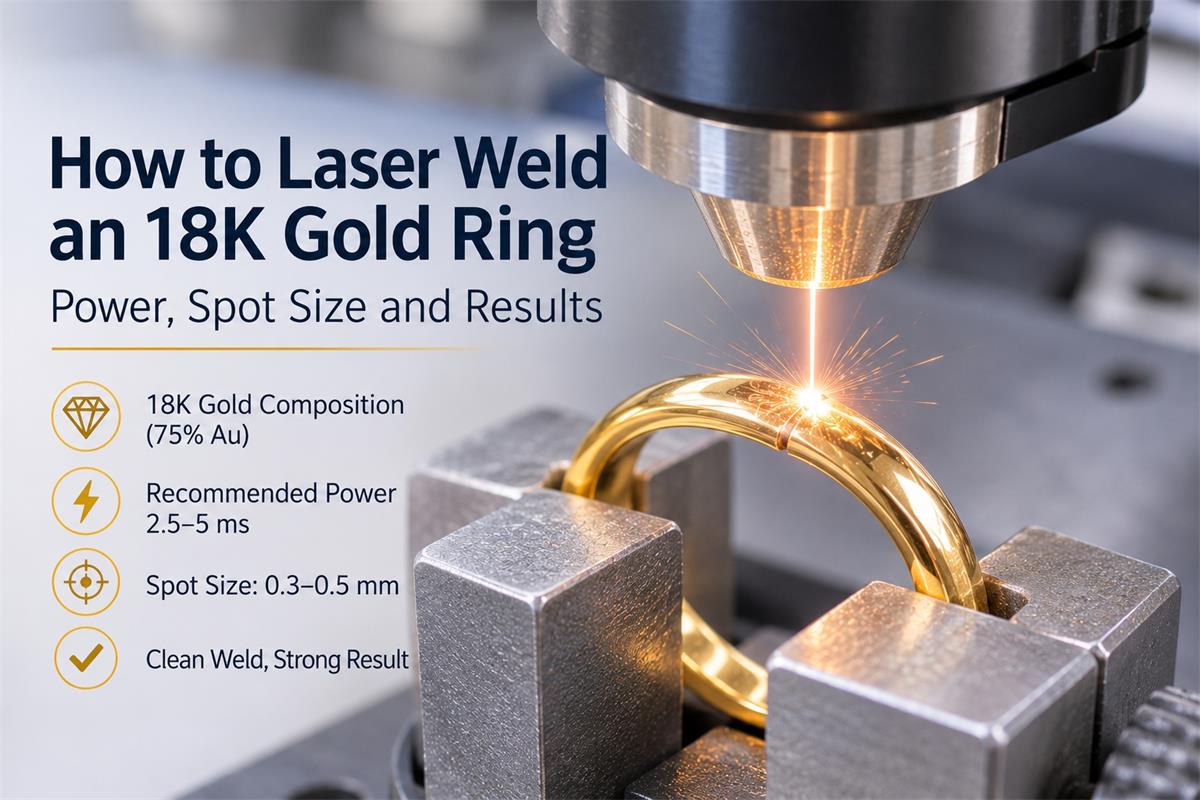
Laser welding is widely used in jewelry manufacturing and repair, especially for precious metals such as 18K gold. Using a professional jewelry laser welding machine, jewelers can repair cracked ring bands, close resizing joints, and restore damaged gold jewelry with localized heat input. But what laser power is suitable for 18K gold? What spot size should you use, and how can you avoid common welding defects? This guide explains the practical process with real jewelry applications and parameter references.
1. What Material Is Used in an 18K Gold Ring?
18K gold is one of the most commonly used materials in fine jewelry manufacturing. Unlike pure gold, which contains 99.9% gold, 18K gold contains 75% pure gold and approximately 25% other alloying metals.
For a typical 18K yellow gold ring, the alloy usually contains copper and silver in addition to gold. Their proportions affect the color, hardness, melting behavior, and welding characteristics.
| Gold Type | Typical Alloy Characteristics |
|---|---|
| 18K Yellow Gold | 75% gold mixed with copper and silver |
| 18K White Gold | 75% gold mixed with palladium or nickel-based alloys |
| 18K Rose Gold | 75% gold with a higher copper content |
| 18K Green Gold | 75% gold with a higher silver content |
These differences are important during laser welding. Different gold alloys have different melting characteristics and may respond differently to the same laser parameters.
For example, 18K rose gold generally requires different parameter adjustments from 18K yellow gold. White gold may also present additional challenges because of its alloy composition and surface appearance.
Before welding, identify the actual gold alloy whenever possible rather than relying only on its color.
2. What Laser Power Is Needed to Weld an 18K Gold Ring?
A pulsed YAG jewelry laser welding machine is commonly used for repairing and manufacturing 18K gold rings.
A 150W jewelry laser welder is a practical choice for many small jewelry repair applications. It produces concentrated laser pulses that melt a localized area without unnecessarily heating the entire ring.
However, machine rated power and the energy delivered by each welding pulse are two different things. A 150W rating does not mean every weld should be performed at maximum power.
Actual welding performance depends on pulse energy, pulse duration, spot diameter, material thickness, and alloy composition.
Recommended Starting Parameters for 18K Yellow Gold
| Parameter | Starting Reference |
|---|---|
| Machine Type | Pulsed YAG Laser Welder |
| Rated Machine Power | 150W |
| Pulse Duration | 2.5–5 ms |
| Spot Diameter | 0.3–0.5 mm |
| Pulse Voltage | Approximately 250–300V on comparable flashlamp systems |
| Welding Method | Localized pulsed welding |
Important: These values are initial testing references, not universal production settings. Voltage values apply only to comparable flashlamp-excited systems. Different machines may use different control systems and energy scales.
For a thin ring band, start with lower pulse energy and gradually increase it until sufficient penetration is achieved. For thicker sections, more energy or a longer pulse may be necessary.
The best approach is to test on a piece of matching 18K gold before repairing a valuable finished ring.
3. Choosing the Right Laser Spot Size
Spot size is one of the most important factors when welding gold jewelry.
A larger spot distributes energy over a wider area, while a smaller spot concentrates energy into a more localized welding zone. Choosing the correct diameter helps control melting depth and minimize unnecessary heat input.
| Spot Diameter | Typical Application |
|---|---|
| 0.2–0.3 mm | Fine cracks and delicate jewelry details |
| 0.3–0.5 mm | Ring seams and general repair |
| 0.5–0.8 mm | Larger joints and thicker metal sections |
A smaller spot is particularly useful when repairing rings with intricate patterns or nearby stone settings.
However, a smaller spot does not automatically produce a stronger weld. If the energy is insufficient, the laser may only melt the surface without achieving adequate penetration.
The objective is to achieve sufficient fusion while keeping the heat-affected area as small as possible.
4. Where Should You Apply the Laser When Welding an 18K Gold Ring?
The welding position depends on the type of ring damage or manufacturing operation. Here are four common applications in jewelry workshops.
A. Closing a Ring Resizing Joint
When resizing a gold ring, a small section of the band may be removed or additional gold may be inserted. The two ends must be accurately aligned before welding.
Start with a few positioning pulses at different points along the joint. Then weld along the seam using overlapping pulses.
Avoid applying excessive energy to one location because it may cause excessive melting or deformation.
B. Repairing a Crack on the Ring Band
Cracks can develop on either the inner or outer surface of an 18K gold ring due to mechanical stress, wear, or previous repair work.
The damaged area should be cleaned and positioned under the microscope. Apply laser pulses directly along the crack, ensuring that the edges melt and fuse together.
For deeper cracks, several controlled passes may be preferable to one excessively powerful pulse.
C. Repairing the Connection Between the Ring and Setting
Some rings have decorative settings or raised components connected to the main band. If the connection becomes loose, laser welding can restore the joint.
The laser should be directed at the metal connection rather than the gemstone or surrounding decorative surfaces.
Special care is necessary when working near heat-sensitive gemstones. Some stones may need to be removed before welding.
D. Repairing Small Surface Defects
Small pores, scratches, and localized material losses can sometimes be repaired by adding compatible 18K gold filler material.
The filler should have a suitable alloy composition and color. Use small pulses to melt the filler into the damaged area while avoiding excessive buildup.
5. What Does a Good Laser Weld on an 18K Gold Ring Look Like?
A successful laser weld should provide both mechanical strength and a clean appearance. The final result depends on the material, welding parameters, joint preparation, and finishing process.
- Good fusion: The two gold sections are properly joined without an unfused gap.
- Minimal discoloration: The surrounding gold retains its original appearance as much as possible.
- Small heat-affected zone: The surrounding metal is not unnecessarily melted or distorted.
- Smooth surface: The welded area requires minimal grinding and polishing.
- Low porosity: The weld does not contain visible holes or internal voids.
For example, when closing a resizing joint, the final weld should follow the original ring profile. After welding, the jewelry technician can perform light grinding and polishing to restore the original surface finish.
A properly executed laser weld can make the repair area difficult to distinguish from the surrounding gold after finishing.
6. Common Problems When Laser Welding 18K Gold Rings
Even experienced jewelry technicians can encounter problems when welding gold. Understanding the causes makes parameter adjustment much easier.
Problem 1: Small Holes or Porosity
Porosity appears as tiny holes in the welded area.
Possible causes:
- Dirty or contaminated gold surfaces.
- Excessive pulse energy.
- Poor joint fit-up.
- Gas trapped during melting.
- Unsuitable filler material.
Solution: Clean the welding area thoroughly, improve joint fit, and adjust pulse energy. Appropriate shielding gas can also help in applications where oxidation or contamination is a concern.
Problem 2: Cracks After Welding
Cracks may appear during cooling or after the welded ring is handled.
Common causes:
- Excessive local heat input.
- Incompatible filler alloy.
- High residual stress.
- Poor joint preparation.
- Metallurgical differences between the base metal and filler.
Solution: Use compatible filler material, optimize pulse energy, and ensure proper joint alignment. Avoid excessive heat concentration in a single location.
Problem 3: Excessive Melting or Deformation
If the laser energy is too high, the ring surface may melt excessively. This is particularly problematic for thin ring bands and delicate decorative structures.
Solution: Reduce pulse energy, shorten pulse duration, or adjust the spot diameter. Use several controlled pulses instead of concentrating excessive energy in one location.
Problem 4: Weak Welding or Incomplete Penetration
Sometimes the surface looks melted, but the joint is not sufficiently fused. This usually happens when the laser energy is too low or the welding position is incorrect.
Solution: Gradually increase pulse energy or adjust pulse duration. Check joint alignment and perform destructive testing on matching scrap samples when developing a new process.
Problem 5: Dark or Discolored Welding Areas
Some gold alloys may develop visible discoloration after welding.
Possible causes:
- Surface contamination.
- Excessive heat input.
- Oxidation or unsuitable shielding conditions.
- Differences in alloy composition.
Solution: Clean the metal before welding, optimize pulse parameters, and use suitable shielding conditions when necessary.
7. Why Choose a Jewelry Laser Welding Machine for 18K Gold Rings?
Traditional soldering can introduce heat into a relatively large area of a jewelry component. A pulsed YAG jewelry laser welding machine offers a different approach by concentrating energy into a small spot.
Its main advantages include:
- Precise welding of small jewelry components.
- Localized heat input.
- Reduced risk of affecting nearby decorative details.
- Ability to repair cracks, joints, and small material defects.
- Less post-welding finishing in suitable applications.
- Compatibility with various gold, silver, and platinum jewelry alloys.
For jewelry workshops that regularly repair 18K gold rings, a desktop 150W jewelry laser welding machine can be a practical investment.
Dowin offers a jewelry laser welding machine equipped with a microscope and LED shadowless lighting, allowing operators to position the laser accurately when working on small jewelry components.
Explore Dowin Jewelry Spot Laser Welding Machines to learn more about the equipment and its applications in professional jewelry repair.
8. Frequently Asked Questions
Q1: Can a 150W laser welding machine weld an 18K gold ring?
Yes. A 150W pulsed YAG jewelry laser welding machine can handle many 18K gold ring repair applications, including crack repair, resizing joints, and small surface defects. The appropriate pulse parameters depend on the ring thickness and alloy composition.
Q2: What spot size is best for welding 18K gold?
A spot diameter of approximately 0.3–0.5 mm is a useful starting range for general ring repairs. Smaller spots can be used for delicate details, while larger spots may be suitable for thicker joints.
Q3: Does laser welding change the color of 18K gold?
Laser welding can produce localized discoloration depending on the alloy and welding conditions. With suitable parameters and proper surface preparation, the original gold color can generally be retained after appropriate finishing.
Q4: Can you laser weld an 18K gold ring with diamonds?
Yes, in some cases. However, the technician must consider the gemstone’s heat resistance, distance from the welding area, and heat transfer through the ring. Some stones require removal before welding.
Q5: Is laser welding stronger than traditional soldering for gold rings?
Neither method is universally stronger. Joint strength depends on the alloy, joint design, penetration, and workmanship. Properly executed laser welding can produce strong, localized joints with minimal heat input.
Conclusion
Laser welding 18K gold rings requires more than simply selecting a 150W machine. Material composition, pulse energy, pulse duration, spot diameter, and welding position all influence the final result.
For most general ring repair applications, a 0.3–0.5 mm spot and a carefully tested pulse duration provide a useful starting point.
The key is to achieve sufficient penetration without excessive melting, porosity, or thermal damage.
For jewelry manufacturers and repair workshops, a pulsed YAG jewelry laser welding machine offers an accurate and efficient solution for working with 18K gold rings.
“`
Post time: Nov-19-2026
